
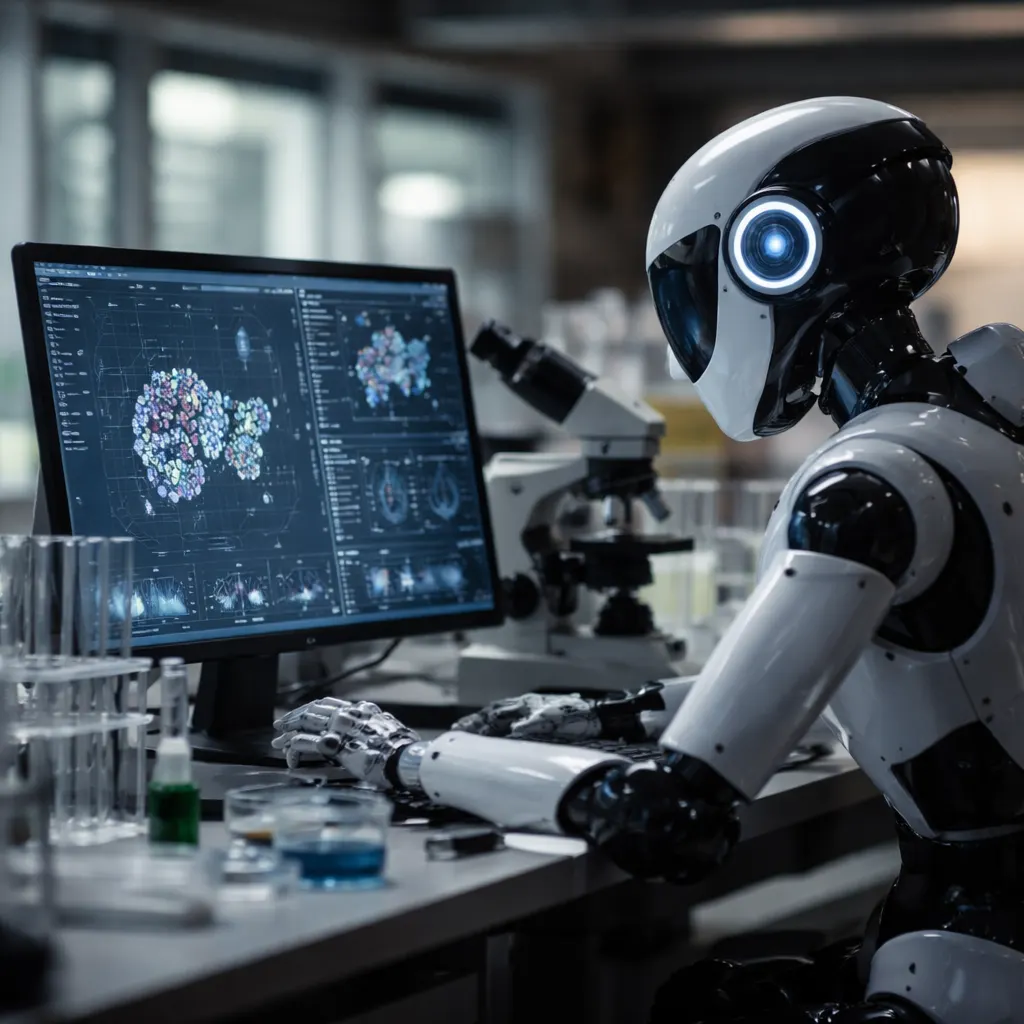
Artificial intelligence agents capable of using tools and synthesizing evidence from multiple sources will accelerate scientific discovery more rapidly than breakthrough models like AlphaFold, according to an August 2026 article in MIT Technology Review co-authored by Eric Schmidt, former Google CEO, and Suhas Mahesh of Schmidt Sciences. While AlphaFold's protein structure predictions earned a Nobel Prize in chemistry in 2024, the conditions that made it possible are uncommon across most scientific fields, and replicating them elsewhere will require decades rather than years, the authors argue. The shift to agentic AI represents a different path: tools that mirror the iterative, judgment-based process human researchers already use, rather than requiring vast, standardized datasets that most disciplines can't produce.
AlphaFold succeeded because it trained on the Protein Data Bank, a collection of approximately 170,000 experimentally validated protein structures assembled over 53 years through international collaboration at an estimated cost of roughly $21 billion. The key experimental method behind this dataset, protein crystallography, is unusually replicable and dependable, having contributed to more than 25 Nobel Prizes. But in most experimental science, results vary: cell lines drift, chemicals contain trace contaminants, and lab humidity fluctuates, making it scientifically impossible to generate datasets consistent, accurate, precise, and scalable enough to train modern neural networks in biology or most chemistry. Only a handful of fields meet these requirements today, including weather forecasting, much of genomics, and very limited areas of chemistry.
The authors describe AI Co-Scientist, announced by Google in May, which received a one-page brief with a goal: determine how antibiotic resistance spreads between bacterial species. The system generated sub-agents that drafted hypotheses from the literature, critiqued them like peer reviewers, ran tournaments to rank candidates, and refined the winner. The agent concluded that resistance genes were traveling on bacterial viruses, using whichever virus could transport them into a new host. Researchers at Imperial College London had spent a decade reaching the identical conclusion through wet-lab work; their paper, unseen by Co-Scientist, remained in peer review. Schmidt and Mahesh write that agents "do not represent a new way to do science—instead, they digitally model the human process of discovery."
Agents offer a structural solution to science's reproducibility crisis, the report explains, because they automatically log every action they take, creating an exact record of the method that produced their results and enabling precise replication. The scientific community has long asked researchers to share raw data and exact code to standardize experimental processes, but researchers have resisted this administrative burden. Agents also amplify scientific memory by recording a lab's entire scientific history in a central, standardized repository, replacing the messy lab notebooks graduate students typically consult. When testing an idea takes less time than debating it in a meeting, the authors note, researchers stop arguing and simply run the test; an agent that can read a thousand papers in an hour, design 500 molecules, and learn from failed tests by morning will lower the cost of experimentation and fundamentally change the pace of science. This speed will give researchers freedom to pursue bold, unusual questions they wouldn't have risked time on before, opening scientific doors not yet imagined.
While AlphaFold-style breakthroughs will drive important discoveries in the narrow fields where massive, standardized datasets exist, the shift toward agentic AI represents a rarer category of breakthrough: a tool that envelops every field of science at once, the authors conclude. Historically, tools of such scope have arrived only a handful of times—calculus, statistical inference, spectroscopy, the computer—and each revealed problems no one had thought to formulate, which in turn redefined their fields. The report acknowledges that agents face real challenges before becoming ubiquitous: they hallucinate, their judgment isn't consistent, and memory and input constraints limit how long they can run autonomously. But as these technical barriers fall away, the compounding effects on the reliability, consistency, and velocity of science will become apparent. The institutions that master agentic workflows earliest may find themselves navigating not just faster research cycles, but an entirely different competitive landscape where the bottleneck shifts from generating results to interpreting them wisely.