
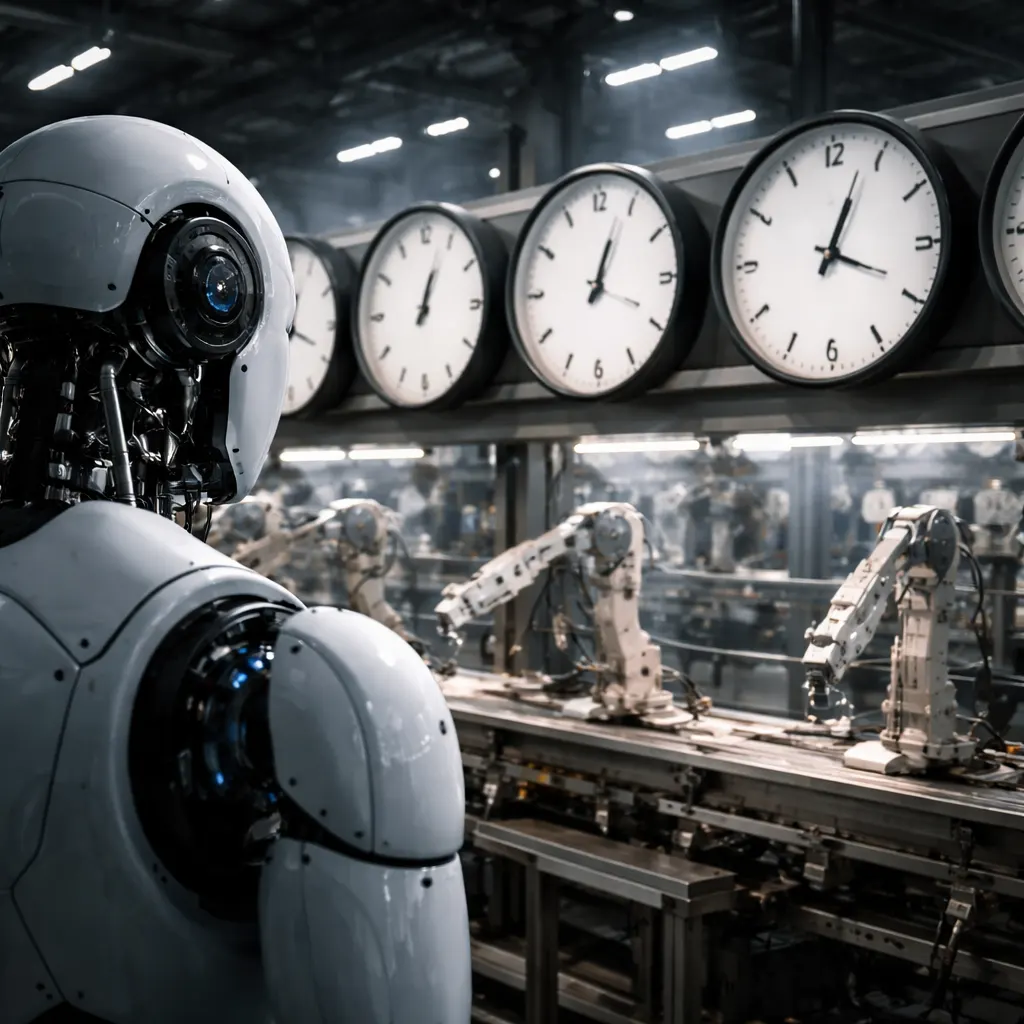
Artificial intelligence can detect timing problems in factory systems before they cause breakdowns, but allowing AI to directly control industrial clocks creates dangerous risks, according to a new analysis published in CIO on timing synchronization in operational technology. The report examines how machine learning models can watch clock drift, network delays, oscillator health, and unusual timing patterns across industrial systems where three milliseconds of delay can turn a functioning production line into a collision between robot arms and conveyors. While AI promises to spot trouble earlier and explain it faster, the analysis cautions that systems built on probability shouldn't govern infrastructure that depends on certainty.
Industrial devices require shared time because they act together, and IEEE 1588 Precision Time Protocol delivers networked measurement and control systems a common clock with far greater accuracy than ordinary business networks need. Power utilities use demanding synchronization classes defined in IEC/IEEE 61850-9-3 to ensure protection relays, sensors, drives, and switches agree on when events occurred and when the next action should begin. When three devices disagree on time, investigators may see an operator's response logged before the warning and the warning before the fault, turning accurate individual logs into a combined record that's false. Machine learning models trained on normal device behavior can spot oscillators drifting as temperature changes, components age, and workloads shift, detecting curves before operators see cliffs and connecting rising offset with new network paths or cabinet warming patterns.
The report states that AI can estimate when a device is moving outside tolerance, compare its behavior with peer devices, and suggest the likely cause, offering operators something beyond symptoms. According to the analysis, "'The clock is wrong' starts a search. 'The clock began drifting after the switch update, and the pattern matches path asymmetry' starts a decision." The report finds that AI can vary monitoring based on context, recommending closer checks for unstable assets and reducing needless traffic around devices that remain steady, but warns that changing a monitoring interval differs fundamentally from correcting the clock that governs a protection function.
Security concerns compound the control problem because attackers don't need to stop a process if they can make it misunderstand time. Forged signals can shift timestamps, delay attacks can make legitimate clocks appear accurate while pushing dependent devices away from true references, and GPS spoofing can corrupt systems that trust satellite time. Research on power grid time attacks has demonstrated effects on fault detection, voltage monitoring, and event location, while work on Precision Time Protocol delay attacks has shown how targeted path asymmetry can move clocks without easy detection. Beyond these external threats, attackers may poison the data used to train models, alter timing telemetry, suppress alerts, or tamper with model updates to teach detectors that hostile behavior is normal. The subtler attack edits the baseline so that once the model learns the lie, silence looks healthy and the detector stops recognizing danger.
The report recommends keeping approved time sources, PTP, NTP, local clocks, holdover capability, and redundant grandmasters at the core while letting AI sit around that core and observe. It calls for setting hard tolerances that models cannot rewrite, requiring human approval before material timing changes, and recording every recommendation with the evidence behind it. The analysis advises starting with drift detection or anomaly detection across redundant time paths, running models in observation mode to watch, report, and explain rather than touching live clock control. Firms should test not only the model but the disagreement, asking what happens when the protocol says healthy and the model says danger, who decides, and how quickly they can restore the known state. The safest design keeps time deterministic and makes oversight richer, with protocols distributing the clock, engineers defining limits, and AI watching the edges where heat, delay, aging, and attack begin to bend the truth. Organizations that blur the line between advisory intelligence and autonomous authority risk discovering that precision manufacturing tolerates neither ambiguity nor algorithmic overconfidence when production runs at full speed.