
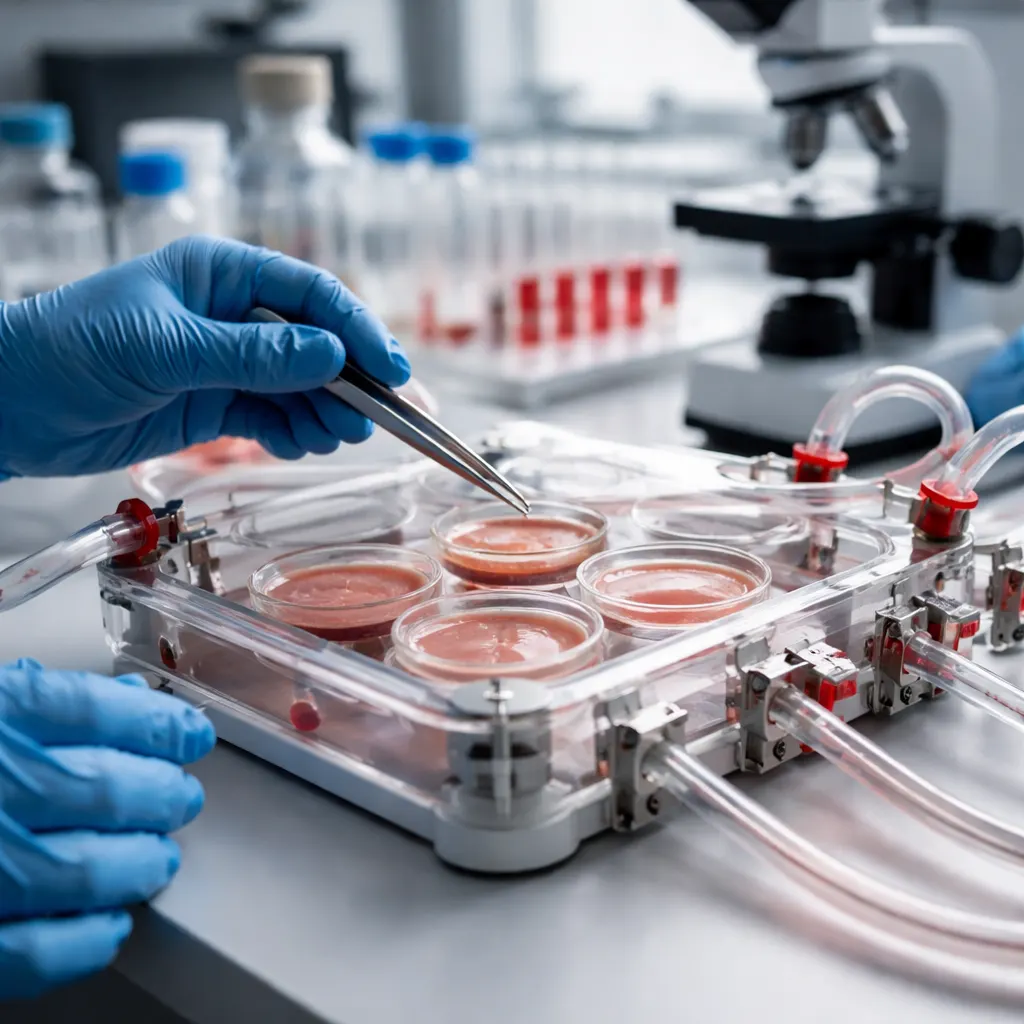
A stealth biotechnology startup has spent years developing a system that keeps living human tissue alive outside the body for over a month, far exceeding the industry standard of just a few days, according to a profile published August 21 in TechCrunch. Outer Biosciences, co-founded in 2022 by Michael Polansky and three partners, feeds living skin tissue nutrients and removes waste to extend its viable life, then uses artificial intelligence trained on that tissue to predict promising skincare ingredients. The company is now generating a new candidate compound roughly every six weeks, a dramatic acceleration from the 18 months it initially took to produce just a couple of leads.
The startup sources human skin discarded after surgery—mostly plastic surgery—through vetted non-profit and commercial biobanks operating under institutional review board oversight, principally the National Disease Research Interchange and the Cooperative Human Tissue Network. Outer Biosciences has raised roughly $23 million to date from backers including Wing Ventures, Initialized, and Polansky's own firm, Hawktail, and currently employs 19 people. The company operates through collaborative research partnerships, including work with a pharmaceutical partner studying why certain cancer drugs trigger severe skin reactions, and engagements with consumer beauty brands testing whether the startup's data aligns with their product-development needs. Four of the company's six current leads appear likely to reach commercialization, with several dozen additional promising compounds logged in its system.
The tissue maintained by Outer Biosciences' proprietary support system retains its original architecture and preserves its initial epidermal, stromal, and immune-associated molecular programs, meaning 30-day-old tissue resembles day-one tissue, though it isn't fully indistinguishable. According to Polansky, the extended timeframe allows researchers to track biological processes like collagen remodeling, pigmentation shifts, and barrier repair that unfold over weeks rather than days—the same reason dermatologists tell patients to expect changes over a matter of weeks. The startup's value isn't any single component but how the pieces work together: human tissue kept alive for weeks, a diverse donor pool subjected to controlled experiments, repeated molecular measurements, and results fed into an AI model that improves its predictions with each cycle, Polansky emphasized.
The approach addresses a fundamental constraint in biology and chemistry: there's no ethical way to run experiments directly on people, yet the proxies scientists use—animal models, simplified cell cultures, lab-grown organoids—are poor substitutes for how actual human organs behave, the report notes. The company can induce UVB damage in living tissue, then monitor the stress, inflammatory, and recovery responses that follow over subsequent weeks, watching an injury happen and tracking the biology that follows rather than attempting to heal the skin. This creates data that doesn't exist anywhere else, potentially making the company's position more defensible than traditional software-based AI startups, though considerably slower to build. The current universe of skin-active ingredients backed by actual research numbers only around 200, presenting substantial opportunities for discovery in a market where only about 120 to 130 active ingredients are FDA-approved across 13 categories of over-the-counter skin drugs.
Rather than seeking FDA approval, Outer Biosciences plans to license or sell its finished ingredients to beauty or pharmaceutical companies that will formulate them into consumer products and bring them to market under their own brands, following a two-step route: obtaining a standardized industry name for each ingredient, then completing safety testing under guidelines set by the OECD, whose member countries accept each other's properly conducted studies. The company is building out a product-development team to handle formulation, manufacturing scale-up, supply chains, and safety testing—work currently done manually by the same scientists who discover the compounds. Polansky says the more important long-term goal is developing a predictive model accurate enough to identify promising directions in skin biology without running every experiment physically first, opening up a discovery rate in dermatology that doesn't currently exist. The shift from stealth to public operation reflects the confidence the team has gained from the data they're beginning to accumulate, allowing them to move from working in private to collaborating openly with the scientific and commercial communities. For companies navigating the intersection of biological data and machine learning, the tension between proprietary advantage and the collaborative norms of scientific progress will likely sharpen as these platforms mature. The question isn't whether tissue-based training yields better predictions than synthetic alternatives, but whether the operational complexity and donor-consent infrastructure can scale faster than competitors can close the data gap through volume or algorithmic efficiency.