
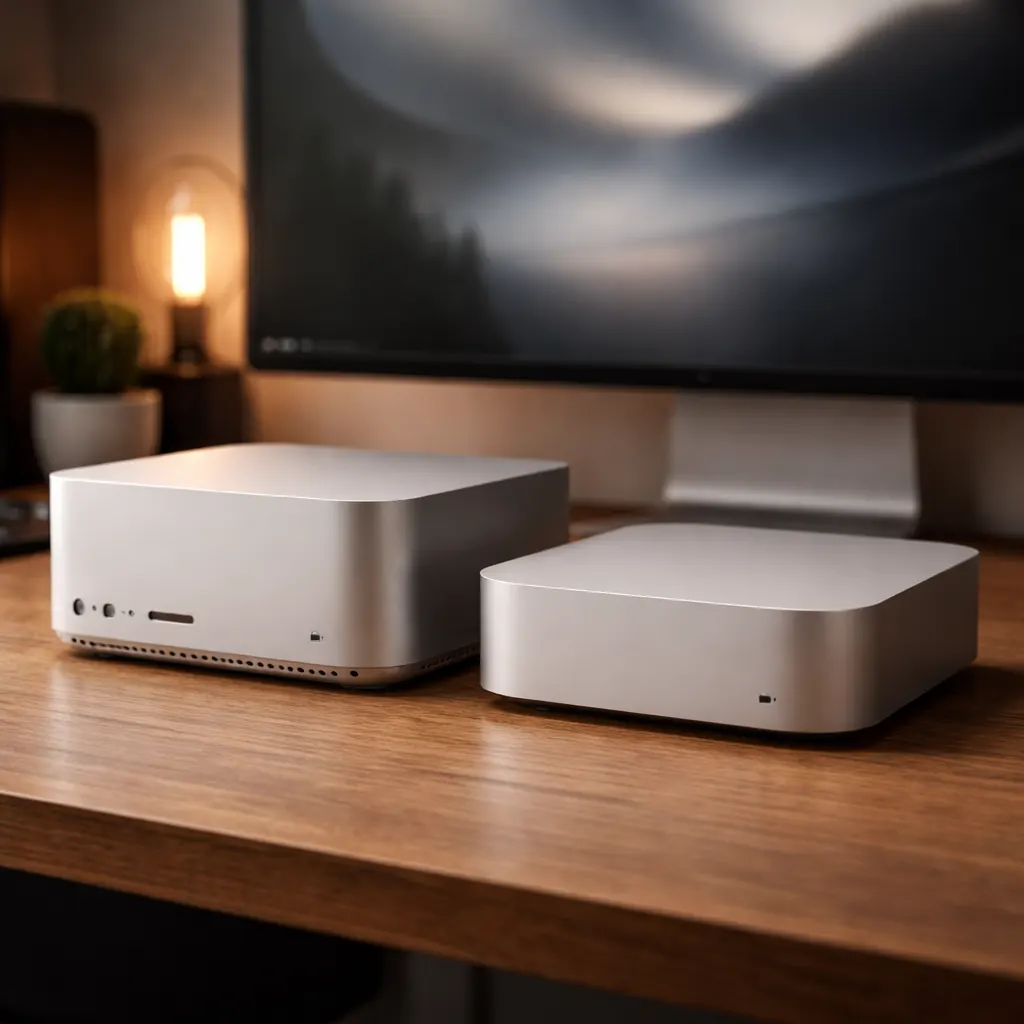
Apple announced on Tuesday that it will refresh its Mac Studio and Mac mini desktops, available for pre-order now with shipments beginning September 22, 2026. The compact machines deliver strong local AI performance, but memory upgrades carry steep price tags driven by rising costs across the industry. According to the company's hardware chief Johny Srouji, the redesigned Mac Studio represents "our most powerful Mac ever," while the Mac mini has been repositioned as the firm's "most versatile Mac," emphasizing its emerging function as an always-on device for AI agents.
The Mac Studio ships with two processor options: the M5 Max starting at $2,499 and the M5 Ultra priced at $5,499. The M5 Ultra configuration offers up to 36 CPU cores and up to 80 GPU cores, supporting as much as 512 GB of high-bandwidth unified memory with 1.2 TB per second of memory bandwidth, though that top-tier memory won't ship until October. Customers can configure the machine with 256 GB of memory for an additional $4,000, bringing a fully loaded Mac Studio with 256 GB RAM and 16 TB storage to $18,299. The Mac mini offers an M6 chip at $899 or an M5 Pro chip at $1,699, but the entry model includes only 16 GB of shared memory, and stepping up to 32 GB costs $400. The M6 supports up to 32 GB of memory with 170 GB per second of bandwidth, while the M5 Pro handles up to 64 GB of unified memory and 307 GB per second of bandwidth.
Apple's silicon engineering VP Sri Santhanam described the M6 as the company's first chip built on a 2 nm manufacturing process, calling it a 12-core processor with "two more cores than before." The M6 integrates a new CPU architecture, two extra CPU and GPU cores, a dual 16-core Neural Engine, and increased unified memory bandwidth to handle workloads with greater energy efficiency, according to Santhanam. Srouji pointed to the integration of Apple's Neural Accelerators into processor GPUs and the advantages of high-bandwidth unified memory as justification for the "most powerful" designation. Outgoing CEO Tim Cook acknowledged in June that memory prices have climbed due to AI demand, and those increases are being transferred to buyers.
The pricing reflects both Apple's hardware advantages for AI workloads and the broader industry squeeze on memory supply. Earlier this year, enthusiasm around OpenClaw and open-weight AI models triggered a surge in Mac mini purchases as AI enthusiasts discovered the desktop's suitability for AI agents and local inference. Unified memory architecture—where CPU and GPU share the same RAM—makes a Mac with 64 GB of unified memory more effective for GPU inference than a PC with 64 GB system RAM but only 16 GB GPU VRAM. Apple silicon also supports the company's MLX machine learning framework, delivering respectable private inference performance on hardware that consumes far less power than a desktop GPU workstation. The Mac mini includes Wi-Fi 7, Bluetooth 6, two USB-C ports with USB 3 support, and a headphone jack, while the rear panel features three Thunderbolt 4 ports for M6 or three Thunderbolt 5 ports for M5 Pro, plus HDMI and Ethernet at 2.5 Gb or 10 Gb speeds. Thunderbolt 5 enables clustering, allowing multiple Mac minis to connect and run large AI models on-device. The Mac Studio also incorporates Wi-Fi 7, Bluetooth 6, and Thunderbolt 5 with support for PCIe expansion chassis. All incoming hardware ships with macOS 27, expected to launch in mid-September. For enterprises weighing AI infrastructure investments, the trade-off is clear: compact, energy-efficient devices with unified memory deliver meaningful advantages for local inference, but scaling up capacity means absorbing costs that reflect industrywide constraints rather than Apple's markup alone.