
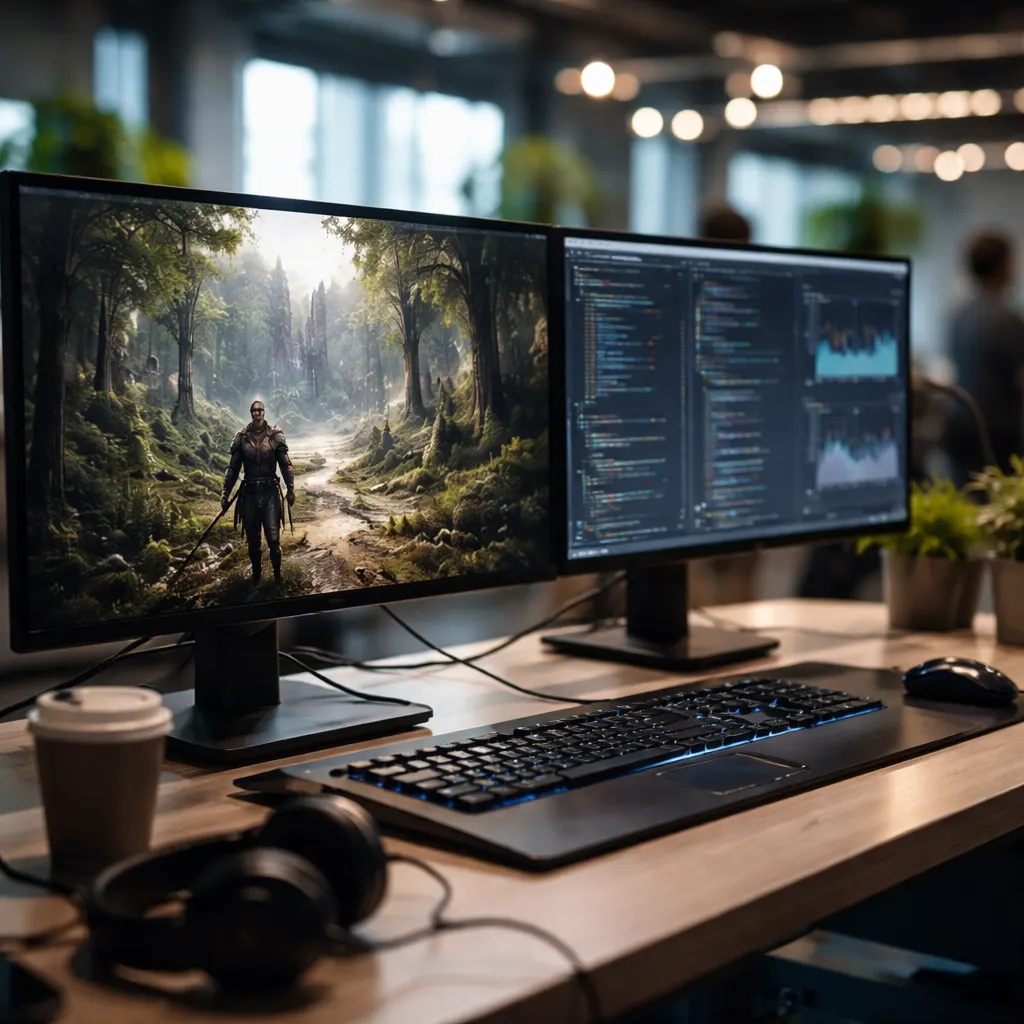
A British startup called Worldmodeldata has secured licenses for nearly 1 million hours of video game data to train a new generation of artificial intelligence systems. The company, advised by AI researcher Yann LeCun, is betting that the controller inputs and visual information captured during gameplay can help AI models learn to navigate physical environments and perform tasks requiring precision and spatial awareness. Unlike large language models trained on text, these "world models" need visual and action data paired together—a type of training material that's scarce on the internet but abundant in gaming studios.
Worldmodeldata has licensed almost 1 million hours of data from studios behind various popular titles, though CEO Rhea Loucas declined to identify which games are included. The startup positions itself as a broker that curates and organizes gaming data for AI labs, sparing them from negotiating separate deals with numerous studios. Some companies, including General Intuition and Niantic, are already gathering video game information from their own platforms to build models. Worldmodeldata plans to establish channels in the future that would allow individual players to receive compensation as well.
According to Loucas, "there are millions of great games, and they are more and more similar to the real world," making video game experiences a logical source for teaching AI. The report notes that world models require paired visual and action information—what Xiatian Zhu, an associate professor specializing in AI at the University of Surrey, describes as "cause and consequence"—which is largely absent from internet sources. Researchers are operating under the assumption that world model performance will scale with training dataset size in a manner similar to large language models, making the scarcity of suitable training data one of the biggest obstacles to advancement.
There's growing consensus in segments of the AI industry that large language models will ultimately hit limits due to their inability to interact with physical space. Trained exclusively on written material, LLMs are likely poorly suited to operate autonomous vehicles, control robotic arms, or execute other actions demanding finesse and precision. Some labs have attempted to generate their own data manually by attaching sensors to humans and robots in test settings, but this method produces only small amounts of information and fails to account for the unusual scenarios a model might face in real-world deployment. Nicole Fraenkel, a partner at VC firm Khosla Ventures, which has invested in General Intuition, explains that repetition alone won't capture the disorder machines must handle in actual operation. Worldmodeldata's hypothesis is that gaming environments provide both the necessary volume and sufficient variety to capture critical edge cases where mistakes could prove costly with cars, planes, drones, factory forklifts, or autonomous quadrupeds.
The startup's approach addresses a fundamental challenge facing researchers including Fei-Fei Li and Yann LeCun who are concentrating their work on world models rather than language-based AI. To become proficient in real-world physics, these models need training on combined visual and action data—such as factory floor footage paired with details about grip strength and torque manipulation before they can skillfully operate a robotic arm. The gaming industry produces this paired data as a natural byproduct at massive scale, offering a potential solution to the training bottleneck. The company's broker model could streamline access for AI labs seeking diverse training material without the overhead of managing relationships with individual studios. For industries where autonomous systems face high costs of error—from manufacturing to transportation—the ability to train on edge cases captured in gaming scenarios may prove essential for deploying reliable AI in physical environments.