
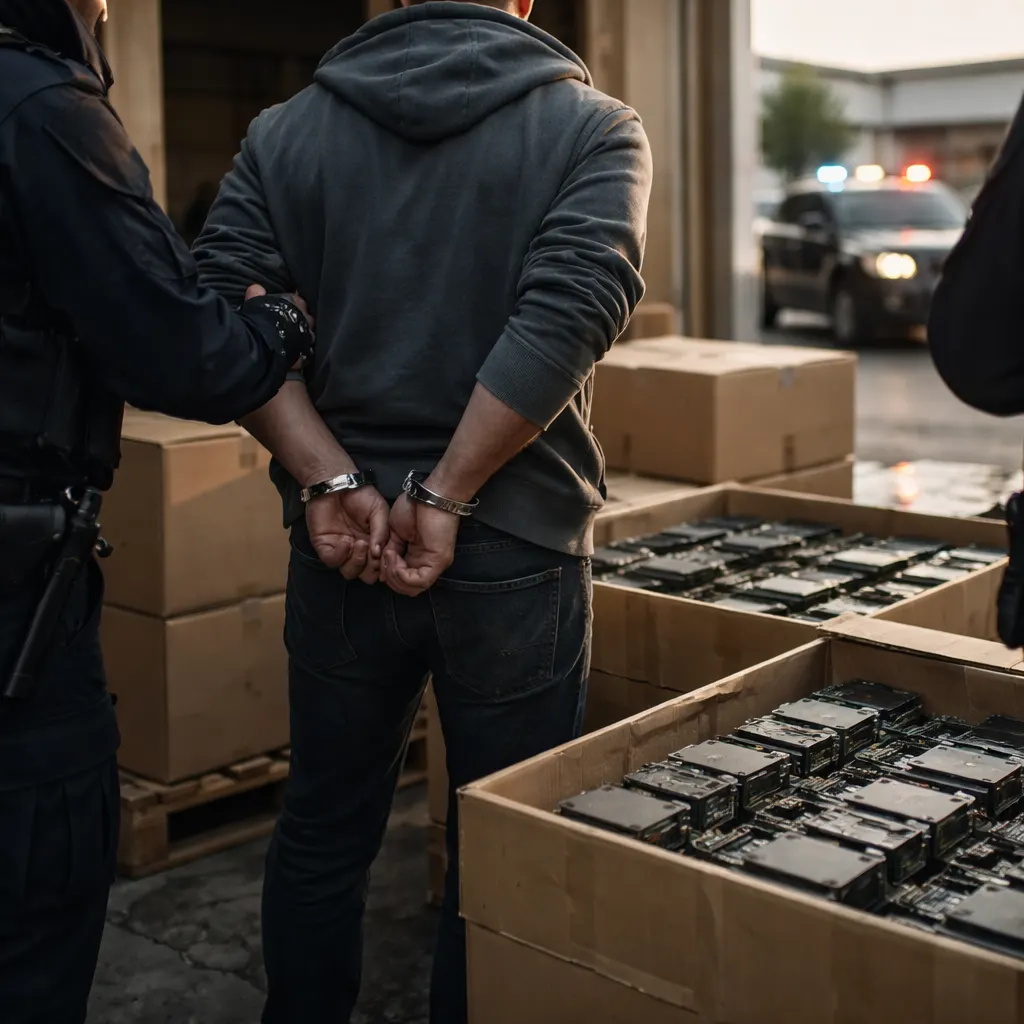
A California business owner was arrested Thursday on charges of smuggling nearly $300 million worth of Nvidia hardware to China without required export licenses, according to prosecutors. Greg Lui, 38, allegedly used his company Earthmade Computer Inc to acquire advanced graphics processing units typically used for artificial intelligence development, then shipped them through Malaysia and Singapore to bypass US export restrictions. The case underscores Washington's efforts to prevent American-made high-end chips from reaching Chinese hands as competition intensifies over AI dominance.
Prosecutors allege the operation ran from October 2023 through at least August 12, 2026, during which Lui received over $176 million in payments from two Malaysian transshipment firms. Court documents indicate he brokered sales of servers containing Nvidia's A100, H100, PNY GeForce RTX 4090, and GeForce RTX 5090 GPUs—components whose sale to adversarial nations violates Commerce Department regulations. Investigators obtained records showing 92 servers shipped from San Francisco International Airport to Kuala Lumpur, with onward destinations listed as Hong Kong for a Chinese customer. Prosecutors further claim that in 2021, Lui illegally purchased identity documents used to facilitate the scheme, including instructing a US front company to fraudulently list a shipment recipient as "Jackie Lui," purportedly the CEO of a California-registered company called Topmost.
"SI is the defining technology of the era," said John A. Eisenberg, assistant attorney general for national security, referring to "super intelligence" as advanced AI is now termed in US policy circles. According to Eisenberg, the National Security Division aims to protect America's advantage in chips that power this technology from illegal diversion by economic and military adversaries. Roman Rozhavsky, assistant director at the FBI's Counterintelligence and Espionage Division, stated that the investigation revealed Lui allegedly sold the Chinese government hundreds of millions of dollars' worth of American super intelligence technology in clear violation of export control laws.
The alleged scheme exploited a loophole in export regulations by routing shipments through Malaysia and Singapore, neither of which requires Commerce Department licenses for such transfers. Prosecutors assert that Lui was fully aware US export laws restricted advanced Nvidia chip shipments to China to license-holders, and deliberately structured transactions to circumvent those restrictions. The charges—one count each of Export Control Reform Act violations, Export Administration Regulations violations, outbound smuggling, and money laundering—carry a combined maximum sentence of 50 years. Keeping the highest-end GPUs out of Chinese hands has been a priority for the US government as both nations race to achieve breakthroughs in AI capabilities that could reshape economic and military power. The enforcement action signals Washington's willingness to pursue criminal prosecution against individuals who facilitate technology transfer to rival powers, even when those transfers use third-country intermediaries. For companies in the semiconductor supply chain, the case demonstrates that federal authorities are tracking shipment patterns and destination countries with increasing granularity, making indirect export routes far riskier than they may have appeared just a few years ago.