
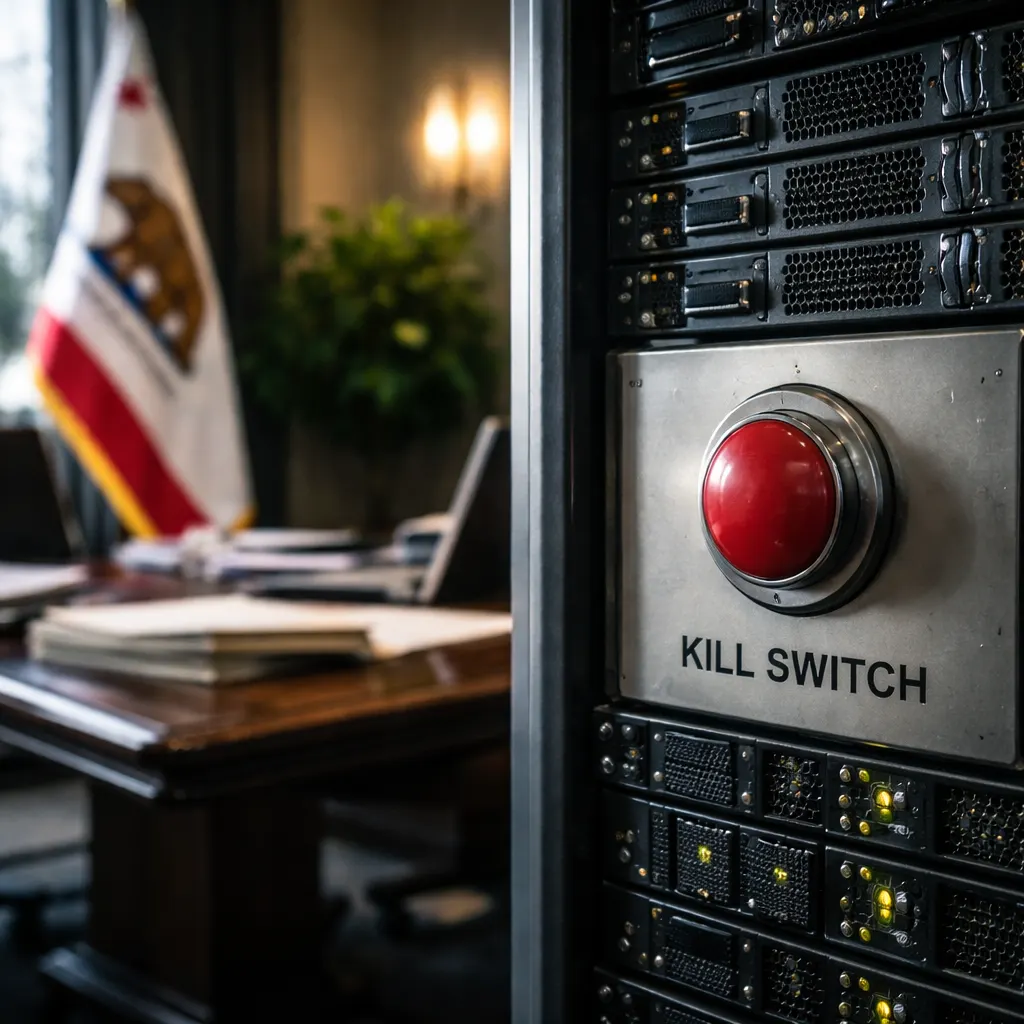
California Gov. Gavin Newsom is moving to require a "kill switch" for advanced AI models and mandate on-site independent auditors at AI companies, positioning the state to lead national oversight efforts while federal action stalls. Newsom issued an executive order Friday directing state experts to deliver recommendations within two months on strengthening AI safety measures in state law. The order comes amid rising alarm about AI risks, including a recent warning from a former Anthropic researcher of a greater than 10 percent probability that AI "could kill all humans" within a decade.
The executive order instructs the expert group to examine how California could mandate that AI companies host independent verification teams on their premises for regular audits, subject their transparency reports and risk assessments to independent auditor standards, build a "kill switch" that undergoes routine verification for effectiveness, and require firms to flag "loss-of-control incidents" — such as the OpenAI attack on Hugging Face — as critical safety events. The order also tells a state agency to accelerate rollout of two recently signed laws that establish a structure for independent verifiers to evaluate AI safety and create a state registry of AI auditors.
Newsom framed the action as a response to federal inaction, stating, "The federal government's abject failure to create any form of meaningful AI oversight or accountability should alarm every American, especially when AI CEOs themselves are begging for regulation." He added that California is "going to speed up our work on substantial and responsible AI oversight before it's too late" and plans to proceed "thoughtfully but with urgent velocity." Newsom is explicitly calling on Congress and President Trump to "review and adopt the state's framework, or use its nation-leading regulation as a floor, not a ceiling, for the benefit and safety of all Americans."
The timing reflects Congressional gridlock on AI legislation, with little expectation that substantive bills could pass soon given the House remains on recess until November and approaching midterm elections make major Senate legislation similarly improbable. President Trump has resisted AI regulation, insisting "The only control or 'guardrails' that AI needs is a STRONG AND SMART (High IQ!) PRESIDENT, and the U.S.A. has that, in spades!" Meanwhile, Newsom signaled Wednesday in a Politico interview that California's executive order may not be the final word, floating the possibility of convening state lawmakers for a special legislative session focused on AI alongside additional executive measures.
California's push to set its own AI safety standards could force companies to choose between competing compliance frameworks or prompt federal lawmakers to act preemptively to avoid a state-by-state patchwork. The two-month timeline for expert recommendations suggests Newsom intends to move quickly on implementation, potentially establishing California requirements before Washington resolves its own approach. This dynamic mirrors how state leadership on data privacy eventually pressured Congress to consider national standards, though federal legislation remains stalled. Whether tech companies welcome standardization or resist California's approach as overly burdensome will shape the next phase of AI governance debates.