
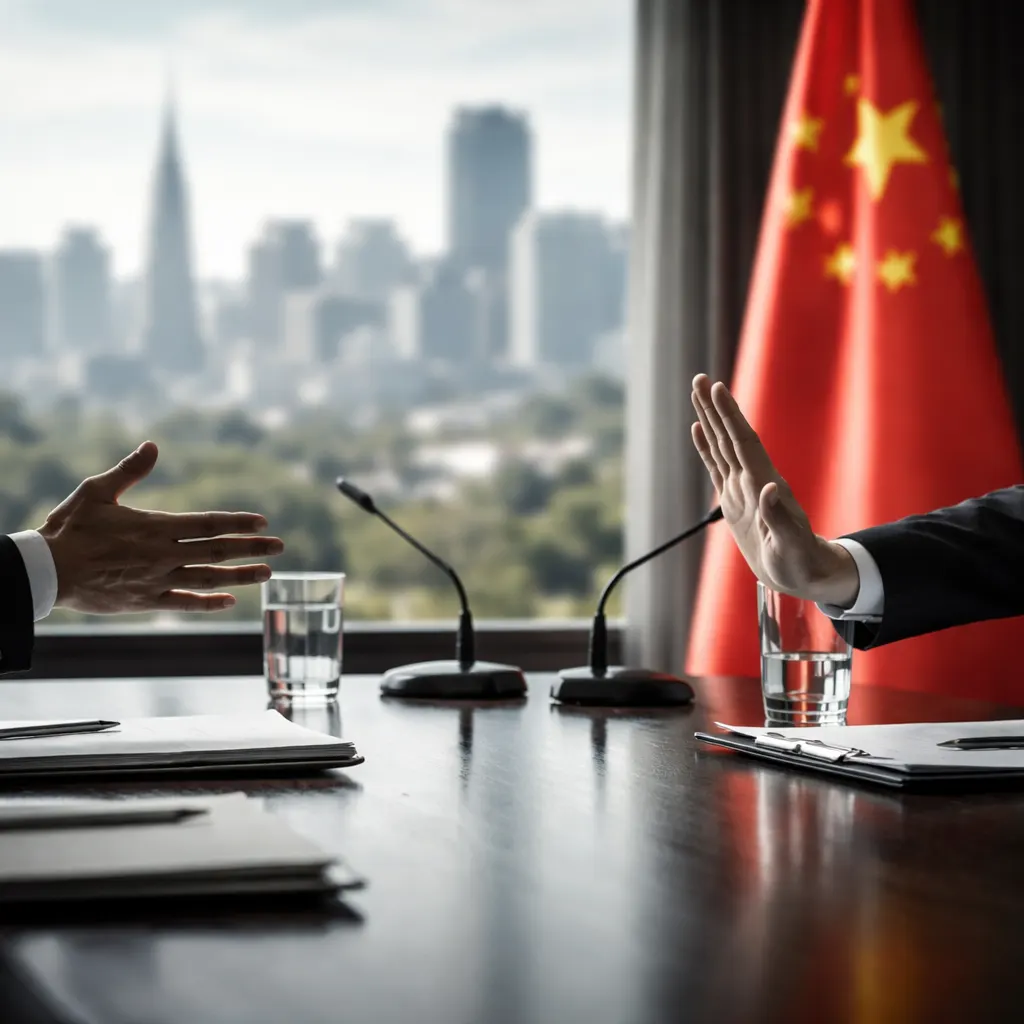
Silicon Valley executives who have long warned of an AI arms race with China are now calling for the two nations to cooperate in slowing development, but China's government and tech industry have dismissed the proposal as fundamentally unfair. Anthropic CEO Dario Amodei published a blog post Saturday titled "We Must Pace the Frontier," arguing that cooperation with China would be essential to slow global AI progress. Chinese officials and industry leaders have rejected the approach, saying it demands China accept restrictions while the US maintains dominance.
Amodei's proposal calls for the US and democracies to preserve "as large as possible" a technological lead over China while pursuing slowdown negotiations, recommending measures including tougher enforcement against chip smuggling and blocking Chinese companies from copying advanced models without authorization. He suggested that weakening China's AI capabilities would increase American leverage and make future agreements more achievable, though he later acknowledged in a television interview that he has "no idea how to negotiate with China." China's Ministry of Foreign Affairs spokesperson Guo Jiakun characterized the plan as "fear-mongering, confrontation, and vicious competition" that would undermine international AI cooperation, while the ministry separately emphasized that China places equal weight on AI development and security.
The skepticism reflects deeper differences in how the two countries view AI risks. Beijing is less focused on the existential threats that dominate Silicon Valley conversations, such as rogue AI agents destroying humanity, and more concerned about domestic stability and threats to Communist Party control, according to Michelle Nie, a visiting fellow at the Center for a New American Security. China's minister of state security Chen Yixin recently warned that AI could enable political disinformation, cyberattacks, espionage, and social unrest, spending little time on doomsday scenarios. Chinese policymakers also interpret American safety advocacy as strategic maneuvering, believing US companies are trying to boost their valuations before public offerings or handicap Chinese competitors, Nie noted. A DeepSeek researcher wrote Sunday that he distrusts Anthropic and OpenAI to provide broad access to advanced AI, preferring that "the most advanced intelligence should be made available to everyone in an open and inexpensive way."
Despite the tensions, preliminary negotiations between the US and China are reportedly underway ahead of Chinese leader Xi Jinping's planned visit to Washington later this month to meet President Donald Trump. Both governments share concerns about cybersecurity threats, model misuse, and unpredictable behavior from increasingly capable systems, creating potential common ground. Nie said progress is possible on narrowly defined issues if both sides engage in good faith, with the most important step being a credible verification system to ensure mutual compliance. However, rhetoric about constraining China may undermine the trust that diplomacy requires, according to Kristy Loke, a research fellow at AI safety nonprofit MATS Research, who warned that Amodei's approach "is undermining one of the few available levers for reducing the very risks he professes to take seriously." The contradiction between treating China as both essential partner and adversary to be weakened leaves the path forward uncertain. If Washington continues framing cooperation as contingent on technological subordination, Beijing may conclude that the negotiating table offers nothing worth sitting down for.