
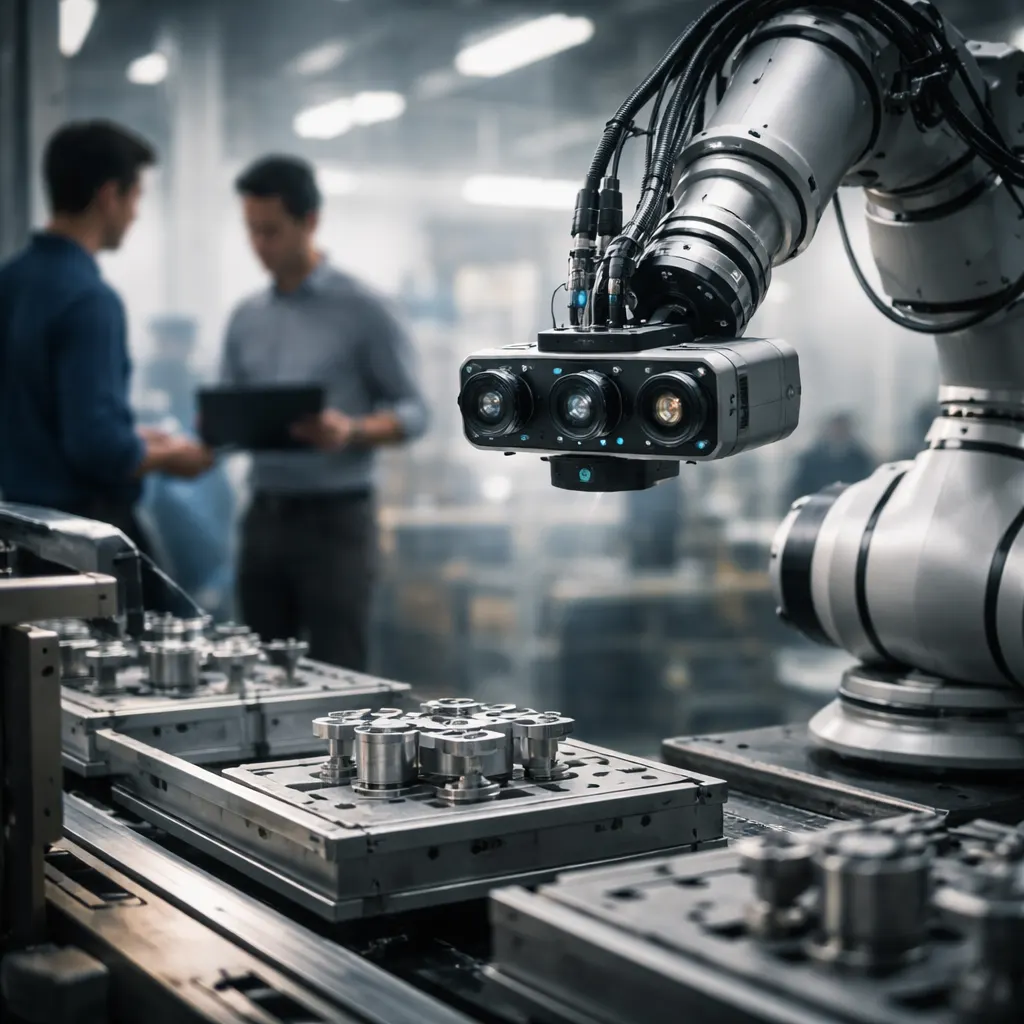
Two former Meta research scientists have launched a new vision model designed to help industrial robots navigate warehouses and factory floors, according to a report by TechCrunch. Perceptron, the startup founded by Armen Aghajanyan and Akshat Shrivastava in November 2024, this week released Isaac 0.5, software that gives machines the capacity to "perceive, reason and act" in industrial environments. The duo previously worked in Meta's Fundamental AI Research division and are now positioning their technology as the next generation of automated factory deployment.
The model was trained on one million hours of general video footage to teach the algorithm to recognize specific settings, visuals, and scenarios, the company says. Perceptron also drew heavily on ego video—footage captured from a person's perspective through wearable cameras like GoPros while completing physical tasks—as well as UMI video, which records repetitive human actions to teach AI systems movement patterns. While the startup isn't revealing the sources of its training data, Shrivastava said the firm had "internally built petabyte-scale datasets that span across modalities, whether it's images, text, video, etc. all the way through robotic trajectories." Isaac 0.5 is being released as an open-weight model, meaning anyone can inspect its parameters and training materials. The company previously secured $16 million from Bessemer Venture Partners, The Explorer Fund, and SmartGateVC in 2024, and TechCrunch reports the startup is currently closing an additional funding round.
Aghajanyan and Shrivastava say their software stands apart from existing models because it's built for general purposes rather than one specific, repetitive task. "Physical AI today forces a false choice: generalist foundation models that need multiple dedicated cloud GPUs for every instance, or narrow models that handle perception or control, but never both," the company states. The model is engineered to adapt flexibly depending on the particular environment or situation it encounters. Aghajanyan told TechCrunch, "Nothing like this really exists out there."
The software addresses a fundamental challenge in warehouse automation: a seemingly simple task like sorting packages actually requires multiple complex steps, according to Shrivastava. A robot must first read labels on packages, conduct spatial analysis to understand where boxes are located, decide which one to pick up, and—if handling multiple boxes—plan the sequence in which to pick them up. While the industry already has software capable of helping machines perform most of those individual tasks, few programs are designed to do it with flexibility, the report notes. Perceptron's software guides robots through each step of the process, helping them extract visual intelligence from videos recorded by those bots as they move through complex environments like warehouses or factory floors. The startup plans to market its software to vendors across manufacturing, logistics and warehousing, security, mobility, and media and entertainment industries, potentially seeing its intelligence layer integrated into a broad array of sectors.
The obvious utility of software that can help robots operate competently in warehouses positions Perceptron to lead the next wave of industrial automation, the company believes. By offering a vision model that handles both perception and control in a single general-purpose package, the startup aims to eliminate the trade-off between cloud-dependent generalist models and narrow task-specific programs. The firm's ability to build massive, multi-modal datasets internally—spanning images, text, video, and robotic trajectories—gives it the foundation to train flexible models that can adapt to different industrial settings without retraining for each new environment. As factories and warehouses increasingly look to automate physical tasks, the demand for vision AI that can reason through multi-step processes in real time will only grow. The move toward open-weight deployment and multi-industry applicability suggests the technology could become infrastructure rather than niche tooling. However, competing on flexibility alone may prove difficult as larger players enter the physical AI space, and the lack of disclosed training data sources raises familiar questions about transparency in foundation model development.