
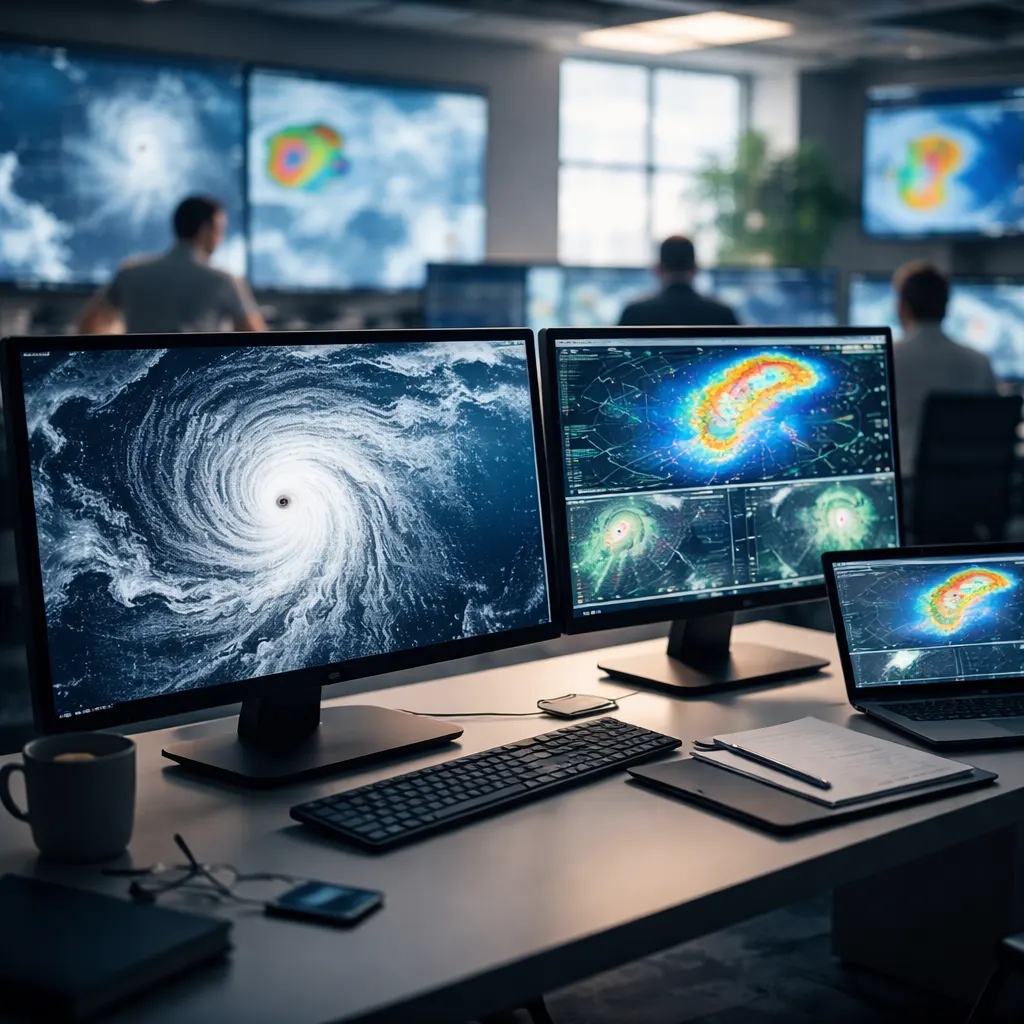
An artificial intelligence model developed by Google's DeepMind and Google Research can forecast cyclones with accuracy that gives meteorologists a full day more advance warning than existing systems, according to research published Thursday in Nature. The WeatherNext model delivers three-day-ahead predictions that match the precision of conventional models' two-day forecasts, offering communities critical extra time to evacuate and prepare. The breakthrough marks a leap that historically would have required a decade of research to achieve, the study's authors say.
The model demonstrated its capabilities in October 2025 when it predicted Hurricane Melissa would strike Jamaica as a Category 5 storm five days before landfall, with 80 percent confidence. While other weather models debated whether the Caribbean system would stay weak and reach Haiti or gain strength and move toward Jamaica, the AI correctly anticipated the latter scenario. The catastrophic hurricane brought flooding and landslides across Jamaica, but the earlier alert allowed forecasters to warn communities sooner. The event marked the first time the National Hurricane Center successfully forecast a Category 5 hurricane when the system was only at Category 1 strength.
Kate Musgrave, tropical cyclone group lead at the Cooperative Institute for Research in the Atmosphere and a study co-author, notes that earlier AI models performed well at predicting storm paths but "intensity they could not do well at all." Mike Brennan, director of the US National Hurricane Center, emphasizes the value of the extra lead time: "Time is really golden when it comes to those types of decisions, so the ability to push forecast accuracy out as much as a day beyond what we've previously been able to do is really valuable." The model now generates 1,000 potential scenarios per storm, up from 50 last year, providing forecasters with a range of outcomes that existing numerical models can't match with current computing power.
The AI's success stems from tackling a fundamental challenge in predicting extreme weather: the scarcity of training data. Machine learning typically needs abundant examples, but major hurricanes are rare events. Ferran Alet, a DeepMind research scientist and lead author, explains the team trained the system on extensive general weather data alongside cyclone-specific information. Hurricanes operate across multiple spatial scales—tracking their direction requires global atmospheric data like cold front locations and prevailing winds, while predicting intensity demands highly localized information about ocean and atmospheric conditions. Surprisingly, the WeatherNext model achieves its accuracy using much lower-resolution data than traditional forecasting systems need. When researchers told the meteorological community their model used relatively coarse inputs, "they were shocked," Alet says, because it suggests lower-resolution data contains more predictive signal than previously understood. Even the DeepMind team doesn't fully grasp how the AI extracts intensity forecasts from such data—"it's a black box at the end of the day," Alet acknowledges—but that mystery gives physicists clues about cyclone dynamics that weren't known before.
Brennan cautions that WeatherNext is a valuable addition to forecasters' toolkit but one of many tools, noting no single model guarantees the best performance for every storm or season. The human element remains essential, he stresses, because "a hurricane is not just a track or an intensity forecast"—experts must translate predictions into impact assessments, "and it's the impacts that kill people." Google DeepMind is open-sourcing the WeatherNext models from last hurricane season so researchers can build on and refine them. Alet expresses optimism that broader access could reveal fresh insights into cyclone behavior: "I think AI is giving us new tools to poke into the laws of the universe." The shift toward machine learning in weather prediction may force meteorological agencies to rethink how they balance computational resources between traditional physics-based modeling and data-driven approaches. As AI forecasting becomes operationally critical, the industry faces questions about transparency and trust when life-or-death decisions rest on systems whose reasoning mechanisms remain opaque.