
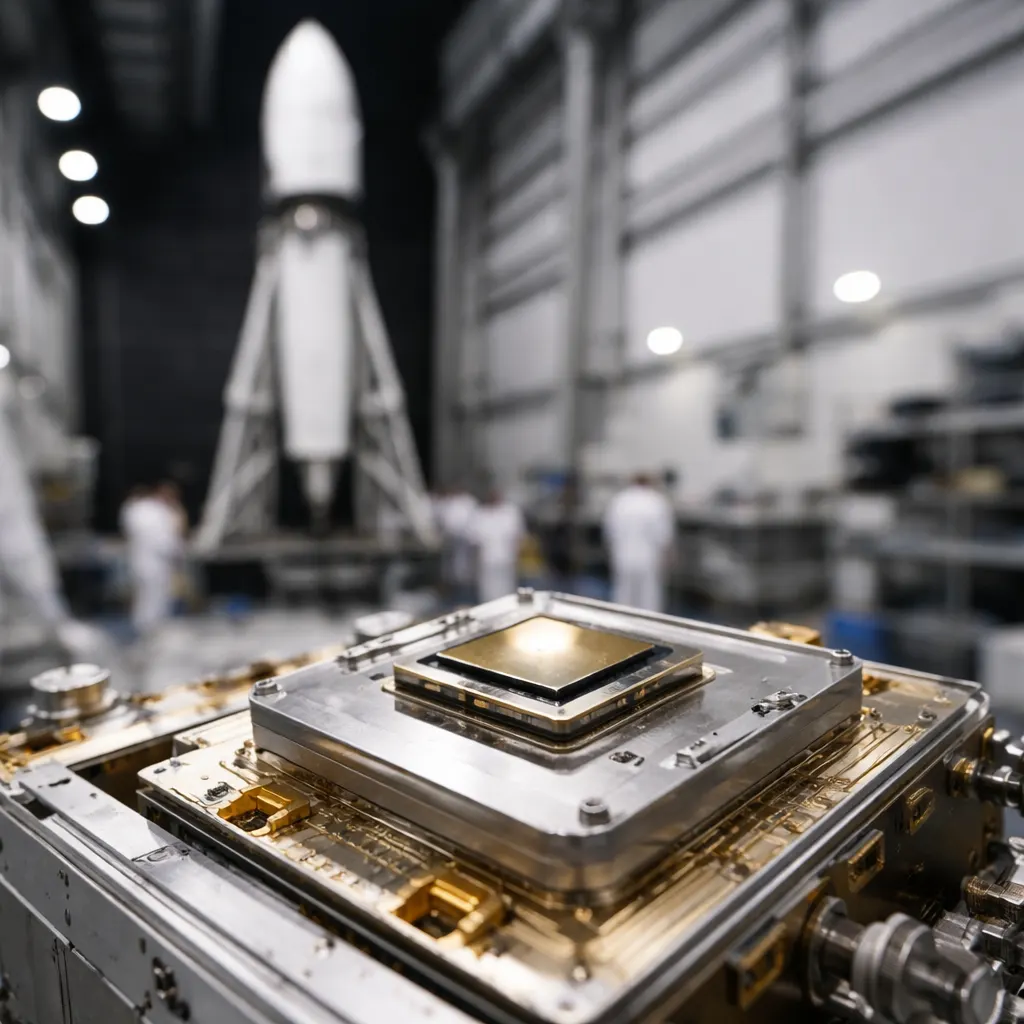
Google is scheduled to send four Tensor Processing Units into space on Oct. 1 aboard SpaceX's Transporter-18 rideshare mission, marking the first orbital test of the company's AI hardware. Planet constructed the prototype spacecraft that will allow Google to examine how its AI chips withstand launch forces and continuous operation in orbit, according to the report. The experiment forms part of Project Suncatcher, Google's investigation into whether satellites powered by solar energy could eventually deliver practical AI computing capacity.
Engineers subjected the hardware to months of testing against anticipated launch stresses. A flight lasting approximately 10 minutes can subject spacecraft to continuous acceleration reaching 10 times Earth's gravity, with individual parts experiencing far greater forces. Radiation experiments bombarded Trillium TPUs with proton beams at intensity levels surpassing the company's projections for a five-year mission, producing no hard failures from total ionizing radiation at the maximum tested dose. Because standard airflow can't remove heat in a vacuum, engineers designed cooling systems using heat pipes and radiators instead of the infrastructure backing ground-based AI data center power expansion.
The report notes that a single spacecraft can validate the hardware, but more demanding computing tasks require multiple satellites sharing data rapidly enough to function as one system. Suncatcher envisions high-speed laser connections between spacecraft, and Planet is constructing two additional prototype satellites slated for 2027 to validate that linkage in orbit. According to the report, expanding the concept also hinges on continuing declines in launch expenses, with rockets, networking, and satellite equipment all contributing to the financial equation.
If orbital computing eventually reaches commercial viability, it would still require integration with corporate systems on the ground, potentially generating recognizable work for systems integrators around connectivity, workload positioning, and integration with cloud or on-premises setups. Partners holding hybrid cloud and edge expertise would possess the nearest existing framework to adapt. Security would introduce another set of challenges, as managed security service providers might eventually need to extend identity verification, monitoring, and workload safeguards across infrastructure that's physically distant and linked through satellite networks. The report emphasizes that pricing, latency, availability, compliance, and workload appropriateness would all influence whether orbital capacity offers tangible benefits over standard cloud or edge infrastructure.
The October launch is chiefly a validation of whether the underlying hardware can endure and function in space, with no immediate commercial channel opportunity available yet. Google Cloud partners should therefore monitor how Project Suncatcher evolves past the hardware trials—whether orbital capacity enters Google Cloud's portfolio, its pricing structure, and whether partners can provision, administer, or resell it. AI expansion is already straining ground-based power and data center resources, helping to account for interest in unconventional infrastructure like orbital computing. Whether satellites ever constitute a substantial component of enterprise AI infrastructure will hinge on far more than placing TPUs in space, as cost, networking, dependability, security, and integration must all function at commercial scale. The immediate justification for channel partners to watch Project Suncatcher isn't that orbital computing is ready for market, but that Google is validating whether a fresh infrastructure tier could someday coexist with cloud, edge, and on-premises computing. Partners navigating tomorrow's infrastructure landscape may find themselves architecting solutions that span not just multiple clouds or edge sites, but orbital and terrestrial layers simultaneously—a paradigm shift that would demand entirely new frameworks for latency calculation, disaster recovery, and workload orchestration.