
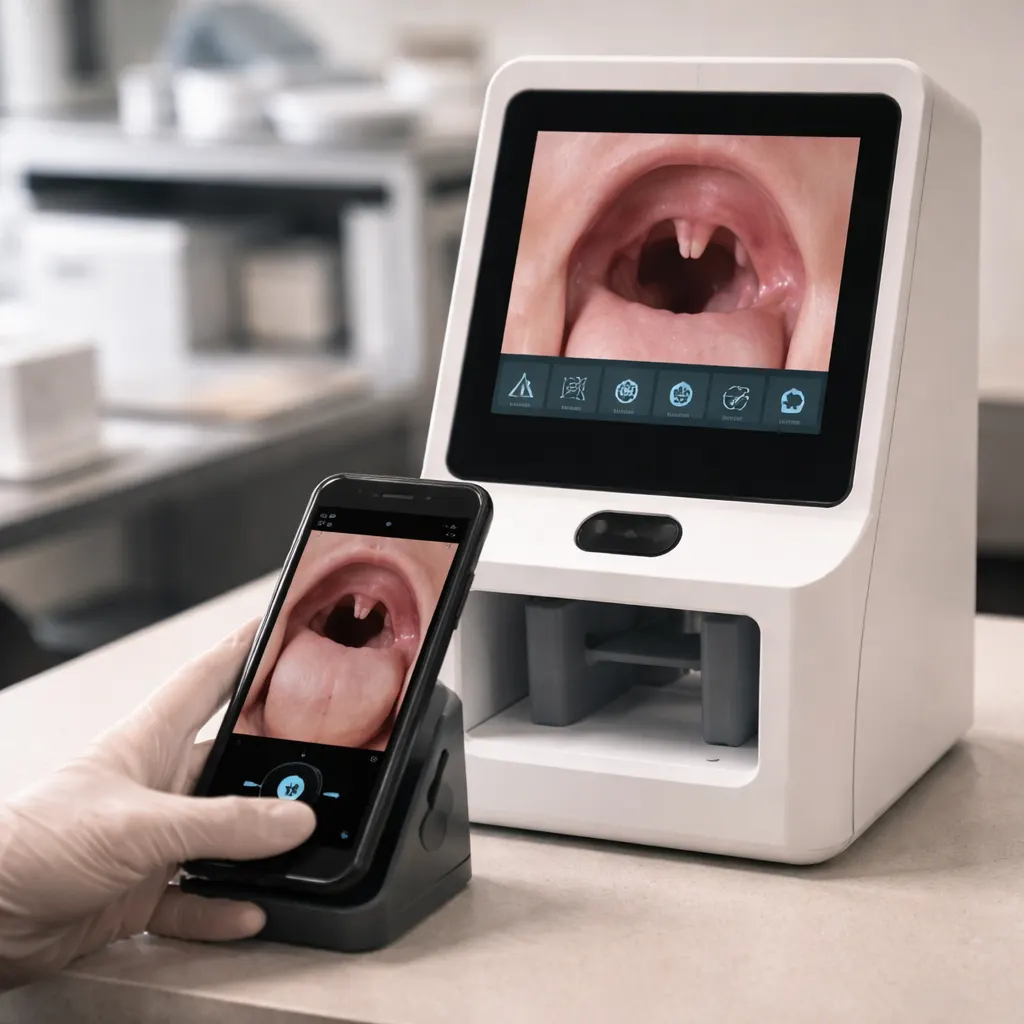
A medical device that uses artificial intelligence to diagnose influenza from a throat photograph has been deployed at more than 2,000 healthcare facilities across Japan, according to a profile published by Wired. The system, called Nodoca and developed by Japanese company Iris, became the country's first AI medical device approved as a "new medical device" with national health insurance coverage in 2022. In October 2025, regulators approved an additional feature for Covid-19 detection.
The technology analyzes pharynx images taken with a compact camera alongside patient interview data and delivers an influenza assessment in slightly more than 10 seconds, eliminating the discomfort of nasal swab testing and allowing diagnosis at earlier stages after symptoms begin. Before commercialization, the company collected training data by distributing specialized cameras to roughly 100 clinics over approximately three years with patient consent. The dataset has since expanded from hundreds of thousands of throat images to several million as anonymized data accumulates with each clinical use. Iris founder Sho Okuyama, a former emergency room doctor, notes this network effect has prevented competitors from entering the same market.
According to Okuyama, the company's breakthrough came not from the diagnostic algorithm itself but from "sensing—how the data is acquired," including proprietary hardware and venturing into pharyngeal imaging where no previous dataset existed. He envisions that "in about 10 years, we'll reach an era in which a single photograph of the throat can be used to perform a comprehensive range of tests," with AI inference costs remaining minimal even as test volume grows. The firm is researching whether patterns in throat mucosa and blood vessels can reveal lifestyle diseases including diabetes and hypertension.
The technology addresses a fundamental medical practice unchanged since antiquity—visual throat examination—where patterns vary by pathogen but contain hidden information doctors struggle to extract consistently. By building both the camera hardware and the AI model simultaneously, Iris navigated three major risks: device development, training data collection, and proving AI-assisted diagnosis could function in practice. Okuyama's experience treating patients on a remote island with minimal equipment beyond a stethoscope informed his focus on capturing diagnostic information through simple imaging. The report notes Okuyama is also lobbying government agencies for regulatory reform to enable AI implementation across multiple healthcare stages, from automated interviews and telemedicine consultations through primary care and specialist treatment.
Okuyama frames the long-term goal as "redesigning health care itself" with AI embedded at every patient touchpoint, a vision already partially realized through AI medical interviews and online consultations becoming standard practice. The throat imaging platform's low marginal cost for additional tests could enable mass screening for multiple conditions simultaneously, fundamentally changing how preventive medicine operates. For companies evaluating where medical AI creates sustainable moats versus temporary advantages, the lesson appears clear: proprietary data pipelines matter more than algorithms alone. Organizations that control both the sensing layer and the feedback loop from clinical deployment may find themselves with defensible positions that pure software plays cannot replicate.