
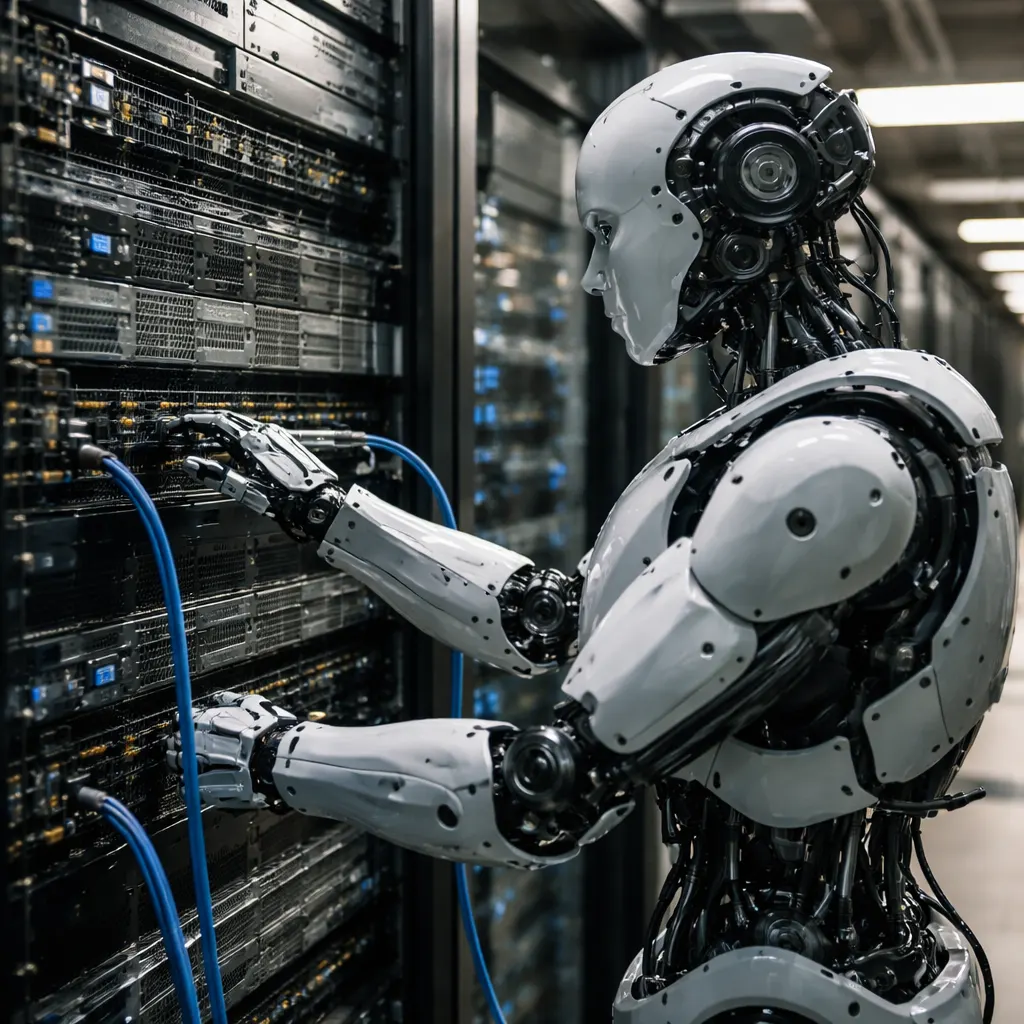
Meta is evaluating robots capable of plugging in cables, restarting servers, and performing other physical tasks at its data centers, according to a report published by WIRED. The previously unreported initiative could eventually enable the social media giant to run its fast-growing data center network with fewer human workers, helping control labor expenses as spending on artificial intelligence infrastructure climbs. The experiments involve hardware from multiple vendors, including Watney Robotics, Kinova, and ABB, according to current and former employees familiar with the projects.
In one trial, Meta is assessing whether a Kinova Gen3 robotic arm can handle power cycling or shutting off electricity to servers. The company is also testing a separate robot designed to swap networking cables. One data center technician estimates the cable-swapping bot could take over as much as 80 percent of certain workers' tasks if deployed successfully. At some locations, Meta has quietly introduced a simpler robot resembling a finger or pointed stick that presses power buttons on Mac Minis and similar devices to restart them when a human prompts it remotely. Meta's tugger and inventory robots are now running in multiple facilities, including those in Iowa and Virginia. The inventory bot is being used for failure inspections but can't tell green from red indicator lights because its camera captures only grayscale, meaning human checks remain necessary for some breakdowns. Since last June, Meta has tried out a pair of dual-armed Watney robots for cabling work at one Altoona building. In New Albany, Ohio, four-wheel robots made by ABB with a scissor-lift-style riser and a six-axis arm are being tested to reseat parts and may eventually take on other duties with less human supervision.
At a conference last year, Eric Xu, senior manager for robotics at Meta, stated the company's "long-term goals" are to deploy robots in data centers, arguing they could accelerate incident response, monitor conditions, and handle preventative maintenance. Until recently, robots weren't well suited for the delicate work in data centers—they were costly, and in earlier industry trials they sometimes crushed servers while attempting basic tasks, according to the report. But hardware prices have dropped, and the AI models running robots are now far more advanced than they were several years ago. "More and more of our customers are telling us 'we want to run our data centers using humanoid [robots]' because you can run them at higher temperatures, in the dark, and all these things," says Paul Golding, who leads physical intelligence at chipmaker Analog Devices.
Robots could deliver more consistent performance at lower expense than human labor, especially in less populated areas where data centers are common but qualified workers are scarce, the report explains. Supporters also point to a worker-friendly argument: just as AI agents promise to do for office workers, robots could handle data center technicians' most repetitive and hazardous duties while allowing them to concentrate on more complicated problems. Over the long term, removing workers from the equation could make it more practical to operate data centers underwater, in space, or in other settings potentially hostile to living organisms. But some workers are concerned about job security. In Altoona, Iowa—where Meta runs what's now its biggest data center campus—employee group chats have adopted a discouraged tone, "saying we're all going to be gone in a few years anyway because of the robots," according to a person familiar with the conversations. Even if robot adoption proves slower than expected, some fear the caliber of available positions is declining. Two workers say Meta is building AI software and related tools they believe will let the company hire less-skilled and therefore lower-paid employees and consolidate certain roles in locations such as Denver, Colorado, that are more financially beneficial.
The idea that robots will triumph over humans isn't certain, however. "There's been a lot of pilots and demos, but no provable working solution," says Helen Oleynikova, CEO of Exclaim Robotics, which is developing prototypes to replace broken parts and reset cables in data centers. At Meta's facilities, some workers have complained about how much downtime the robots require to recharge batteries. Meta has also acknowledged internally that robots aren't ready for certain jobs, such as the intense cabling work needed to run an Nvidia GB300 supercomputer. "Things have been designed for human hands forever to make everything a five-minute repair," says one former Meta employee. "Redesigning everything will take time." Still, as tech companies race to expand AI infrastructure, the tension between automation promises and workforce realities may force communities to reconsider data center tax incentives and weigh whether the job creation arguments that justified those breaks still hold. The question facing policymakers and workers alike is whether the industry's push toward robotics will create new opportunities or simply eliminate roles that were once considered safe from automation.