
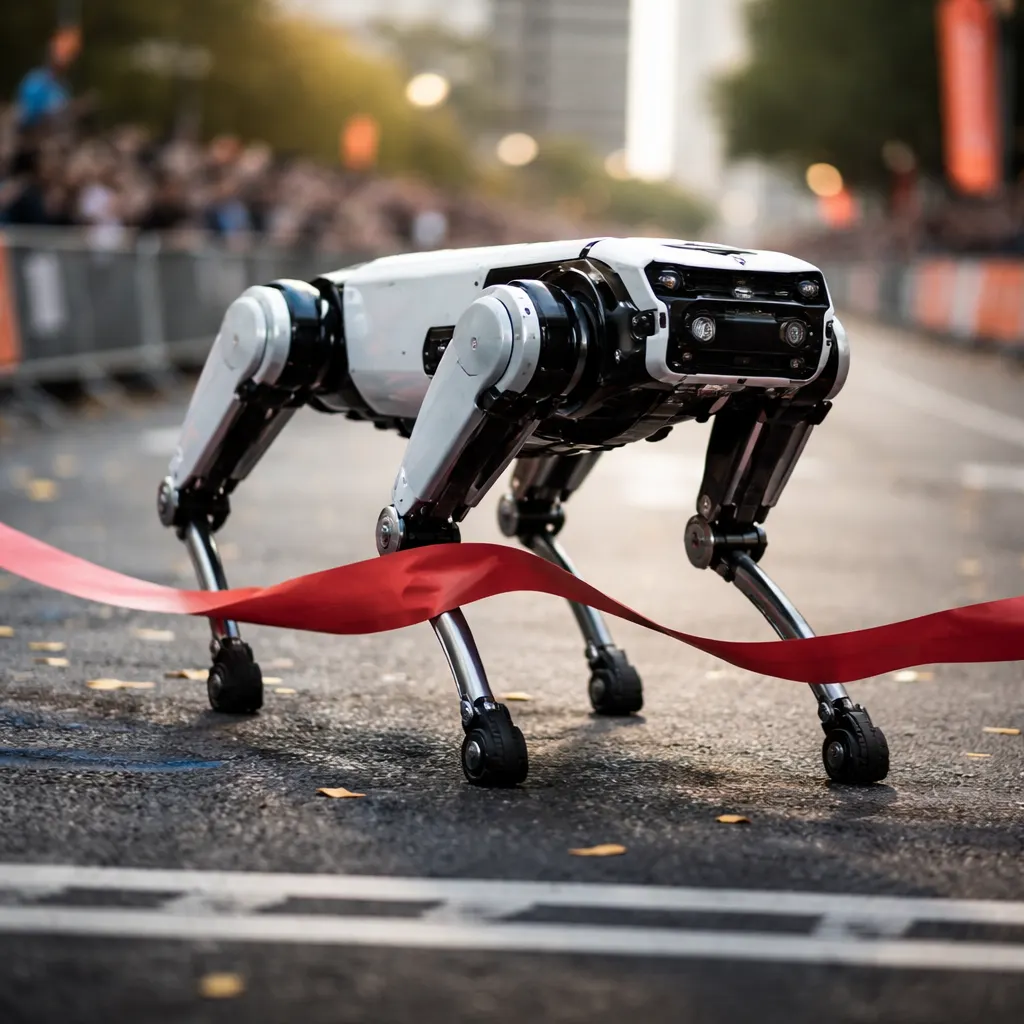
A four-legged robot completed a full marathon on a single battery charge with more than three times the range of comparable machines, according to a study published in Nature this week by researchers at the Korea Advanced Institute of Science and Technology. The robot, called RAIBO2, finished the 42.195-kilometer course at the Sangju Dried Persimmon Marathon in November 2024, nearly two years before the team released details of how they achieved the efficiency breakthrough. The paper explains how lightweight construction, low-loss electrical systems, and machine learning combined to extend the robot's operating distance far beyond what existing quadrupeds can manage.
RAIBO2 covered the 26.2-mile route in 4 hours, 19 minutes, and 52 seconds at an average pace of 2.64 meters per second, navigating 286 meters of elevation shifts and inclines as steep as 18.4 degrees. The machine consumed 1,280 watt-hours from a battery holding 2,016 watt-hours of capacity. Its cost of transport—the energy needed to move a given weight across a given distance—measured 0.25, beating the researchers' human benchmark of 0.37 and marking the first time a quadruped robot has surpassed that figure. Most recent quadrupeds manage roughly 20 kilometers per charge because their joints burn energy holding up the machine's weight, while repeated impacts between foot and ground add further losses.
The research team, led by associate professor Jemin Hwangbo, wrote that "compared with existing quadrupeds, RAIBO2 offers more than three times the travel range per battery charge." The paper states that "this breakthrough in energy efficiency paves the way for extended outdoor applications in which prolonged battery life is critical." The authors acknowledge that the efficiency record doesn't make the robot autonomous, noting that stairs or mountainous terrain might need adjustments to energy loss models and constrained postures, requiring "a more environment-aware strategy."
Legged robots can cross stairs, rubble, slopes, and uneven ground that wheeled machines can't handle, making them potentially valuable in mountainous regions and disaster sites. Robot dogs are already helping with nuclear cleanup at the UK's Sellafield facility, while military uses are considerably less friendly. The trade-off is operating distance—wheels remain more efficient on smooth surfaces, and humans stay faster, with Kenya's Sabastian Sawe setting the official world record of 1 hour, 59 minutes, and 30 seconds at the London Marathon in April 2026. The KAIST team achieved its range gains by merging lightweight mechanical components, efficient motor-driving circuits, and a locomotion strategy optimized for energy use through reinforcement learning.
The researchers believe their work could extend the range of future legged robots, though the study assumes human operation rather than autonomous navigation. The paper notes that autonomous systems would require planners capable of identifying energy-optimal routes based on understanding global maps, and that "the loss models developed in this study provide a valuable foundation for addressing these challenges." Whether the extra mileage gets spent inspecting disaster zones, carrying deliveries, or chasing humans depends on whoever purchases the machines. The efficiency gains arrive at a moment when longer deployment windows could determine whether legged robots move from controlled trials to continuous field operations, though the gap between technical capability and practical autonomy remains a design challenge rather than just an energy problem.