
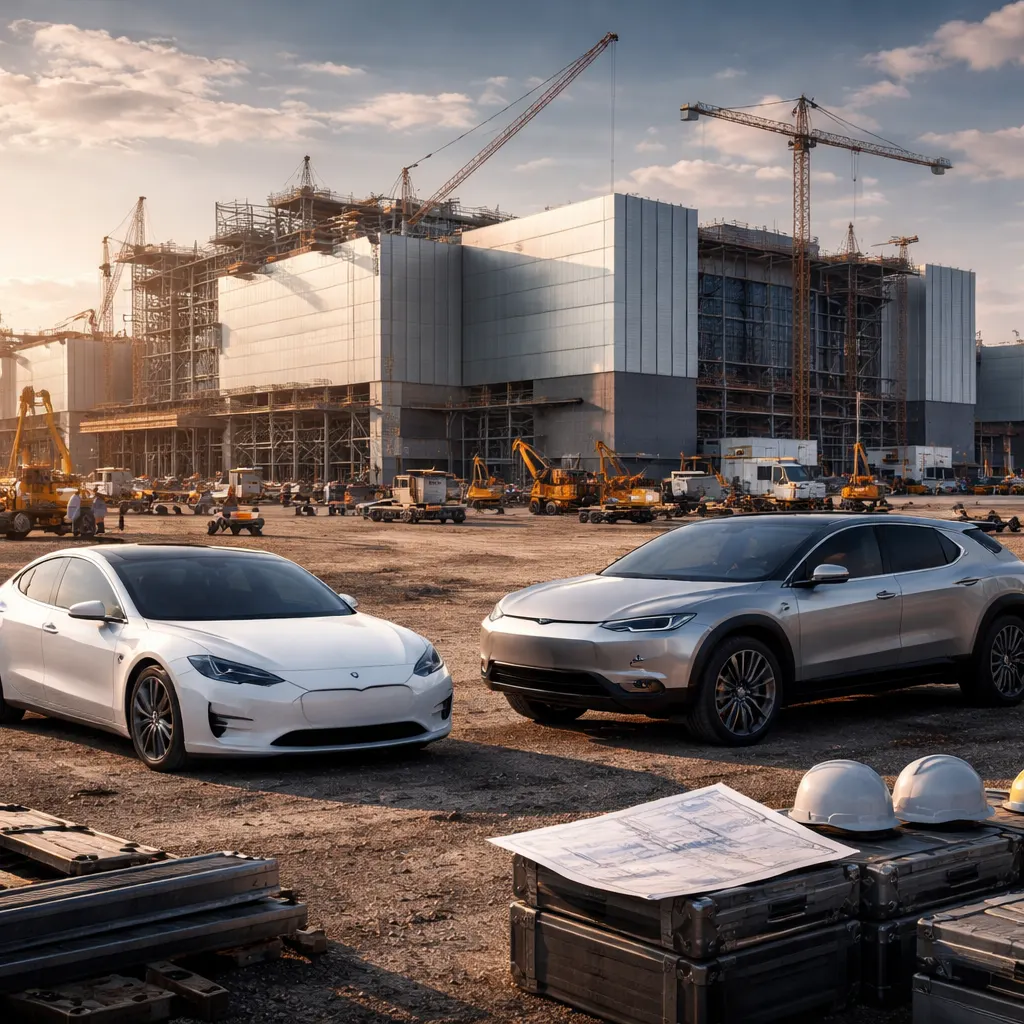
Tesla and SpaceX announced Thursday that they will commit an initial $16.8 billion to construct "Terafab," an advanced semiconductor manufacturing facility in Grimes County, Texas, just outside Houston. The two companies say the plant will be the world's largest building by square footage and value, designed to bridge the gap between today's global chip production and the massive computing requirements of tomorrow.
The facility will span more than 100 million square feet of manufacturing space, according to the companies, and is expected to employ at least 3,000 workers from Grimes County and neighboring Brazos County. SpaceX has indicated in regulatory filings that it may ultimately spend as much as $119 billion on the project through a multi-phase construction timeline, though the company made no mention of Terafab during its first earnings call earlier this week. Intel has confirmed it will participate in the project but hasn't disclosed specifics about its contribution. The announcement came one day after a heavily attended county meeting where hundreds of local residents showed up and voiced concerns about millions of dollars in tax incentives granted to the venture, as well as limited public disclosure around the deal.
Terafab will function as a vertically integrated semiconductor fabrication plant, housing the production, packaging, and testing of cutting-edge logic and memory chips under one roof. According to SpaceX, consolidating these operations in a single location will allow for rapid, iterative enhancements and faster deployment of new computing hardware. The factory will manufacture processors optimized for edge computing and inference—chips intended for devices like Tesla's Optimus humanoid robots and self-driving Cybercabs—alongside high-performance chips engineered to power SpaceX's planned space-based data centers. SpaceX also stated it is committing to draw water from the nearby Gibbons Creek Reservoir rather than tapping local groundwater supplies.
The push behind Terafab stems from Elon Musk's view that his companies' ambitions—millions of robots replacing human labor, autonomous vehicles handling all transportation, and satellites functioning as orbital AI training hubs—demand a level of computing capacity that far exceeds what current chip production can deliver. SpaceX describes the project as "epic in both its mission and in its sheer size, designed to build new compute at an unprecedented scale and speed." Dr. Sarah Borowicz, superintendent of Anderson-Shiro Consolidated Independent School District, called the agreement "a defining moment" for the district and pledged to manage the opportunities it creates with transparency and a student-centered approach. The scale of the investment signals a bet that control over semiconductor supply chains will be critical to maintaining the pace of hardware innovation required for AI and robotics at the edge and in orbit. Whether the facility can deliver chips fast enough to match Musk's timeline for mass-market robots and robotaxis will depend on execution across a decade-long buildout and coordination with partners like Intel whose commitments remain partly undefined.