
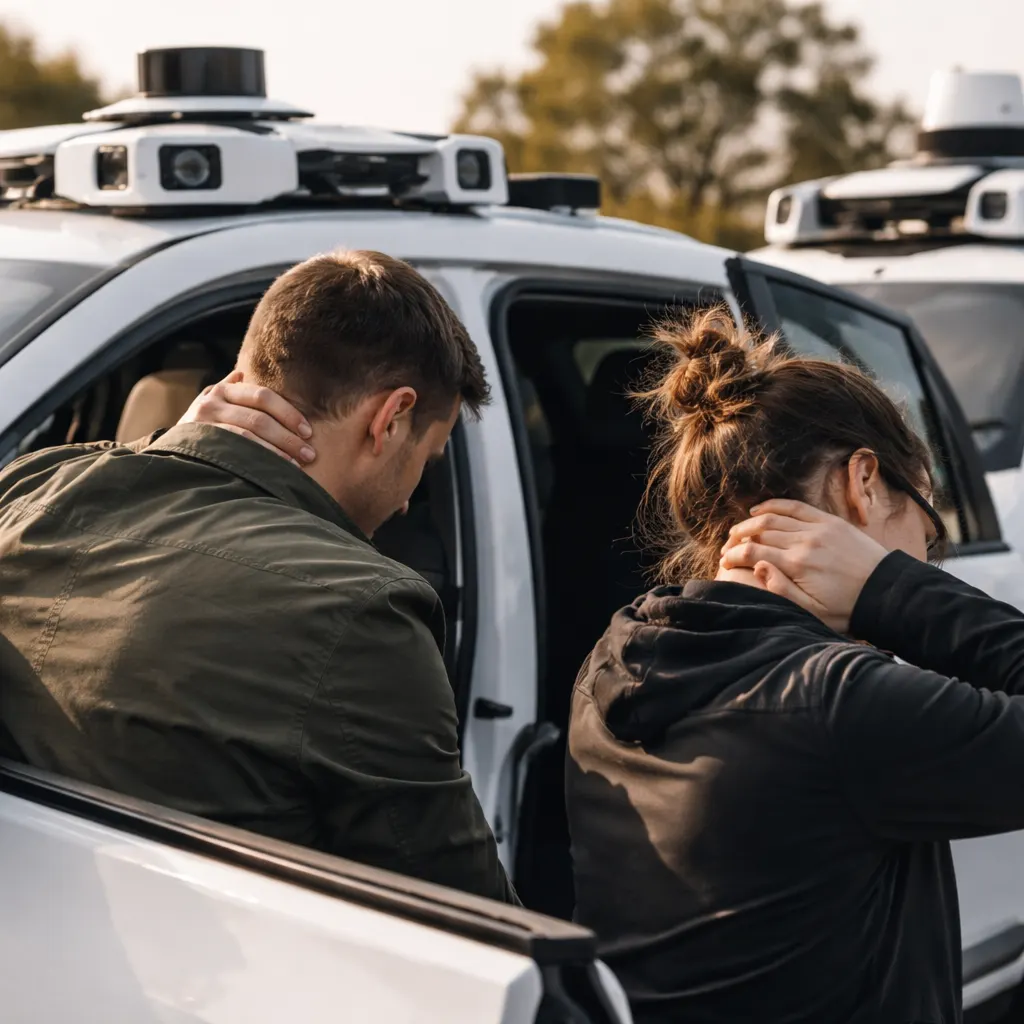
Test drivers for Waymo and Zoox sustained more than two dozen injuries in 2024 and 2025 from hard braking or other abrupt movements by autonomous vehicles, according to a TechCrunch review of data filed with the Occupational Safety and Health Administration. These workers, who put self-driving cars through their paces on public roads, suffered sprains, strains, whiplash, and other injuries that sidelined some for weeks or months. The review shows that the rapid expansion of robotaxi services over the past two years has come with a hidden cost to the humans still involved in testing.
Transdev, which employs and manages Waymo's test drivers, reported 16 injuries linked to Waymo depot locations across three cities that were caused by the autonomous software stopping suddenly or swerving sharply. Zoox reported as many as eight worker injuries connected to hard braking. The injuries jumped sharply as operations scaled: Transdev reported five Waymo test driver injuries in 2024 across San Francisco, Los Angeles, and Phoenix, with one related to hard braking and four to erratic vehicle behavior. That number climbed to 11 injuries in those three markets in 2025, with hard braking causing nearly all of them. In one 2024 case, a test driver reported the car "suddenly backed up" while parking itself and "whipped the steering wheel," catching his left hand and bending it "to the point he heard a crack in his wrist," leaving him off work for more than two months. Last September, a Phoenix test driver spent 157 days away from work after their vehicle "made an exaggerated breaking [sic] event without any obstruction." At least two other injury reports from 2025 specifically note that the hard braking occurred for no apparent reason.
Seven of Zoox's eight injury entries explicitly mention hard braking, nogos (internal code for a complete system shutdown), or brake jabs. On January 5, 2025, a Zoox test vehicle in San Francisco slammed on the brakes abruptly, injuring a contractor's shoulder and upper arm and leaving them on restricted duty for 16 days. Later that month, another driver was hurt after an "unexpected" stop injured their neck and left them with a swollen shoulder, keeping them out for eight days. Four of the injuries Zoox reported in 2025 happened after the company issued a recall meant to resolve a year-long federal investigation into the tendency of its autonomous vehicles to brake unexpectedly, according to the review. Current and former Zoox contractors told TechCrunch that hard braking can happen multiple times on a single test drive, sometimes in the same location, and at any speed. The scariest incidents, they said, occur when a test vehicle experiences a nogo: "You could be going 45 miles per hour and the car will enact a nogo, and suddenly you're being whipped forward in the middle of the street, in traffic, and you need to be able to take over quickly," one contractor said.
The TechCrunch analysis notes that injuries appear to have risen alongside the rapid scaling of robotaxi operations. While Waymo has spent more than a decade developing its self-driving cars, it wasn't until 2025 that it really started to scale, offering rides in new cities and growing its commercial fleet to more than 1,500 vehicles by May 2025 and more than 3,500 today. The amount of autonomous vehicle testing almost certainly increased as the company expanded its service areas and began familiarizing itself with entirely new locations, the review notes. Zoox and Waymo injuries appear in the dataset because the companies classify themselves as taxi, limo, or transit services, which OSHA subjects to greater disclosure because they're "higher-hazard" industries. OSHA also only requires establishments with 100 or more employees in these industries to make this information public, meaning test drivers in newer cities where operations haven't scaled may have been injured without appearing in this dataset. The contractors said the braking often happens when the autonomous driving system detects—or mistakenly detects—debris of some kind on the road.
Zoox told TechCrunch that hard-braking incidents are sometimes unavoidable and that the injuries reported last year represent a small percentage of the millions of miles its test fleet traveled. The company said it follows necessary reporting requirements and takes injuries seriously, but declined to answer specific questions about the injuries it reported or the claims contractors made about continued hard-braking issues. Waymo also declined to answer questions about the injuries reported to OSHA, telling TechCrunch that "the safety of our riders, road users, and team is of paramount importance." The company said that as part of responsibly deploying fully autonomous vehicles, it has driven tens of millions of miles with human operators behind the wheel as part of its ongoing validation process, with learnings from these trips integrated into the service. Current contractors said injuries are still happening at Zoox, with the company's modified Toyota Highlander SUVs still braking hard and abruptly as recently as July, and three contractors said workers are still getting hurt. The companies will need to address these recurring safety issues as they continue to expand, particularly as Zoox begins charging for rides in its purpose-built robotaxi for the first time this month in Las Vegas in a bid to compete with Waymo. As the industry moves from careful testing to mass deployment, the question of whether automation can truly eliminate human risk becomes harder to answer when the humans still in the loop are the ones getting hurt.