
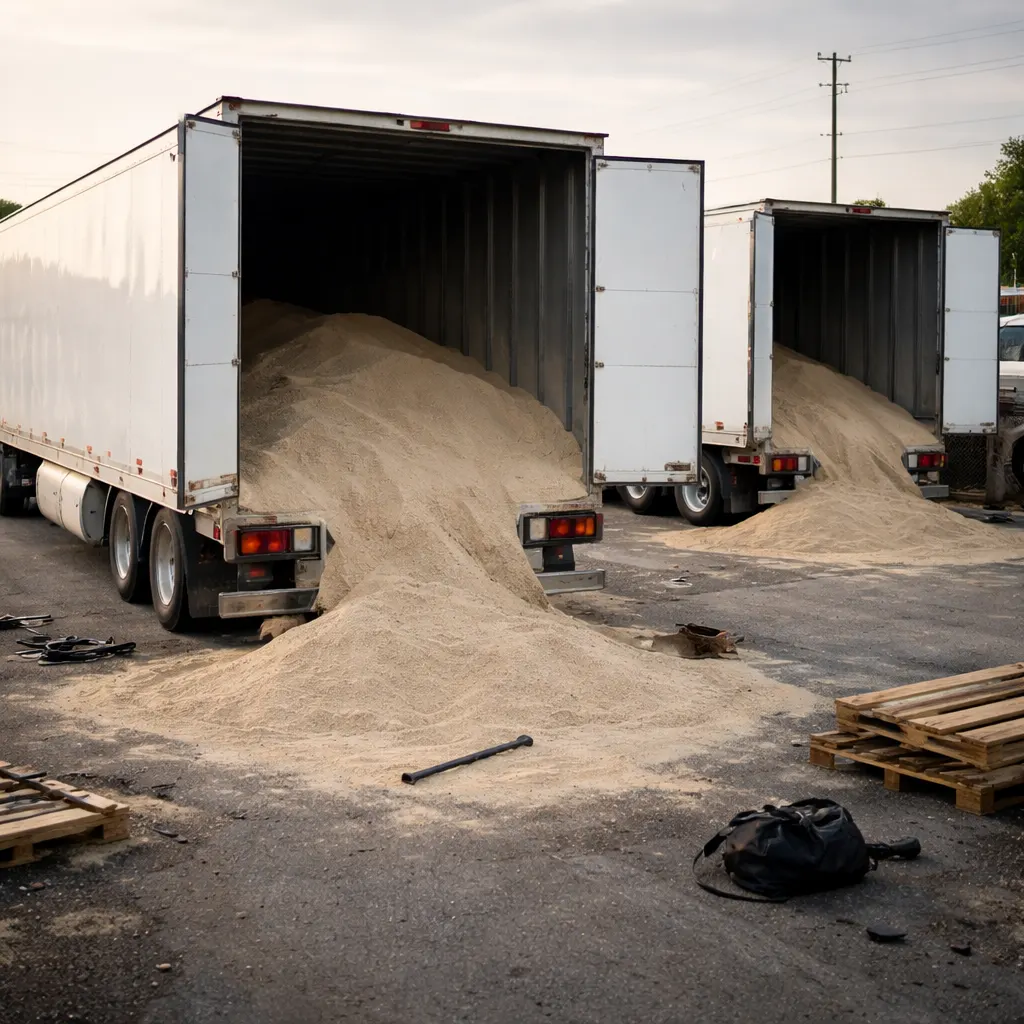
Two trailers displaying Nvidia logos were stolen this week in California, but the thieves who broke the locks and drove away discovered their haul contained roughly 18 tons of sand instead of valuable AI hardware. The vehicles belonged to PlusAI, an autonomous trucking technology firm partnered with Nvidia, and the sand served as ballast during testing to mimic a fully loaded truck, according to a report published by Ynet News. The incident highlights how surging demand for AI chips has turned computing equipment into an increasingly attractive target for organized theft.
The theft came to light Thursday morning after a PlusAI executive got a message from someone who'd seen two company trucks near his workplace in Newark, California—a location where the trailers weren't supposed to be. Investigators believe the thieves arrived with their own tractor units, broke the locks securing the trailers at PlusAI's warehouse, connected them, and simply drove off. Both trailers were later abandoned and recovered by police that same afternoon with all the sand still inside. PlusAI's actual tractor units, which house the company's autonomous driving systems and technology, remained secure inside the warehouse and were never taken.
The trailers bore prominent PlusAI and Nvidia branding, and authorities have not yet determined whether the thieves specifically targeted what they believed to be chip giant equipment. As of publication, no arrests had been made and the investigation continues. Shipments of chips and data center gear can reach values in the millions of dollars, making them lucrative black-market commodities, the report notes.
The failed heist comes as advanced chips and graphics cards have become especially valuable on illegal markets due to enormous AI hardware demand, high prices, and U.S. export restrictions targeting China, according to the report. Recent examples include Macau customs authorities seizing two Nvidia GeForce RTX 5090 graphics cards during an anti-smuggling operation—cards that can sell for thousands of dollars and are useful for running AI models. The RTX 5090 isn't officially sold in China; instead, a restricted version is marketed to comply with American export rules, creating a parallel market. The U.S. Justice Department recently uncovered a smuggling network that moved or attempted to move at least $160 million worth of Nvidia H100 and H200 chips to China between October 2024 and May 2025, with conspirators removing Nvidia markings and falsifying shipping documents to disguise the cargo and destination, the report states.
Thefts of expensive computing equipment are also rising domestically, with two recent California incidents involving vehicles carrying data center gear resulting in millions of dollars in stolen hardware, the report finds. Tesla batteries and Bitcoin mining equipment have also been stolen during the past year. The sand caper may look like a punch line, but it underscores how AI hardware has become a high-stakes target for criminal networks operating both inside and outside the United States. The combination of export controls and soaring AI demand means companies transporting or storing chips now face security challenges once reserved for precious metals or pharmaceuticals. For logistics operators and tech firms alike, the calculus around protecting hardware shipments is shifting as the black-market value of computing power continues to climb.