
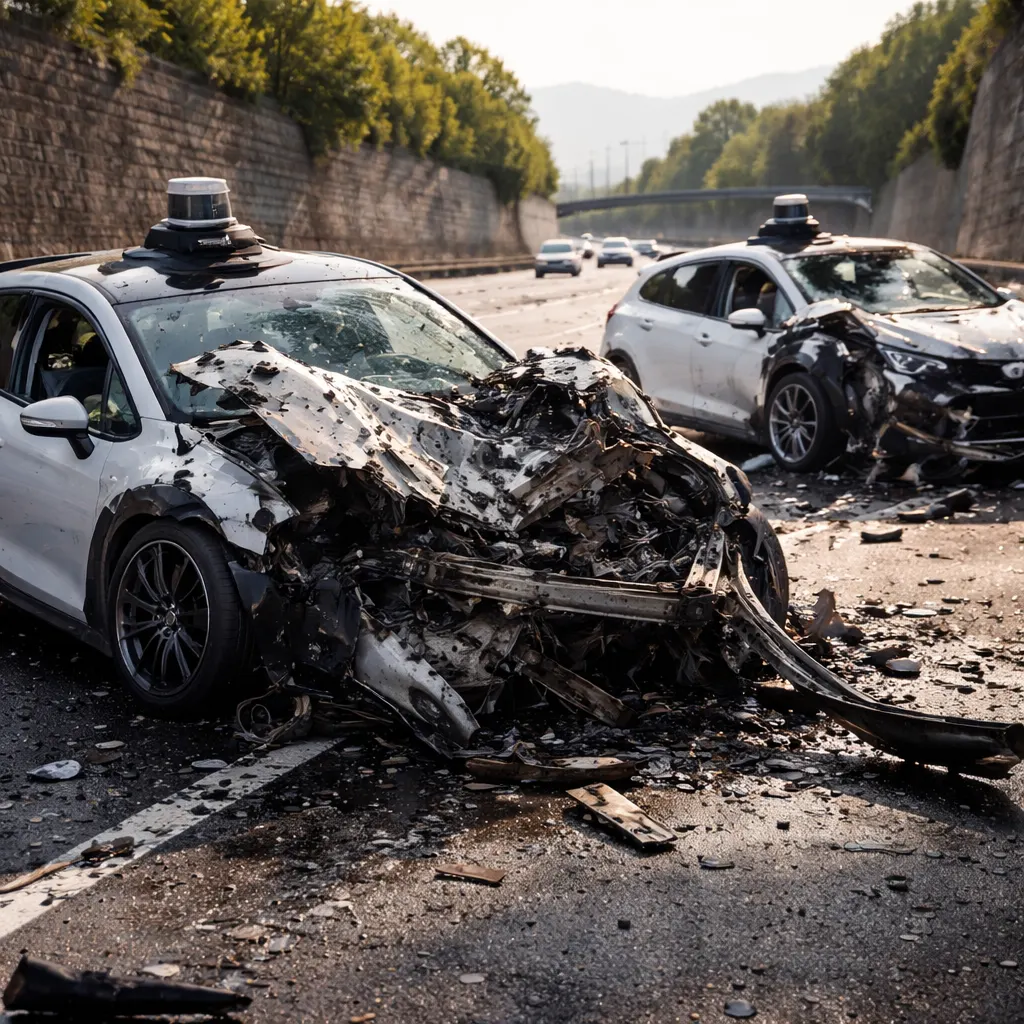
Two autonomous race cars collided at approximately 155 mph during a race held by the Abu Dhabi Autonomous Racing League at Imola, Italy's historic Autodromo Internazionale Enzo e Dino Ferrari, according to a report published by WIRED Middle East. The crash involved PoliMove's vehicle slamming into Unimore's slowing car in Rivazza, the circuit's final and notoriously difficult corner sequence where Formula 1 champions have also met disaster. The incident exposed the gap between autonomous vehicles' computational abilities and their capacity to respond when conditions deteriorate suddenly.
Only two of the five cars competing in the final crossed the finish line. UAE's Kinetiz claimed first place, with Germany's Constructor Racing taking second, while PoliMove finished third despite its damaged vehicle requiring replacement for the podium ceremony. Two-time champion TUM pulled out after its car developed a brake fault during the formation lap. Teams had just nine days of physical testing before the competition, facing conditions that included rain and hail, and this marked the league's first international race away from its usual Abu Dhabi base.
The crash occurred when Unimore's car, Gianna, initiated a safety stop after losing all data from its lidar and radar sensors, leaving GPS alone to locate the vehicle—insufficiently accurate to continue racing at speed. PoliMove's vehicle, Eva, detected Gianna ahead but couldn't avoid impact, with Gianna braking at approximately 1 g force and Eva trailing just 1.5 seconds behind. According to PoliMove, its system identified the hazard and began evasive action, but the delays introduced by perception, decisionmaking, trajectory replanning, actuator response, and vehicle dynamics made collision physically unavoidable once Gianna braked so severely mid-corner.
Nicola Palarchi, engineering director at Aspire, the company that founded A2RL, explained the rationale for choosing such a punishing track: "Because everybody can do 'easy', right? We have to show we go where it matters." The report frames autonomous racing as a laboratory with guardrails, designed to test perception, prediction, and vehicle control at extreme speeds without endangering human drivers. Racing amplifies every challenge because at high velocities, vehicles have less time to interpret incomplete information, predict another car's movements, and execute evasive maneuvers. The failures at Imola produced valuable edge cases including sensor loss, compromised localization, sudden braking, limited visibility, and interaction between autonomous systems making separate decisions. Chee Kiong Ong, deputy team principal at Kinetiz, observed that predictive algorithms developed on the track could eventually help civilian vehicles respond to emergencies, noting "you could probably apply it to make the car stop itself in a safer manner or control it at the limits so that you can save lives."
The next A2RL race returns to Yas Marina, where teams have spent years developing their software, and organizers are already considering increasing difficulty by shortening testing periods, expanding the grid to eight cars, or restricting GPS access. Those changes could reveal whether the systems are becoming more adaptable, while the industry waits to see how this information transfers into real-world scenarios. One caveat remains: unlike other lab testing, companies aren't required to share the precise data collected from their vehicles, meaning the insights from A2RL's racing platform currently stay within the competition. The brutal simplicity of the Imola crash—a vehicle that recognized danger but remained trapped by physics—suggests that perfecting driverless technology may depend less on computational breakthroughs than on designing systems that degrade gracefully when sensors fail. More provocatively, staging these experiments on closed tracks rather than public roads quietly shifts the ethical burden of failure from unsuspecting commuters to engineers who signed up for risk.