
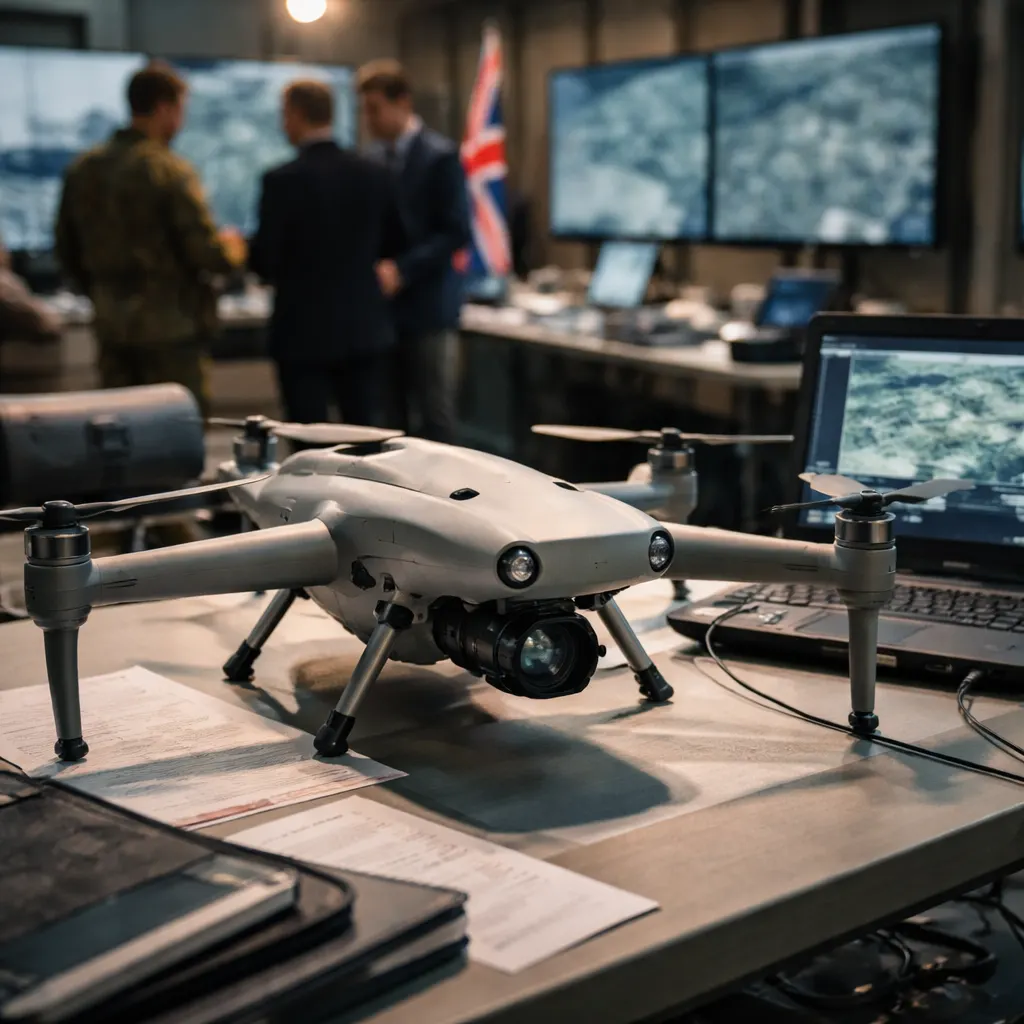
Ukraine's Ministry of Defense announced in January that it would offer millions of data points collected across tens of thousands of drone flights to military contractors and commercial firms alike, according to a report published September 4 by MIT Technology Review. Since that announcement, more than 100 companies and the UK government have secured access to the records. The report, authored by Cory Alpert, a researcher at the University of Melbourne, argues that battlefield drone data is becoming a commercial asset with value extending far beyond military applications, yet the legal framework to govern its use doesn't exist.
The data collected during each unmanned flight includes thousands of individual points—images, video footage, and controller inputs—that together reveal how machines and human operators reacted to rapidly changing conditions. One American firm, Enabled Intelligence, has already processed more than half a million hours of Ukrainian drone footage and made it available for AI training, marketing potential applications in both defense and commercial systems, the report says. American drones flying over Syria and Yemen in the late 2010s produced records that informed the first generation of semiautonomous military hardware, but the current effort represents a wider ecosystem with access extending beyond classified military channels.
According to the report, battlefield data holds exceptional value for AI development because war generates the kinds of rare events—signal jamming, visibility loss, operator improvisation—that AI companies spend years and significant resources trying to capture in controlled settings. "The data that's most valuable for training AI models comes from exceptions," the report states. Alpert writes that combat compresses the unpredictable terrain commercial drones encounter into a much shorter timeline, turning operational logs into training sets when processed and aligned with operator actions. Drones trained in Ukraine's signal-jammed airspace are now being deployed in agriculture to help farmers map fields in areas without the cellular connectivity earlier technology required, the report notes.
The report warns that no agency or regulator currently has authority over what happens when combat records are stripped of operational context, repackaged as datasets, and licensed to firms whose products circulate far beyond the battlefield. Soldiers and civilians visible in sensor data, camera footage, and location coordinates did not consent to becoming training material for products sold years later, creating what the report calls a problem of consent. Errors and assumptions embedded in battlefield data travel with AI models even after they enter civilian applications like delivery vehicles or agricultural machinery. Unlike the controlled weapons transfers governments already regulate, the provenance of AI training data vanishes in ways inherent to the technology itself, making it impossible to trace when planted contact details appear two steps from the original buyer.
Governments that provide access to defense data should handle it the way they treat controlled weapons transfers—recording origin, licensing users, and restricting further sharing, the report recommends. Ukraine's Avengers Labs program lets companies train models on battlefield data without direct access to sensitive databases, but that addresses only part of the challenge. Alpert argues governments should require disclosure when models trained on wartime material later appear in civilian products, making the path from combat to commerce visible. The regulatory system must follow battlefield data wherever it travels—from combat to model to commercial product—to prevent wealthier countries far from danger from profiting off the mortal threat carried by frontline states, potentially creating market incentives for conflict to continue as an endless source of digital resources. The emerging drone data marketplace raises questions that extend beyond technology transfer into the commodification of human experience gathered under lethal conditions, a threshold that will test whether existing governance structures can adapt faster than the industry itself expands.