
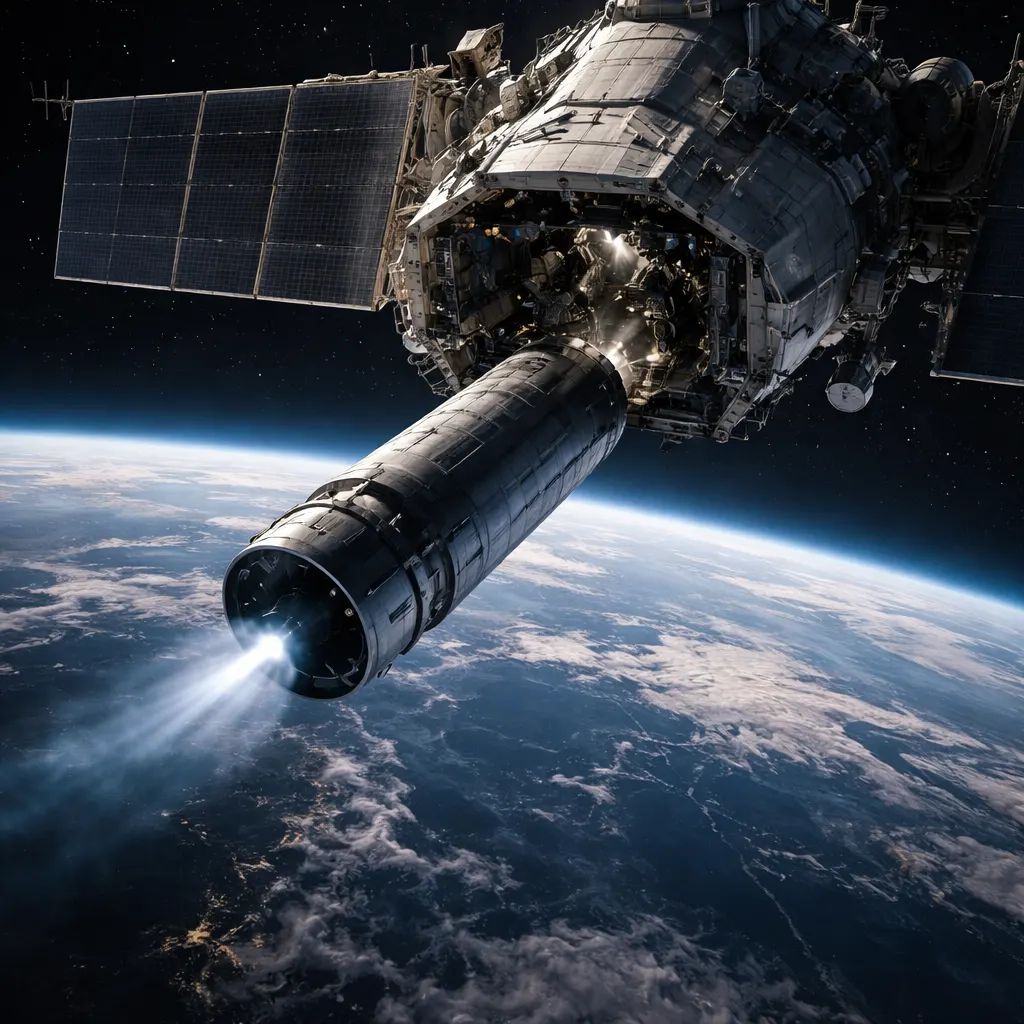
The United States has positioned "space control weapons" in orbit around Earth, according to statements made by US Air Force Secretary Troy Meink at the Air and Space Forces Association conference. Officials haven't disclosed what kind of weaponry was deployed, how it reached orbit, or when the launch occurred. The acknowledgment marks a rare public confirmation of military capabilities in space, though the lack of detail leaves the nature and purpose of the weapons unclear.
The US operates two uncrewed X-37B spaceplanes capable of remaining in orbit for years while conducting classified missions, and numerous classified launches have taken place that could have delivered the weaponry. Potential weapon types include devices that jam satellite communications, systems that fire pulses to disable electronics, or kinetic or ballistic options—though the latter could generate space debris with catastrophic consequences. One observer on social media coined the term "Mutually Assured Kessler Syndrome" to describe the risks of poorly conceived ballistic weapons. Kessler Syndrome refers to a theoretical scenario where collisions between objects in orbit trigger a cascading debris field that eventually renders orbital space unusable.
According to Dr. Bleddyn Bowen, Associate Professor in Astropolitics at Durham University, weapons in space aren't new, even if public confirmations from the US are. Bowen speculated the weaponry might be a close-inspector satellite or "something with a dedicated electronic warfare capability," adding, "If I was putting any money down, that's probably what it is." He emphasized that the weapon's orbital location matters significantly: "The Americans, of course, really don't want any more debris in space," making kinetic options unlikely in geostationary orbits, though "if you're putting this stuff at very low orbits, then you know you might be more inclined to take a chance with debris-generating stuff." China's foreign ministry urged the US to "stop expanding its military capabilities and preparing for war in outer space," while BRICS nations called for preventing "an arms race in outer space" just before Meink's announcement.
The Outer Space Treaty banned weapons of mass destruction in space starting in 1967, but superpowers have circumvented it repeatedly—the Soviet Union equipped Salyut 3 with a self-defense gun in 1974, and the US pursued the Strategic Defense Initiative to intercept ballistic missiles. The current administration's Golden Dome plan envisions a constellation of satellites with detection and interception capabilities. Bowen suggested the public acknowledgment serves a messaging function: "I can see the rationale for saying this to say in public 'we're not sitting on our hands.'" However, he noted the trade-off is that experts can't assess the claim without more information, while adversaries can use the admission at the United Nations to argue "the Americans are weaponizing space, even though they are doing it themselves anyway." The disclosure signals that the US is actively defending its orbital assets, but without specifics, it raises more questions than it answers about the boundaries of acceptable military activity beyond Earth's atmosphere. The carefully calibrated ambiguity may deter rivals while preserving operational security, yet it also invites escalation from competitors who can justify their own space weapons programs by pointing to American precedent.