

Canada's software development job market has done something remarkable: it's now posting stronger growth than the United States. As of September 2026, Canadian postings sit at 77.32 on the Indeed index, exactly matching US postings at 77.32—a stunning reversal from mid-2024, when Canada trailed by nearly 4 points. More striking still, Canada's growth trajectory from its August 2023 low has been steeper and more sustained. For Canadian tech leaders, this isn't just a statistical curiosity. It's a signal that your local talent market is fundamentally healthier than the narrative suggests, and the competitive dynamics with US firms may be shifting in ways that create real hiring advantages—if you know where to look.
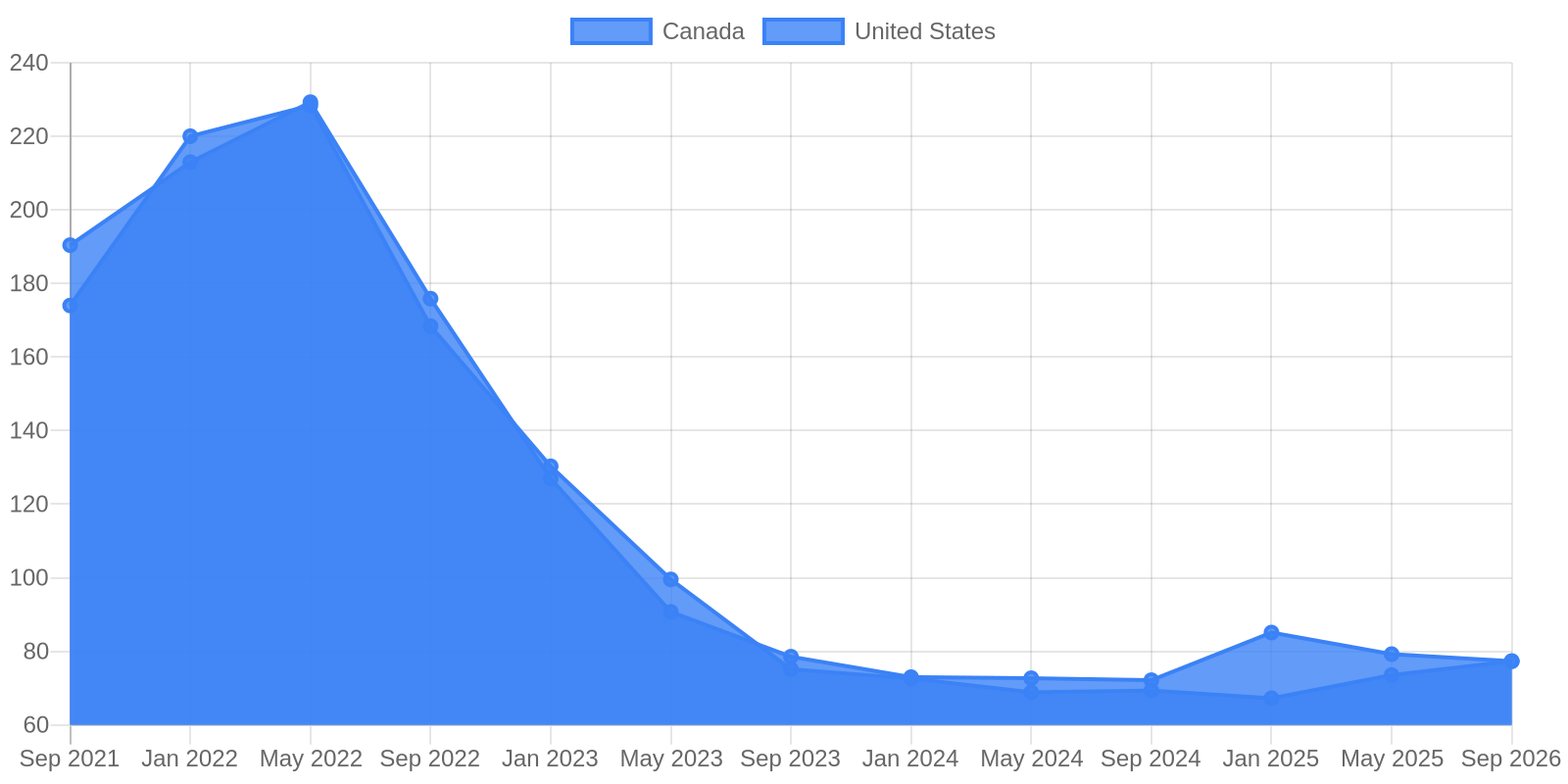
Canadian software development job postings (blue) and US postings (red) tracked closely from 2021 to 2023, diverged sharply in 2024-2025 with Canada leading, then converged again by September 2026. Index baseline: February 1, 2020 = 100.
The data tells a story of two markets that crashed together but are recovering on different timelines. Both countries peaked in early 2022—Canada hit 229.28 in May 2022, while the US reached 233.84 in February—then plummeted through 2023. Canada bottomed out at 70.65 in November 2023, while the US found its floor at 61.12 in May 2025, a full 18 months later. Since those lows, Canada's recovery has been steadier. From mid-2024 to now, Canadian postings climbed from around 68-69 to 77.32, gaining roughly 9 index points. The US, meanwhile, languished in the mid-to-high 60s through most of 2024 and early 2025, only recently converging with Canada in September 2026. The most revealing detail: in late 2024 and early 2025, Canada held a consistent 5-8 point lead over the US—the first time since the data began that Canada sustained higher posting levels than its neighbour.
The divergence wasn't random—it reflects the US tech sector's deeper structural upheaval. At least 127,000 US tech workers were laid off in 2025, following 237,000 cuts in 2024, with software engineers disproportionately affected. Companies like Meta, Microsoft, and Amazon cited AI automation as they cut engineering headcount by thousands, while Salesforce's CEO publicly stated the company might not hire any new engineers in 2025 due to productivity gains from AI agents. Canada avoided the worst of this carnage. While Canadian tech job postings fell in 2023, they stabilized faster, and active tech job postings reached 297,702 in 2025, reflecting continued employer demand. The US market, by contrast, remained "in the doldrums" through much of 2024, with software development postings flat for the second half of the year.
Why did Canada hold up better? Three factors stand out. First, Canada's tech ecosystem is less concentrated in the mega-cap giants that drove the US layoff wave. Toronto, Montreal, Vancouver, and Calgary have diversified tech scenes with smaller firms, consulting practices, and non-tech industries hiring developers—employers less exposed to Silicon Valley's AI-driven restructuring. Second, Canada's net tech employment grew by over 307,000 jobs since 2020, and tech roles are projected to grow twice as fast as the overall Canadian workforce through the next decade. That structural demand cushioned the downturn. Third, while US firms froze hiring to fund AI investments, Canadian employers—often lagging in AI adoption—kept hiring for traditional software roles. The result: Canada didn't experience the same AI-versus-headcount trade-off that hammered US postings. By mid-2025, when US postings finally bottomed and began climbing, Canada had already regained momentum, and the two markets converged in late 2026.
For Canadian SME tech leaders, the takeaway is clear: you're hiring in a market that's stabilized faster and may now be slightly ahead of the US recovery curve. That's an advantage, but it's fragile. As US postings rebound—potentially fuelled by AI-driven demand for specialized roles—competition for senior talent could intensify, especially if US firms re-enter the Canadian market with higher offers. The window to lock in strong hires at reasonable cost may be narrowing. At the same time, Canada's lead suggests your local talent pool is less scarred by mass layoffs and the churn that plagued US engineers. That could mean better retention and morale—if you act now, before the next wave of US hiring pressure hits.