

U.S. businesses just invested nearly $1 trillion in software over the past year, and the acceleration curve looks nothing like the steady climb we've seen for two decades. Between the first quarter of 2025 and mid-2026, software investment jumped by $143 billion — accounting for more growth in six quarters than the entire three-year period before it. The inflection point is unmistakable: from the Federal Reserve data, Q1 2025 saw software spending leap to $814 billion from $780 billion the previous quarter, a $34 billion quarterly increase that dwarfed the typical $5-7 billion gains of the prior two years. This isn't just another tech cycle — it's the moment artificial intelligence moved from PowerPoint to purchase order.
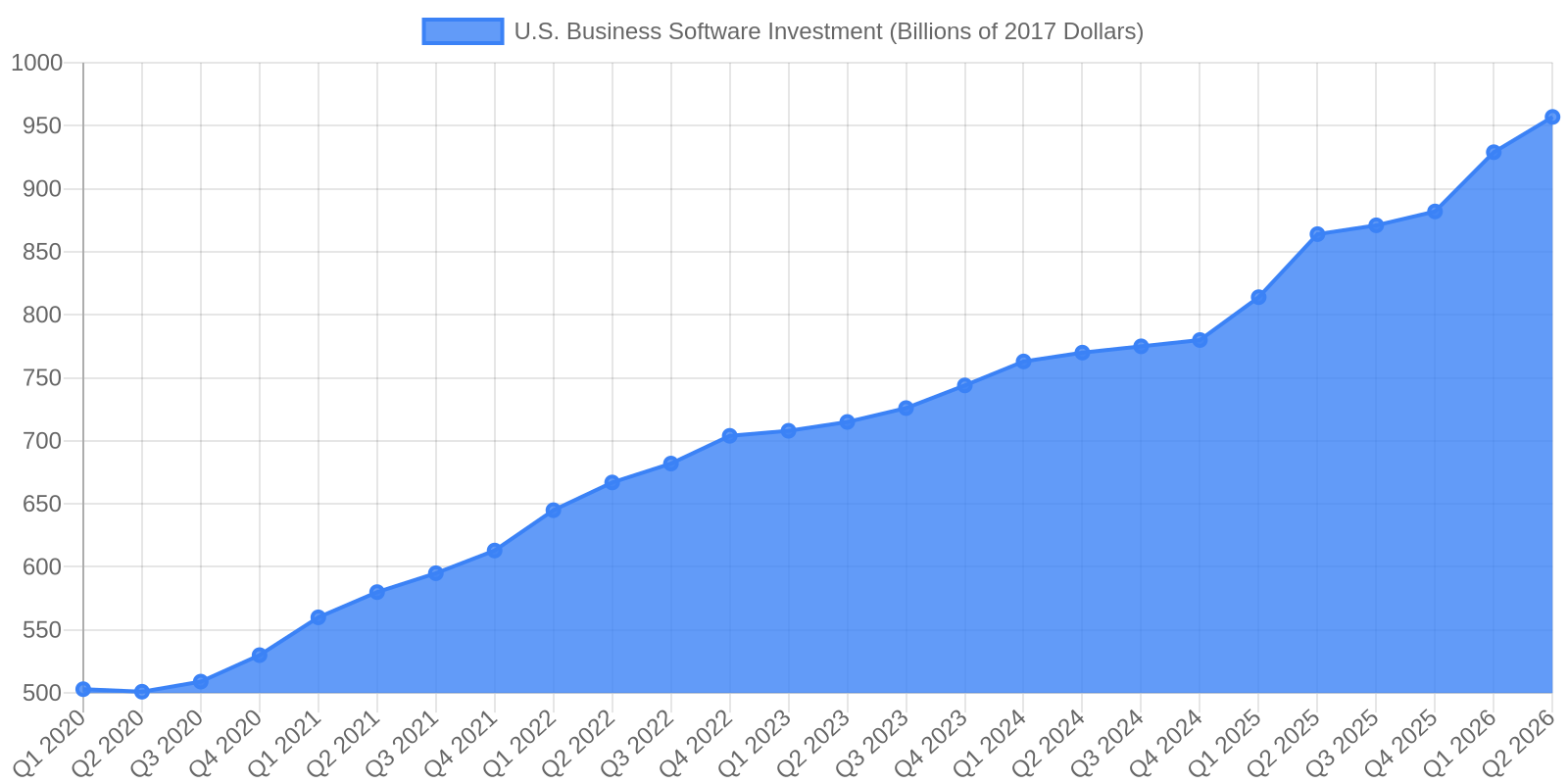
U.S. business software investment accelerated dramatically starting Q1 2025, with the $34 billion jump that quarter and $50 billion surge in Q2 2025 representing the sharpest quarterly increases in decades, driven primarily by AI-related infrastructure spending.
The chart tells a story in two acts. From Q1 2020 through Q4 2024, U.S. business software investment climbed from $503 billion to $780 billion — steady, predictable growth averaging about $12 billion per quarter. Then Q1 2025 hit with a $34 billion jump to $814 billion. Q2 2025 added another massive $50 billion surge to $864 billion, the single largest quarterly increase in the entire dataset. Growth briefly stabilized through Q3 and Q4 2025 at $871 billion and $882 billion respectively, before Q1 2026 delivered another explosive $47 billion leap to $929 billion. By Q2 2026, the figure reached $957 billion. In just six quarters, software investment grew 23% — more than the previous four years combined.
What changed? According to a Desjardins economic analysis, non-residential business investment became "a major contributor to growth in the first quarter" of 2026, with the performance "almost entirely driven by momentum related to artificial intelligence." The report specifically highlighted "annualized quarterly increases of 43.4% in I.T. equipment investment, 22.6% in software and 22.1% in data centre construction" — all AI-related categories surging in tandem. This wasn't companies upgrading their existing systems; it was an infrastructure buildout on the scale of electrification.
The business context explains the timing. Organizations increased AI compute spending 166% year-over-year in Q2 2025, according to enterprise AI adoption statistics. Enterprise spending on generative AI alone tripled from $11.5 billion in 2024 to $37 billion in 2025, Menlo Ventures reported. But the real acceleration came when businesses moved beyond experimentation. Four mega-tech companies — Alphabet, Amazon, Meta and Microsoft — anticipated capital spending of around $650 billion in 2026, up from "only" $359 billion in 2025, Axios reported. That's not venture capital or R&D budgets — that's committed infrastructure spending flowing directly into software platforms, cloud services, and AI development tools. Global VC investment reached $505B in 2025, up 30% year over year, with AI-native companies capturing a significant share, according to Sapphire Ventures' analysis. The Q1 and Q2 2025 jumps coincided with enterprises realizing that AI wasn't coming — it was already reshaping competitive dynamics, and sitting on the sidelines meant falling permanently behind.
The chart's trajectory raises an obvious question: when does this end? History suggests infrastructure booms don't stop on schedule — they overshoot, then correct. But the current spending wave has structural support that previous cycles lacked. Global spending on AI will rise by 47% year-over-year in 2026, totaling $2.59 trillion, Gartner projects, and AI investment is flowing into servers, semiconductors, memory storage, power infrastructure, data centers, software and research and development, according to Goldman Sachs economists. Unlike the dot-com era when revenue models remained theoretical, today's AI deployments are delivering measurable returns in coding productivity, customer service automation, and data analysis — the applications enterprises are actually paying for. The software investment surge isn't speculative froth; it's the cost of building the infrastructure that every knowledge-intensive business now considers essential. Whether that justifies a 23% increase in six quarters is a different question — but for now, CFOs are signing the checks.