
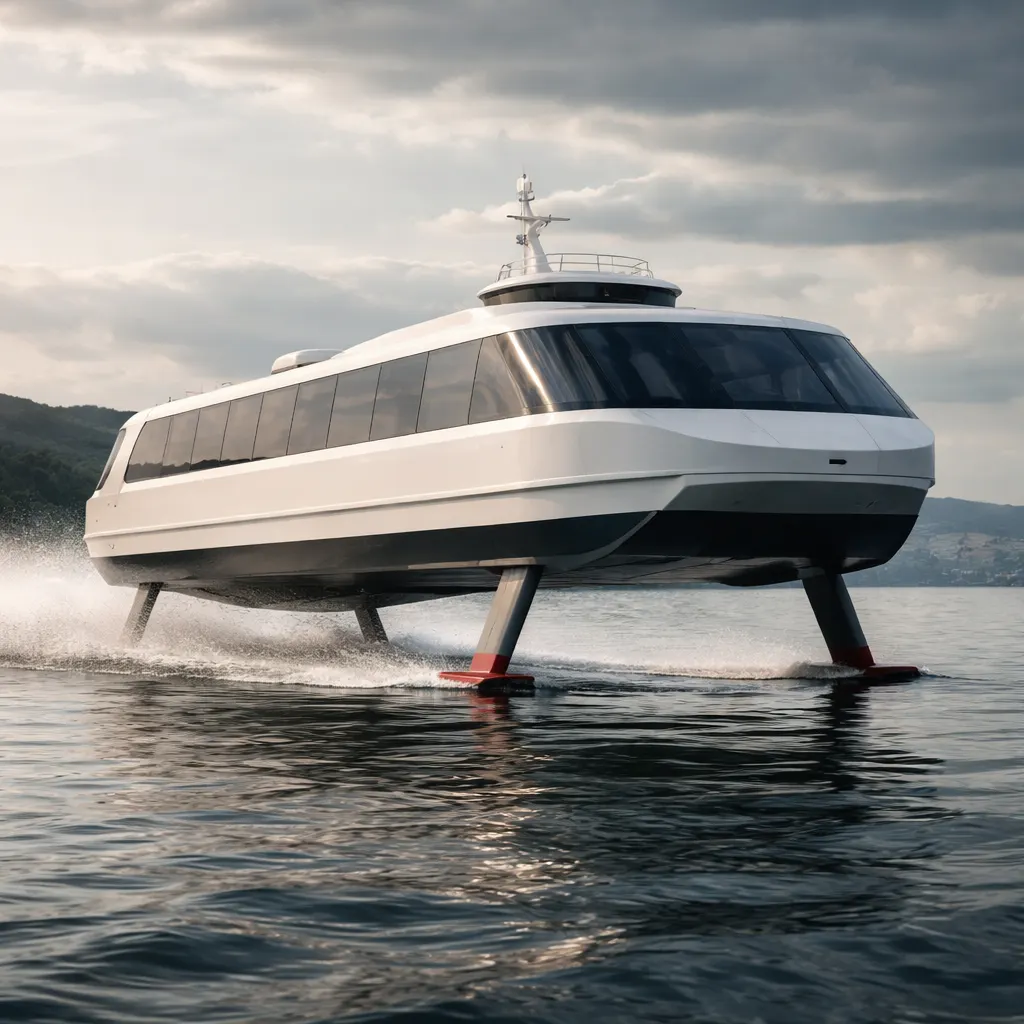
A startup called Vessev has built an electric ferry that rises above the water on wing-like structures, slicing through rivers and bays with minimal wake and enough range to carry passengers up to 46 miles on a single charge. The VS-9, a roughly 30-foot catamaran, uses underwater hydrofoils to lift its hull clear of the surface, enabling it to operate more efficiently than conventional boats—a crucial advantage for electric vessels where every kilowatt-hour matters. The design combines century-old hydrofoil technology with modern electric propulsion and computer-controlled flaps that keep the ride smooth and stable.
The VS-9 clears the water by about two and a half feet when sailing on its foils, with most of the lifting handled by the front foil and roughly 20% by the rear. The rear foil houses an electric motor that Vessev manufactures in-house, though the company sources its batteries from outside suppliers. The vessel can recharge using a standard EV charger and carry a full passenger load across 40 nautical miles, equivalent to 46 miles or 74 kilometers. When approaching docks in shallow water, the VS-9 can raise its foils to access areas where the underwater wings would otherwise scrape bottom.
According to Vessev co-founder and CEO Eric Laakmann, bringing motor production in-house early in development helps keep costs in line—eventually manufacturers have to internalize production, so the company chose to do it sooner rather than later. The batteries, however, "have been commoditized," Laakmann said. The transition from conventional sailing to hydrofoiling is subtle enough that passengers might not notice the moment when the boat begins almost-flying, and the ride feels more like a sports car than traditional boats of this size, which tend to bounce and slap the water as they accelerate.
Hydrofoils work best in waters the boat can clear when sailing on its foils—for the VS-9, that means conditions where waves stay below two and a half feet, since taller swells hit the hull and ruin the smooth ride while draining efficiency. The design isn't suited for open ocean but makes sense for lakes, rivers, and bays, which is why Vessev is targeting transit operations to start. Laakmann believes the pairing of electric propulsion and hydrofoils can lower operating costs for smaller vessels and make them comfortable enough to supplement urban mass transit systems—cities like New York could deploy them to shuttle people to Brooklyn or Queens without building much new infrastructure. Hotels and tour operators represent another early target market, and public demonstrations have already attracted wealthy individuals seeking another recreational vessel.
The VS-9 that recently carried passengers on New York's East River is currently one of a kind, but Vessev—which secured a $19 million Series A in August—plans to build more. Down the line, the company might pivot to producing electric hydrofoil kits that allow other boatbuilders to design their own vessels around the technology. The combination of lower drag, smoother rides, and electric power could open waterborne transit to routes that have been impractical or too expensive with conventional boats, turning underused rivers and bays into viable commuter corridors. Whether the technology scales beyond niche applications will depend on how well operators can manage the wave-height limitations and whether the cost savings justify the added complexity of computer-controlled underwater wings.