
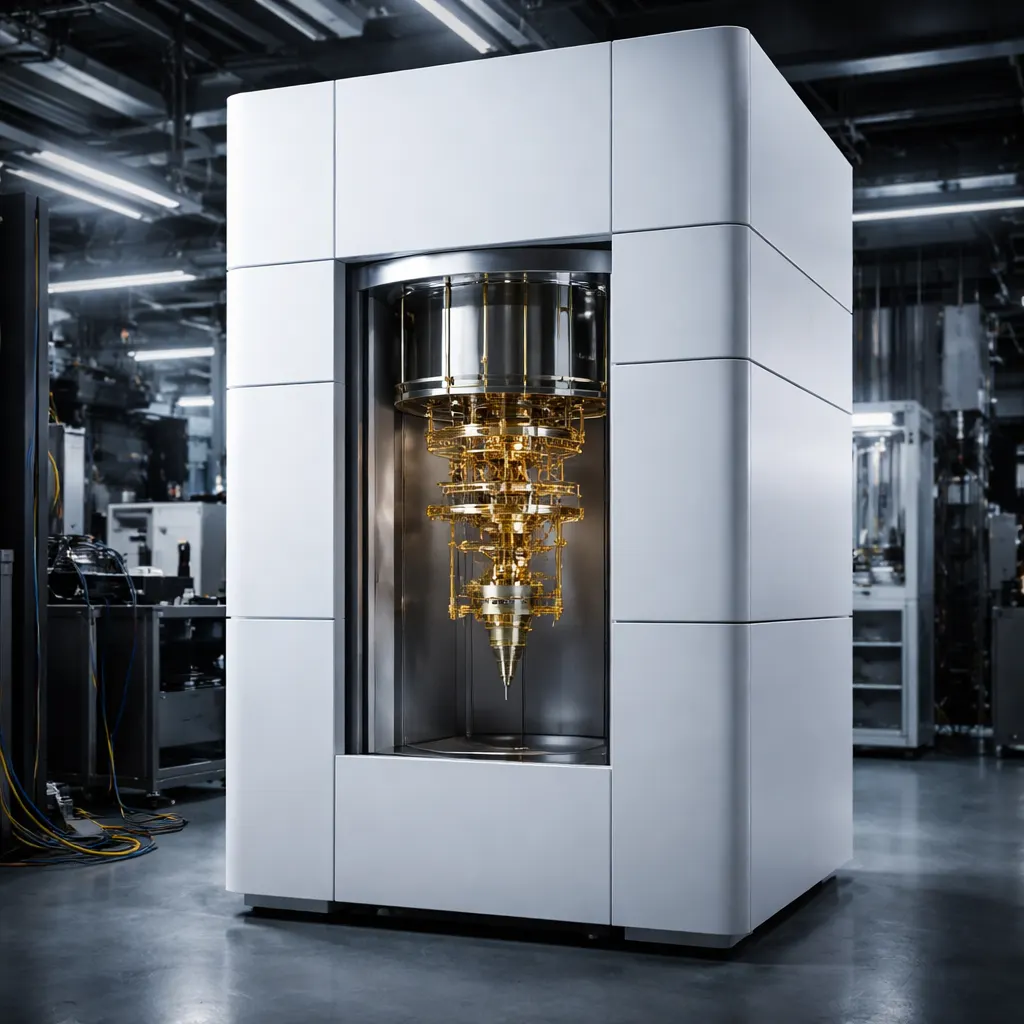
IBM announced Wednesday that it has constructed and successfully cooled the first two modules of a redesigned cryogenic dilution refrigerator built to accommodate the processors in its planned fault-tolerant quantum computers. The company plans to install one Nighthawk processor in each unit later this year, marking the first test of whether processors can function inside the new refrigerator and communicate across the connection between modules. That trial represents a critical milestone for IBM's quantum computing roadmap, which depends on the company's ability to link multiple individual processors and cryogenic modules into a unified system.
The first two connected modules stand roughly 8 feet tall and 8 feet wide and can achieve temperatures below 15 millikelvin, according to IBM. During testing, the company added a 30-microwatt heat load to mimic the processors, wiring, and electronics that will eventually occupy the interior, pushing operating temperatures to 23 millikelvin under that simulated load. Each new module offers approximately 12 times more wiring space than Quantum System One, the company's first commercial quantum computer introduced in 2019. IBM says its initial deployments will use two or three cells and support around 1,000 programmable physical qubits, with the upcoming Starling systems—the fault-tolerant computer slated for delivery in 2029—expected to require about 12 modules.
Jerry Chow, IBM fellow and chief technology officer for quantum-centric supercomputing, pointed out that building larger quantum systems extends beyond simply adding more qubits. "It's really about all the infrastructure and the supporting pieces around it as well in the system," Chow said. The report notes that IBM's best two-qubit operation across an L-coupler—a superconducting cable designed to carry microwave photons between chips separated by as much as a meter—has now reached 99.3% fidelity. The company aims to push that figure to 99.9% for its fault-tolerant systems. Oliver Dial, IBM fellow and vice president of quantum systems, identified reliability as the largest obstacle on the path to fault-tolerant machines, noting that systems must become 1,000 times more reliable as they scale from thousands of qubits to hundreds of thousands.
The modular design addresses a fundamental engineering challenge in quantum computing: superconducting quantum processors require operation at a fraction of a degree above absolute zero to minimize noise, one of the main threats to stable, long-running quantum computers. IBM's rectangular cells can be connected to create a shared ultra-cold environment for the processors, and because the system is modular, engineers can redesign and replace individual wiring assemblies for new processor generations without rebuilding the entire refrigerator. The company says it can build and test each cell before shipping it to a client site, where modules can then be connected into a larger system—an approach Dial says is more practical than constructing a single enormous vacuum chamber, which would be harder to manufacture, ship, and replicate. IBM expects to begin deploying these modular refrigerators next year, with the modular architecture allowing the company to place individual quantum processors closer together while providing the physical space needed for the control and readout wiring, shielding, cooling, and electronics that each processor demands. For organizations weighing investments in quantum infrastructure, the shift to modular cryogenics signals a maturation beyond prototype hardware toward systems engineered for repeatability and field deployment. The bet IBM is placing centers less on any single technical breakthrough than on the industrial discipline required to manufacture, cool, and wire thousands of fragile qubits reliably enough that error correction becomes practical rather than aspirational.