
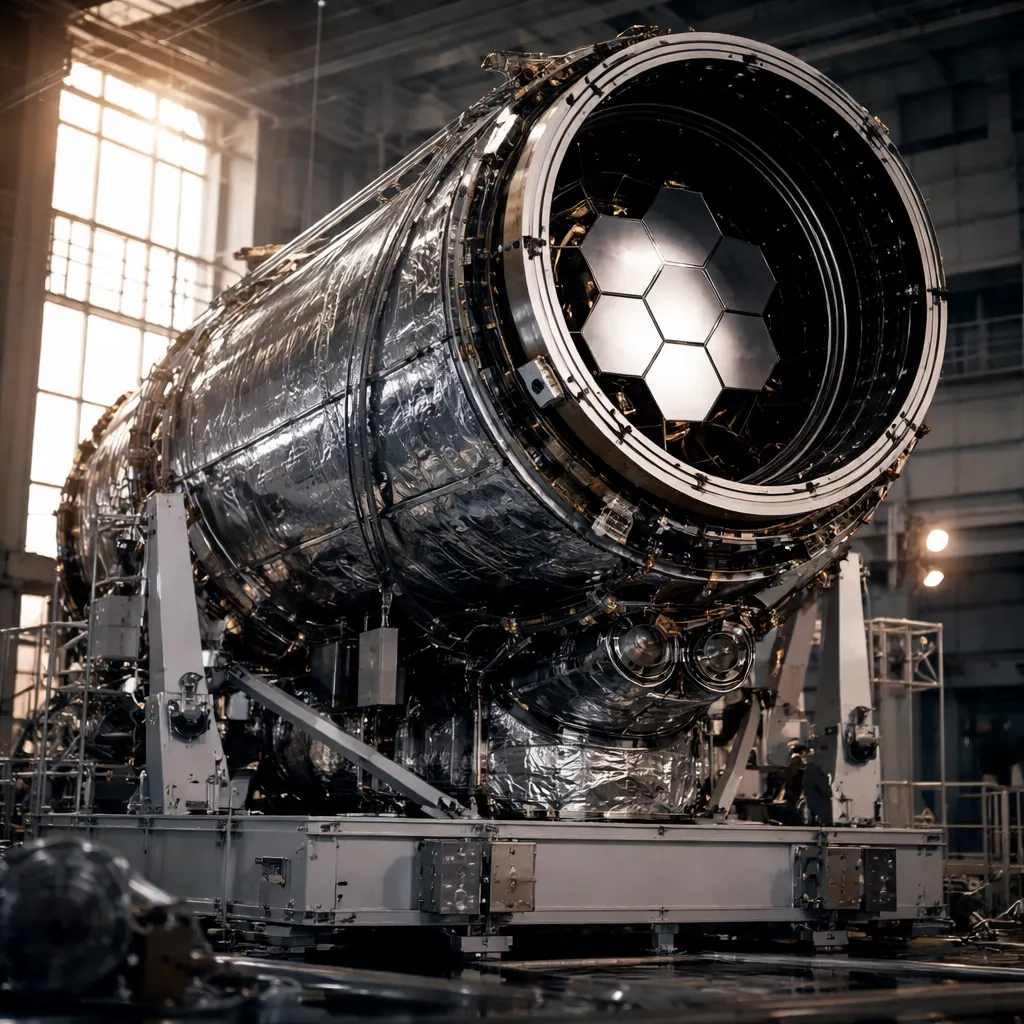
NASA's Nancy Grace Roman Space Telescope, scheduled to launch from Kennedy Space Center in Florida at the end of August, can detect asteroids as small as 60 feet in length—comparable to the space rock that exploded over Chelyabinsk, Russia in 2013 with the force of 500,000 tons of TNT. A multi-institutional team of planetary scientists and astronomers will present their proposal in September at the Europlanet Science Congress in The Hague, outlining how the telescope's unique capabilities could help defend Earth from potentially hazardous asteroids. While Roman was built to study dark matter, dark energy, and distant galaxies, researchers say it could serve double duty as a planetary defense tool.
The telescope is equipped with a 300-megapixel infrared camera that can view a patch of space roughly 100 times larger than what the Hubble Space Telescope can see at once. Around 25,000 asteroids measuring 460 feet or longer are estimated to have near-Earth orbits, and just over half remain undiscovered. An additional 230,000 asteroids roughly 165 feet long are thought to orbit close to Earth, with fewer than 10% currently located. A strike from one of the smaller asteroids on a city would unleash a force comparable to a large atomic bomb without the radiation, while a hit from a 460-foot-long asteroid would destroy or irreversibly damage much of an urban area in an instant.
"Roman can provide infrared observations of more asteroids than JWST could hope to observe in a reasonable amount of observing time," says Bryan Holler, a researcher at the Space Telescope Science Institute in Baltimore. According to the proposal, Roman's infrared scope allows it to offer a decent estimate of an asteroid's size and can even determine whether it's a stony rock, a carbon-rich rock with water content, or a metallic object. The telescope's software will require adjustments to identify space rocks, since it's currently designed to catch and discard streaks caused by cosmic rays, glitches, or asteroids to gather the clearest possible images of the distant universe.
Roman's strength lies in its ability to work alongside other observatories, particularly the James Webb Space Telescope and the Near-Earth Object Surveyor launching in 2027. NEO Surveyor will position itself between Earth and the sun to find elusive asteroids that ground-based telescopes can't see, and could locate 90% of city-killer-size asteroids in near-Earth orbits within years. When NEO Surveyor spots multiple asteroids with uncertain orbits, Roman can look at all of them quickly thanks to its wide field of view, improving orbital precision by several orders of magnitude in days. Roman occupies a different part of space from NEO Surveyor and the Vera Rubin Observatory in Chile, which just began a 10-year survey expected to discover 89,000 near-Earth asteroids. Those different viewing angles help narrow down orbits faster than if all instruments were looking from the same location, allowing Roman to help scientists "make sure we follow up on the correct targets" when telescope resources are oversubscribed and can't track every newly discovered asteroid with a non-zero impact probability.
The proposal emerged last summer after the Trump administration once again threatened Roman with significant funding cuts. Rick Cosentino, a planetary scientist at NASA, told Holler in July 2025 that demonstrating Roman's planetary defense capabilities could increase the mission's visibility with lawmakers and taxpayers. Roman's infrared vision allows it to see asteroids more clearly than visible light telescopes, and provides considerably better measurements of their size. The telescope can also help determine an asteroid's composition, density, and mass—critical information for estimating impact damage or calculating the effort required to nudge it out of its current orbit, whether by ramming a spacecraft into it or potentially vaporizing it with a nuclear weapon. While Roman won't lead planetary defense efforts the way NEO Surveyor will, it will contribute to protecting Earth's 8 billion inhabitants from cosmic catastrophes while pursuing its primary mission of discovering thousands of new planets, tens of thousands of exploding stars, and surveying over a billion galaxies. For a telescope designed to peer into the universe's deepest mysteries, Earth's safety may prove an unexpectedly valuable side benefit—one that could justify continued investment even as budget pressures mount.