
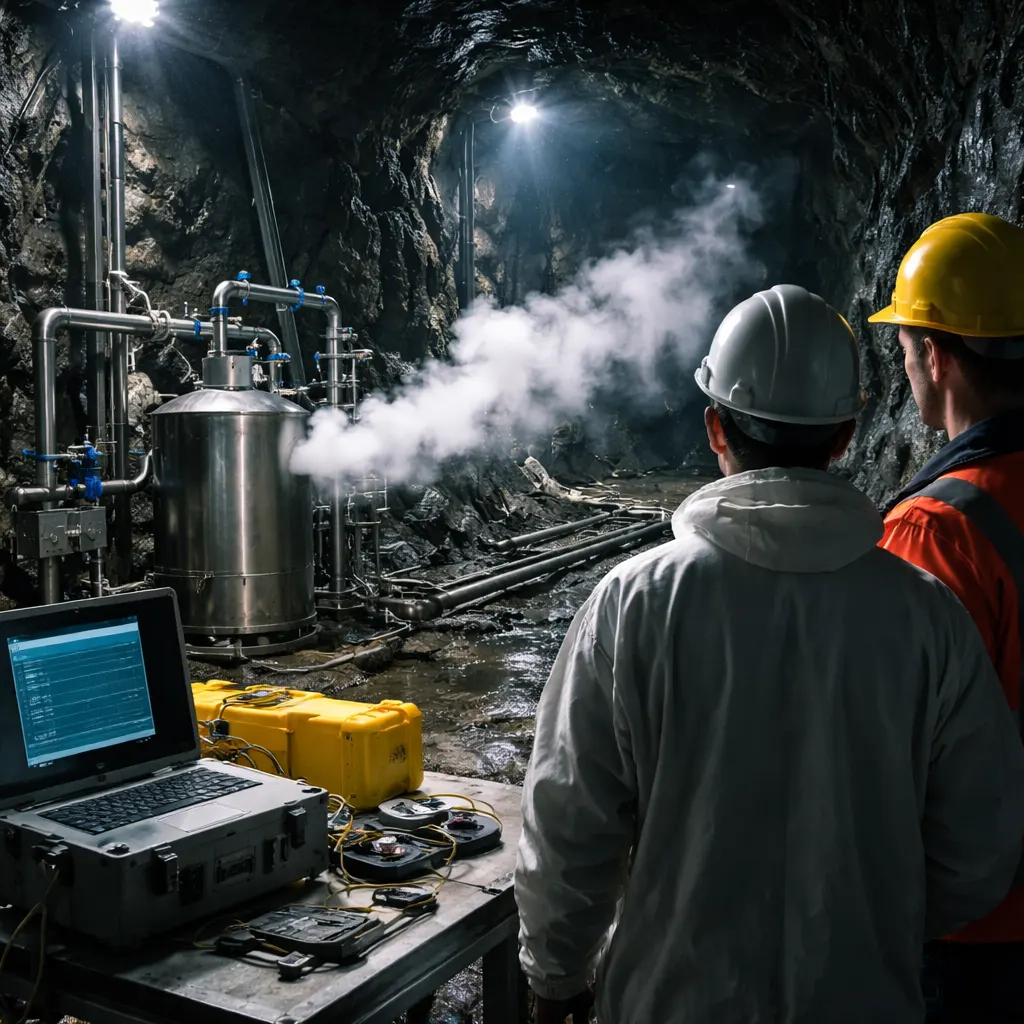
A team of geochemists has documented that roughly 140 metric tons of hydrogen escape unused from the vents of Ontario's Kidd Creek mine each year, according to findings published earlier this year in the journal PNAS. Barbara Sherwood Lollar, a geochemist at the University of Toronto, and her colleague Oliver Warr analyzed data from 35 boreholes at the mine and discovered that each one steadily released an average of eight kilograms of hydrogen annually. While the amount isn't world-changing, the research adds to mounting evidence that naturally occurring underground hydrogen—called "geologic hydrogen"—could offer a zero-carbon fuel source if companies can figure out how to capture and use it economically.
The Kidd Creek findings emerged from more than a decade of measurements at the mine, which descends over three kilometers into ancient North American bedrock. The hydrogen forms when water reacts with iron-rich rock or when radioactive decay of other elements splits water molecules underground. Sherwood Lollar's team had originally discovered billion-year-old water in the mine during the 1990s, along with microbes living off the hydrogen it produced. By scaling up the eight-kilogram-per-borehole rate across Kidd Creek's more than 14,000 boreholes, the researchers arrived at their 140-ton annual estimate. That volume, if fully captured, could power a substantial portion of the mine's own operations, Sherwood Lollar says. Similar work at Albania's Bulqizë chromium mine documented at least 200 metric tons of hydrogen flowing out each year, reported in 2024 by Laurent Truche's team at the University of Grenoble Alpes in France.
According to Truche, "the remaining challenge is not proving that natural hydrogen exists, but proving that it can be produced economically and reliably at commercial scale." Sherwood Lollar frames the Kidd Creek tally as a potentially valuable local demonstration that geologic hydrogen can actually be put to use. Researchers at the US Geological Survey have calculated that trillions of tons of H2 are generated within Earth's crust, and if even a small fraction could be recovered, it might satisfy global hydrogen demand for centuries. Yet the hunt for commercially viable reservoirs has so far fallen short, with no company reporting a discovery that pencils out financially, and public data remaining scarce as startups like Australia's HyTerra and Bill Gates–backed Koloma compete for investors.
The stakes matter because conventional hydrogen production typically generates large volumes of greenhouse gases and consumes more energy than the resulting fuel contains. Tapping ready-made underground reserves would flip that equation. Dozens of exploration efforts have now spread worldwide, targeting ancient oceanic rocks associated with hydrogen formation. More than a dozen projects funded by ARPA-E are exploring whether injecting water, heat, or catalysts into reactive rock could stimulate production, with a goal of accelerating the hydrogen-producing reaction by a factor of 10,000—the rate researchers estimate would make stimulated production commercially viable. Earlier this year in Oman's mountains, a team drilled a one-kilometer borehole, injected 50,000 cubic meters of water, and months later opened the well to find gas spewing out at 90% hydrogen. Jo Shannon, a geoscientist at the University of Southampton in the UK, called it a promising sign but cautioned that the most crucial unknown remains unanswered: whether the hydrogen rose up through stimulation or had been there all along.
The growing body of evidence confirms that natural hydrogen generation and migration are genuine geological processes, researchers say. The question now shifts from whether geologic hydrogen exists to whether it can be extracted at scale and at a price that works. Capturing even modest flows like Kidd Creek's 140 tons could demonstrate the viability of the approach and open the door to larger commercial ventures. The race to prove the concept has engaged startups and government funding alike, with the next phase hinging on whether stimulated production can reach the breakneck pace needed for profitability. If the early signals from Oman and Albania hold up under scrutiny, underground hydrogen could become a meaningful piece of the zero-carbon energy puzzle within the decade. For now, the industry faces a classic chicken-and-egg problem: investment flows to proven reserves, but proving reserves requires the capital to drill and test at scale. The path forward will likely depend on whether a handful of early projects can thread that needle and deliver both technical proof and economic returns.