
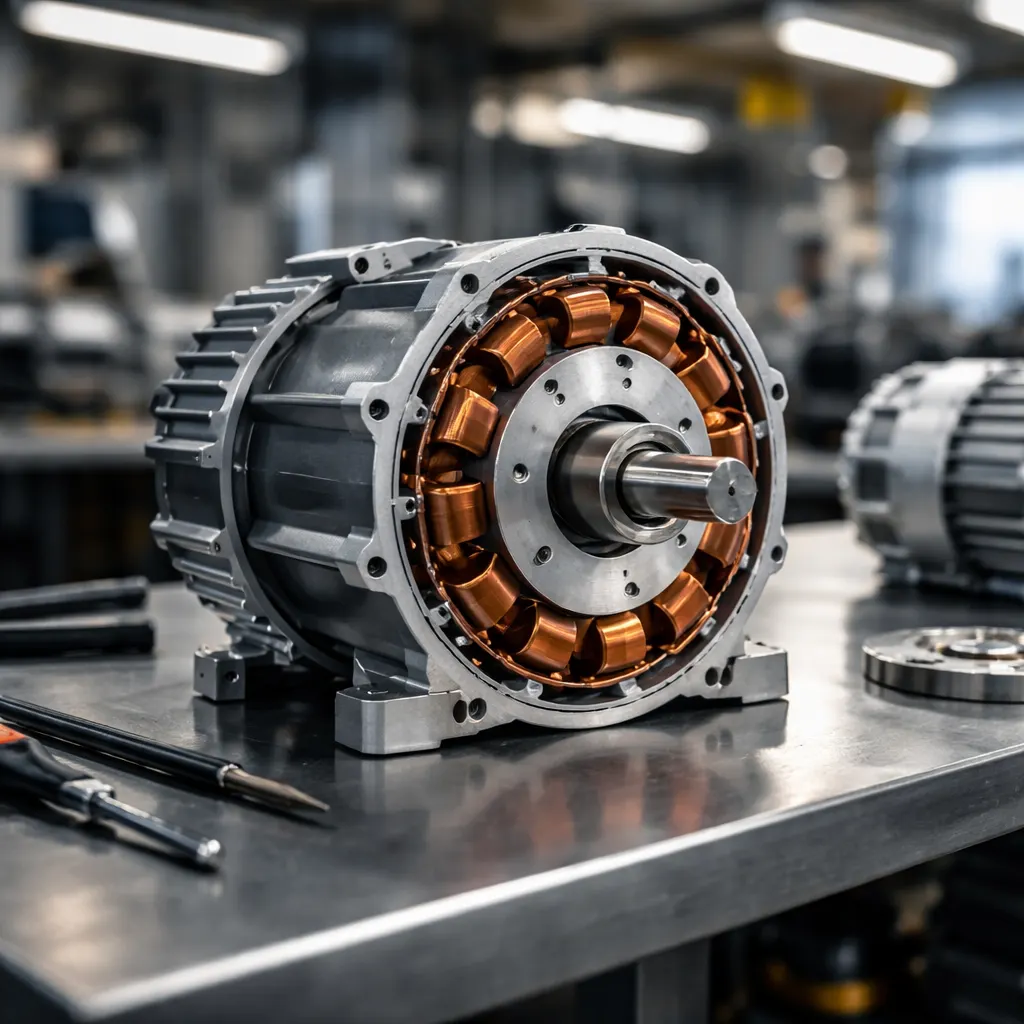
A new startup wants to build electric motors in the United States without any rare-earth magnets, aiming to cut China completely out of the supply chain. Michael Van Steenburg, founder of Modal Motors, announced the approach as his company prepares to compete in Startup Battlefield 200 at TechCrunch Disrupt next month, according to a September 23, 2026 report in TechCrunch. Van Steenburg spent the past ten years manufacturing electric motors domestically and across North America, and believes his rare-earth-free design offers a faster path to true supply chain independence than competitors who continue depending on those materials.
Modal Motors is building two products ahead of Disrupt. The first is a compact electric motor designed for drones that can also power fans, blowers, and actuators, engineered to reduce weight while maximizing torque density and efficiency, the company's website states. The second, more ambitious design is called the "Hybrid Enigma Drive," a flat electric motor that fits into tighter, lower-profile spaces. Van Steenburg is pulling from decades of automotive industry experience to bring these motors to market, including work in the late 1990s on a hybrid gas-electric drivetrain that China wanted for its "People's Car."
"China's already flexed its muscles a couple times," Van Steenburg said, pointing to the country's restrictions on rare-earth product access. He argues that other companies attempting to reshore electric motor production are making a critical mistake by copying Chinese motor designs and hoping domestic rare-earth magnet supply chains mature quickly enough. According to Van Steenburg, those materials remain years away from adequate U.S. production. "Other people are 'reshoring,' [but] they're basically knocking off Chinese motors and just doing it in the U.S.," he explained. "It's going to still be a while longer before they can actually replace China."
The founder sees his work as urgent because of what he's watched unfold over the past quarter-century. "I always tell people that the clock started ticking 25 years ago, and in that whole time, I've watched a slow-motion train wreck as China's been going around the world, grabbing mines, grabbing mineral rights, doing all these things, and slowly but surely monopolizing the entire rare-earth supply chain," Van Steenburg told TechCrunch. He describes himself as maintaining an outsider mentality and firm belief in tackling difficult challenges, traits he says haven't shifted despite the irony of now working to make Modal Motors a China-free alternative after helping the country develop hybrid technology decades earlier. Van Steenburg believes the pitch is timely as manufacturing discussions intensify around hard tech sectors like drones and robotics, where domestic production is becoming a strategic priority. Companies that wait for rare-earth magnet supply chains to catch up may find themselves stuck in dependency longer than anticipated, while designs that eliminate those materials entirely could reach market and scale faster.