
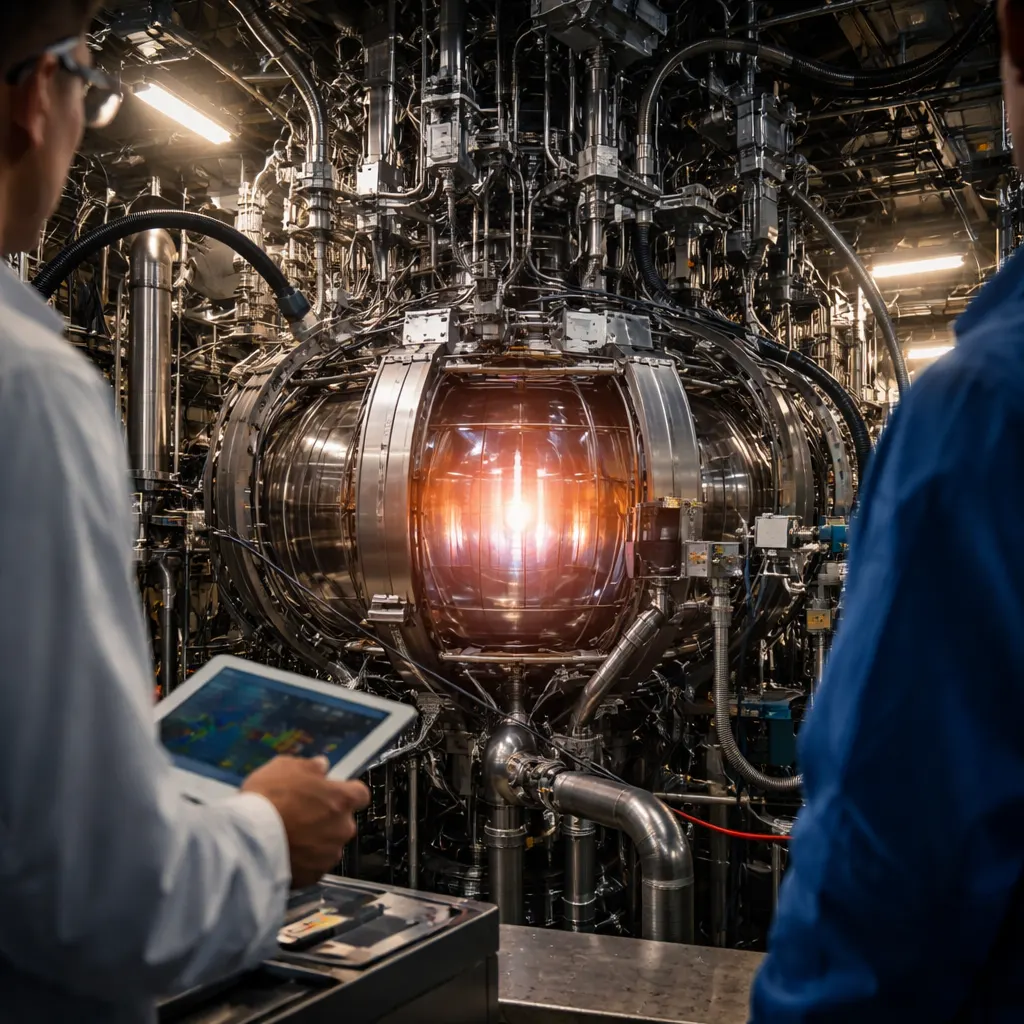
Researchers at the UK Atomic Energy Authority say they've overcome plasma instability issues that have long blocked the path to commercial fusion power plants. Scientists working on the MAST (Mega Amp Spherical Tokamak) Upgrade installation at UKAEA's Culham Campus in Oxfordshire ran a fifth series of experiments during 2025 and 2026, generating more than 1,100 fusion plasmas. The team achieved the highest pressure ever recorded with the MAST Upgrade machine without the super-hot plasma becoming unstable.
The experiments tackled a critical challenge: suppressing instabilities called Edge Localised Modes, or ELMs, which are sudden bursts at the plasma's outer edge. These events can drain up to a tenth of the plasma's stored energy in a single occurrence and cause a loss of plasma pressure, according to the report. Over time, these bursts damage the tokamak's inner wall and exhaust components, making them a serious roadblock to commercial viability. The team used two previously tested techniques to prevent these destructive heat bursts: Quasi-Continuous Exhaust mode (QCE-mode) and Resonant Magnetic Perturbations (RMP). The scientists also gained access to two additional stable operating regimes known as Quiescent H-mode (QH-mode) and I-mode (Intermediate-mode), both improved plasma confinement techniques that deliver better energy confinement while reducing problems associated with large ELMs.
"These findings take us another step closer to practical fusion energy," said James Harrison, head of MAST Upgrade science at UKAEA. According to Harrison, "the results genuinely shape the design of future fusion power plants." The team reports that accessing four stable high-performance plasma regimes shows that MAST Upgrade is producing science at the leading edge of what's possible. The Culham scientists also developed a technique for controlling the plasma's position by measuring visible light created by deuterium emitted from the machine's upper and lower outer divertors, allowing minute positional imbalances to be detected in real-time.
The breakthroughs matter because they address the fundamental obstacles that have kept fusion power perpetually decades away from commercial reality. QCE-mode works by creating high-frequency, low-amplitude filaments at the plasma edge that bleed off pressure before it can build to destructive levels, while RMPs use a magnetic field to induce small perturbations at the plasma's edge that drain the pressure leading to ELMs. QH-mode tackles ELMs using an edge electromagnetic instability called the Edge Harmonic Oscillation to steadily remove excess heat, while I-mode features a steep thermal barrier at the edge that allows particles to escape, preventing pressure buildup. The experiments also explored "negative triangularity" plasma shapes that enable high-power operations without ELMs, an approach being closely watched by the international fusion community. Detecting changes in position represents a step toward automated, real-time control systems that future commercial power plants will need to operate without constant manual intervention.
The MAST Upgrade installation is set to receive further enhancements this year, including two new neutral beam injectors that will double the machine's heating capacity and the installation of an Electron Bernstein Wave system that will provide an additional 1.6 MW of heating power. Following this upgrade, a sixth series of experiments is planned for 2028. EBW systems use high-frequency, electrostatic plasma waves to heat and drive currents in dense fusion plasmas, and the technology is planned for use in STEP (Spherical Tokamak for Energy Production), the UK's pilot fusion power plant to be built at the site of a former coal power station in Nottinghamshire. Earlier this year, the UKAEA published a roadmap of targets it wants scientists to hit before the end of the decade to drive forward development of working commercial fusion reactors. The plasma control techniques developed at Culham could determine whether the long-promised transition from experimental physics to grid-scale energy generation actually happens, and whether utilities will need to rethink infrastructure planning around a technology that's been perpetually out of reach.