
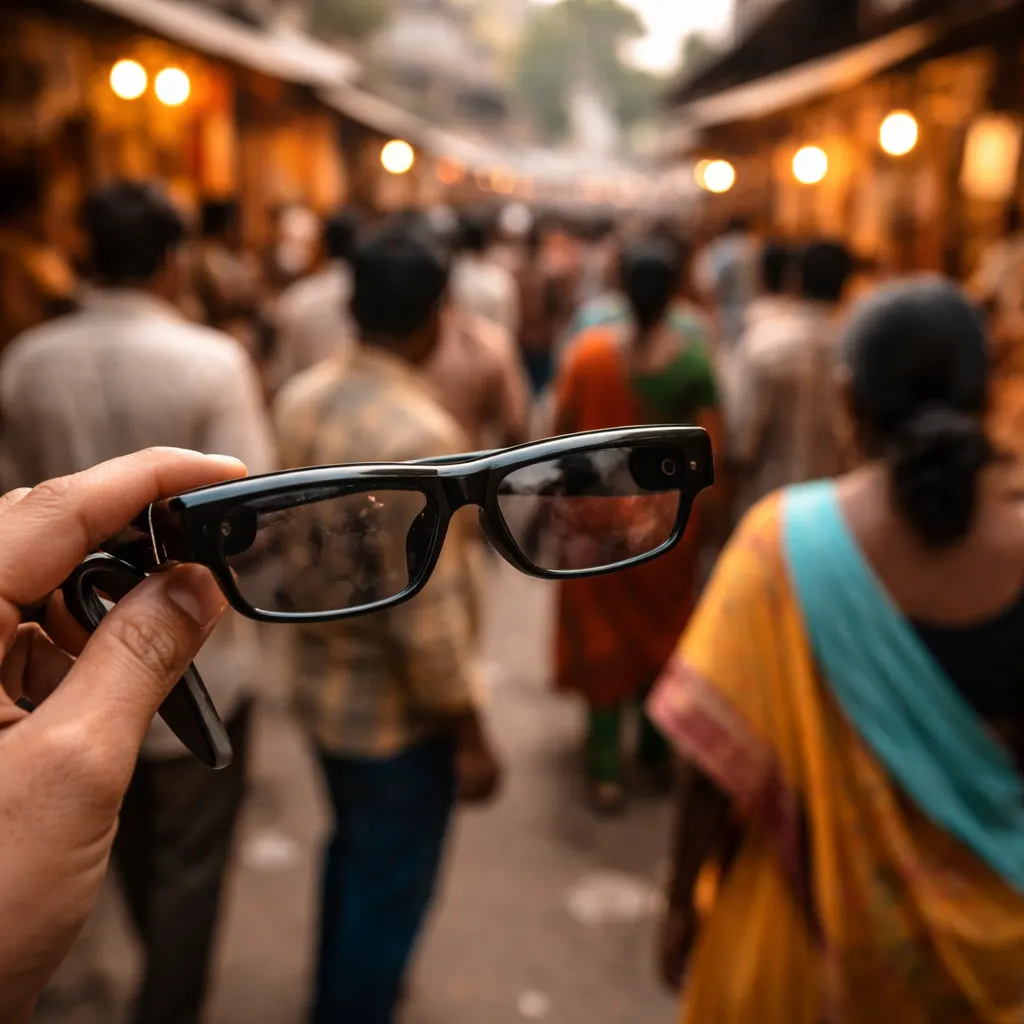
A transgender graphic designer in Delhi was filmed without consent at a protest using Meta smart glasses disguised as ordinary sunglasses, according to a report published by MIT Technology Review on September 23. The resulting video drew millions of views and sparked waves of transphobic abuse, forcing the subject to abandon wearing traditional clothing in public. The report warns that privacy violations from inconspicuous recording devices are becoming especially severe in India, where covert filming and nonconsensual image circulation are already widespread.
Smart glasses rank among the fastest-growing devices in India's wearables market, according to research firm International Data Corporation cited in the report. Reliance Jio, one of the country's largest telecommunications companies, plans to launch a smart glasses product priced below $105 later this year, competing with Meta's model that carries a $420 price tag in India. Delhi police used Meta smart glasses to record thousands of student demonstrators protesting education system problems in June, filming continuously for weeks including during meals and rest periods, according to a petition filed before the Delhi High Court. The report documents that police threatened to send footage of student protesters to their parents and colleges, and India's solicitor general dismissed the case in July as "luxury litigation." Instead of investigating complaints, police opened 10 criminal investigations against the students for offenses including rioting and assault on public servants.
The core privacy problem is that these cameras don't resemble cameras, making it difficult for targets to realize they're being recorded, according to Janusz Świerczyński, an Oxford Saïd Business School researcher who studies privacy and emerging technology quoted in the report. "More and more, the expectation is being placed on bystanders to look out for themselves," he says. Meta relies on a small LED light in the glasses frames that activates during recording, but creators have already demonstrated ways to circumvent it, with tutorials showing users how to cover or obscure the indicator while continuing to film. The report cites Wired's March documentation of a market for "stealth mode" modifications that physically disable or remove the light entirely. Sameer Parmar, a counselor at Meri Trustline, a safety partner working with Meta and YouTube, told the publication that "the hardware is improving, but the country's weak understanding of consent gives an invisible camera far more room to cause harm."
Women and other marginalized groups face greater harm when inconspicuous devices capture and circulate footage without consent, the report finds. India's laws against voyeurism and sharing intimate images were designed around more recognizable forms of abuse like secretly filming someone undressing or using a toilet, offering limited protection when someone is secretly filmed in an ordinary public setting and the footage is then used to humiliate them, according to Apar Gupta, a lawyer and founder-director of the Internet Freedom Foundation. Under India's current rules, platforms can have up to 36 hours to act on certain complaints, a window that can be long enough for a video to be downloaded, copied, and circulated elsewhere, the report states. People are recorded in medical settings, during private encounters, and in public spaces, with those having less power to object particularly vulnerable, according to counselor Parmar, who says abusers "do target people who are a little more unaware or susceptible to how this technology-facilitated harm works."
The problem seems set to grow, the report warns. According to the Financial Times cited in the article, some internal prototypes of new Meta glasses include AI features that continuously photograph and listen to the wearer's surroundings, enabling the glasses to later recall what they saw or heard without activating the external recording indicator. Tech companies have an incredible ability to push these tools out faster than society can meaningfully acclimate to the threat, according to Woodrow Hartzog, a professor of law at Boston University quoted in the report. "By the time society catches up, there's already a degree of normalization," he says. For the subject of the viral video, the danger isn't just that people may become accustomed to being recorded, but that they'll become accustomed to seeing versions of themselves they never chose to put out into the world. The chances of a crackdown on technologies such as smart glasses are slim, given that Indian law enforcement authorities are themselves increasingly adopting AI-powered surveillance tools, including facial recognition systems and their own AI-enabled smart glasses, the report concludes. Policymakers face a fundamental choice between maintaining surveillance capabilities for state actors while attempting to protect citizens from the same tools in private hands, a tension that may prove impossible to reconcile without broader reforms to consent frameworks and platform accountability timelines.