
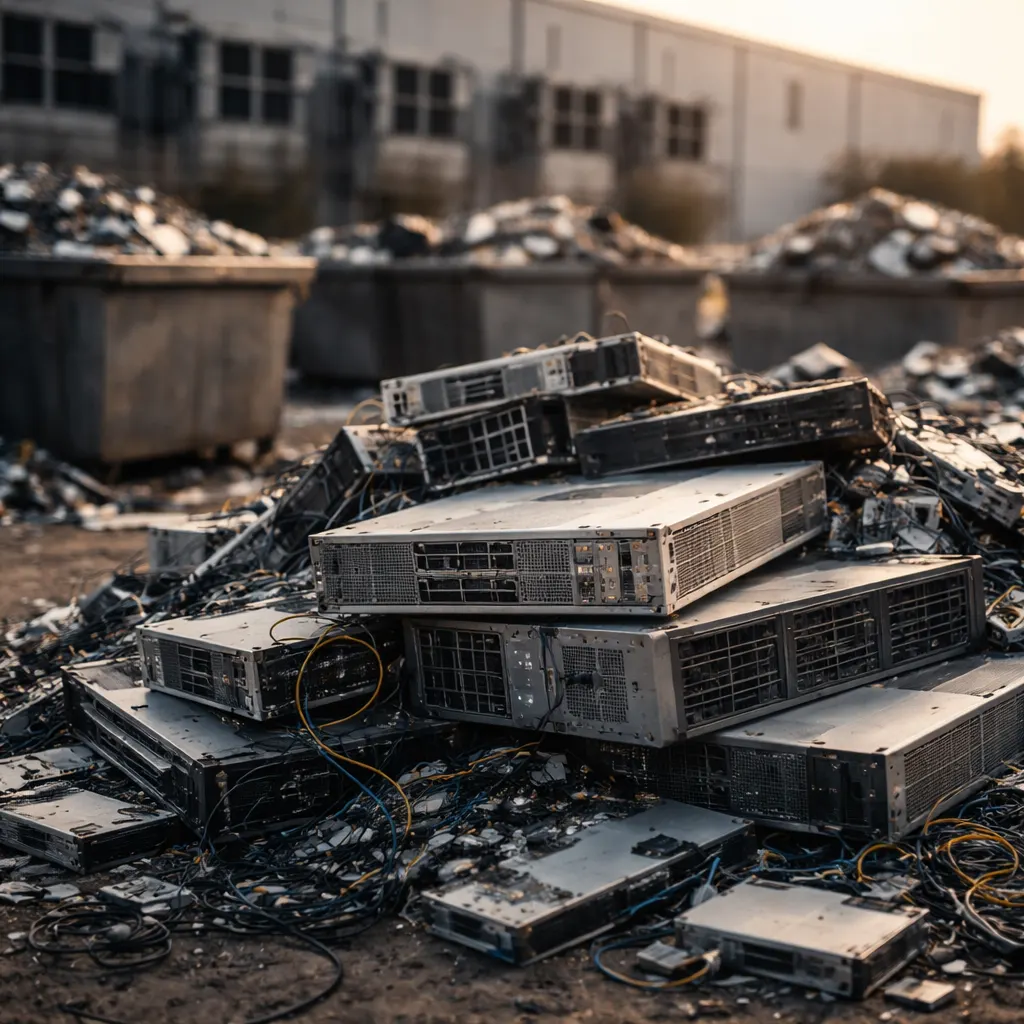
Previous estimates of electronic waste from artificial intelligence infrastructure have overlooked 87% of the equipment that becomes trash, according to a report from the Basel Action Network (BAN), an NGO that monitors enforcement of a 1989 United Nations treaty restricting hazardous waste shipments between wealthy and developing nations. Earlier calculations focused almost exclusively on servers and accelerators, which make up just 13% of a data center's electromechanical systems, while ignoring the vast majority of hardware that also qualifies as e-waste. The group projects that AI-related equipment alone will generate between 31 and 46 million metric tonnes of waste annually by 2050.
The report identifies five equipment categories beyond servers and accelerators that contribute roughly 70,000 metric tonnes per gigawatt of capacity: networking gear, power distribution systems, storage and backup equipment, and cooling infrastructure. By 2030, the study forecasts that AI-driven electronic equipment retirement will reach volumes approximately 40 to 60 times higher than the most frequently referenced academic projection, primarily because earlier work tallied only servers and GPUs. Total global e-waste generation is expected to hit between 196 and 211 million metric tonnes per year by 2050, more than triple the roughly 67 million metric tonnes the world produces today. The data center industry's operational approach and rapid GPU generational changes are already compressing AI equipment lifespans to between 2.5 and 5 years, shorter than conventional replacement cycles would predict.
"Previous quantitative AI e-waste estimates have underestimated the coming volumes, as they focused overwhelmingly on servers and accelerators," the report stated. The authors note that cooling accounts for 35% of a reference facility's infrastructure mass, power distribution represents 34%, backup power makes up 15%, servers and accelerators constitute 13%, and networking contributes 3%. BAN cross-referenced these figures against the World Economic Forum's mineral-intensity data and Microsoft's disclosed copper consumption at a Chicago facility. According to the report, enterprise IT fails to account for much of this hardware when calculating environmental and ROI impact from replacing data center systems, and tends to discard equipment far too quickly.
The accelerated obsolescence stems from AI's demand for different power density, cooling capacity, networking speed, and rack architecture, even when older equipment still functions perfectly, according to the report. The study assumes an 8.8% compound annual growth rate in data center capacity sustained for 26 consecutive years and a 2.5-year retirement cycle for accelerators specifically. IT leaders purchasing AI infrastructure should treat lifecycle and end-of-life impacts as an architectural and procurement requirement, tracking not only compute equipment but also supporting systems, batteries, refrigerants, suppression agents, reuse potential, and responsible recovery or disposal. CIOs should place a lifecycle model alongside the capacity model, asking what happens to equipment at refresh, what can be redeployed into lower-tier workloads, what residual value remains, whether systems are modular enough to upgrade selectively, and what vendors commit to around take-back, reuse, and recovery. Government oversight frameworks being discussed should consider requiring lifecycle transparency for large AI and data center developments, including equipment lifespans, material turnover, reuse, batteries, refrigerants, and fire suppression agents, so that oversight reflects the full infrastructure footprint rather than electricity or water consumption alone. AI has largely been discussed as a software, compute, and energy story, but it's increasingly becoming a materials and lifecycle management story as well. Organizations racing to deploy AI capacity may discover that the hidden cost isn't just energy bills but the mountain of perfectly functional hardware rendered economically obsolete every few years. The procurement decisions enterprises make today will determine whether tomorrow's AI breakthroughs come with a landfill's worth of consequence.