
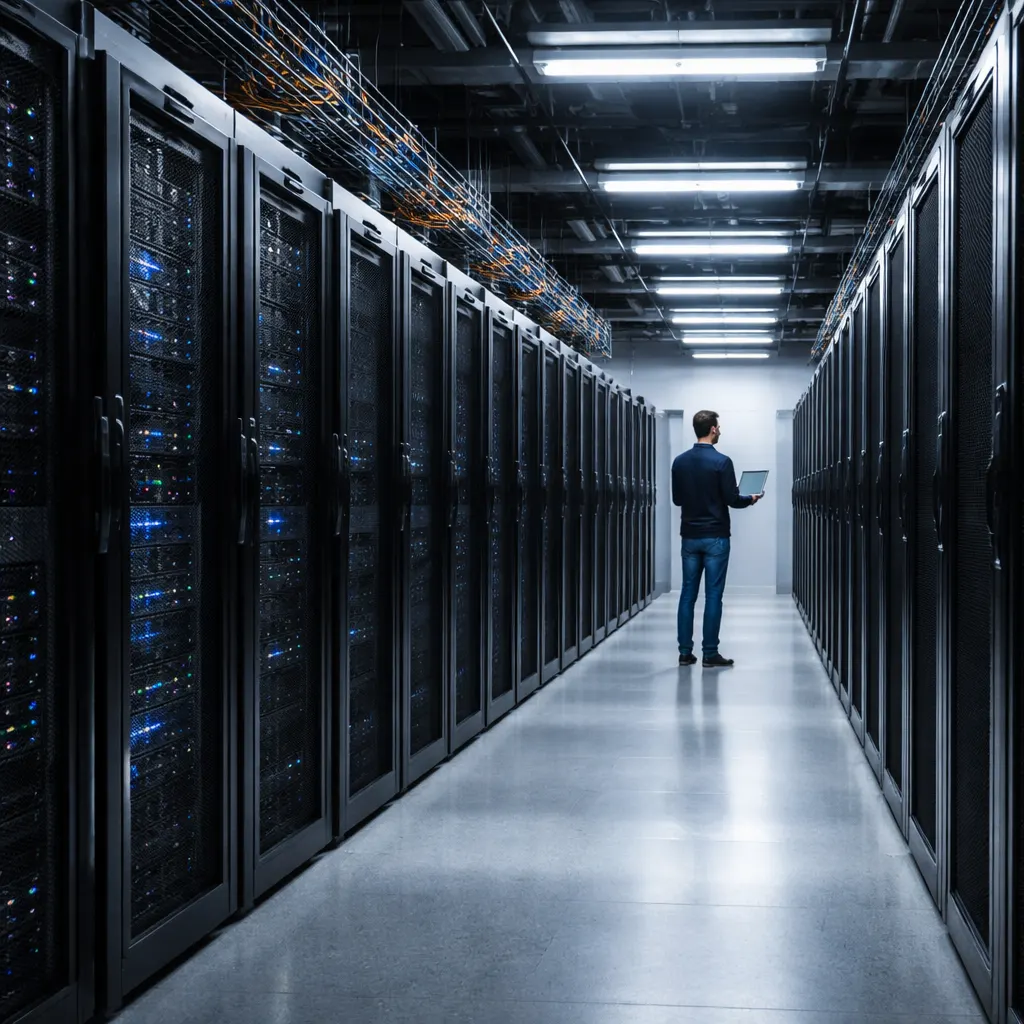
Data center job postings have more than doubled over the past two years even as overall US job postings fell roughly 12%, according to a July 2026 analysis published by ZDNET featuring insights from Cisco's senior VP and chief strategy officer Ammar Maraqa. The reversal comes after years of predictions that virtualization, consolidation, and cloud services would shrink data center footprints and reduce demand for on-site professionals. Now artificial intelligence workloads are driving enterprises to expand facilities within their own walls, creating a surge in hiring for hardware engineers, network specialists, and security experts.
Six in every 1,000 US job postings are now data center-related, up from two per 1,000 in May 2023, the analysis found. The shift isn't limited to hyperscalers or massive external facilities—enterprises are increasingly expanding the centers they operate internally, Maraqa told ZDNET. Cisco's own research shows that an AI agent requires four and a half times the load on the network as a human for an individual task. The demand is especially rising for expertise in what Maraqa calls "deep-tech" fields such as hardware, networking, and cybersecurity, with racks and GPUs becoming so large that specialized skills are needed to network them effectively and connect across data centers.
"AI inferencing and training blew all of the assumptions about smaller data centers out of the water because you needed new infrastructure, you needed GPUs, not just CPUs," Maraqa said. Enterprises are looking inward to manage their own data and infrastructure for security and cost reasons, he explained, with on-premises setups helping companies control IT security, manage token costs, and enable greater creativity. According to Maraqa, data sovereignty and governance are becoming "the new intellectual property," driving the trend toward keeping proprietary data in-house. The report notes there's a shortage of people who understand the deep-tech management of data centers and how to optimize these complicated large-scale systems, with Maraqa stating "we probably won't have enough expertise relative to the demand."
Data center professionals need to understand AI workloads in ways they didn't before, monitoring whether GPUs are running hot or storage is failing, and grasping the stack being created—whether it's the models, the interface, or the prompt. Outdated infrastructure poses major security risks, with some systems so old they can't even be patched, creating vulnerabilities as enterprises deploy AI agents and models. Employing in-house models also avoids the overkill of tapping into large frontier models for tasks that only need cheaper small language models—Cisco uses a resident deep-networking model to help administrators and customers troubleshoot networking without needing a frontier model. Maraqa, who has worked through the e-commerce, cloud, and mobile transitions, said this one "feels fundamentally different" because everything feels demand-driven and constrained at the same time, with use cases being discovered daily and opportunities feeling "pretty limitless in terms of how this technology can help and transform." The infrastructure modernization required to handle agentic AI workloads—and the observability needed to monitor agent behavior against set guardrails—represents an entirely new set of security and technical requirements that can't be solved with aging systems. For enterprises balancing innovation with control, the equation has flipped: bringing computation back on-premises isn't a retreat from the cloud era but a strategic bet that the value of proprietary data and specialized AI models outweighs the convenience of outsourcing. That calculation depends heavily on whether organizations can recruit and retain the deep-tech talent now in critically short supply.