
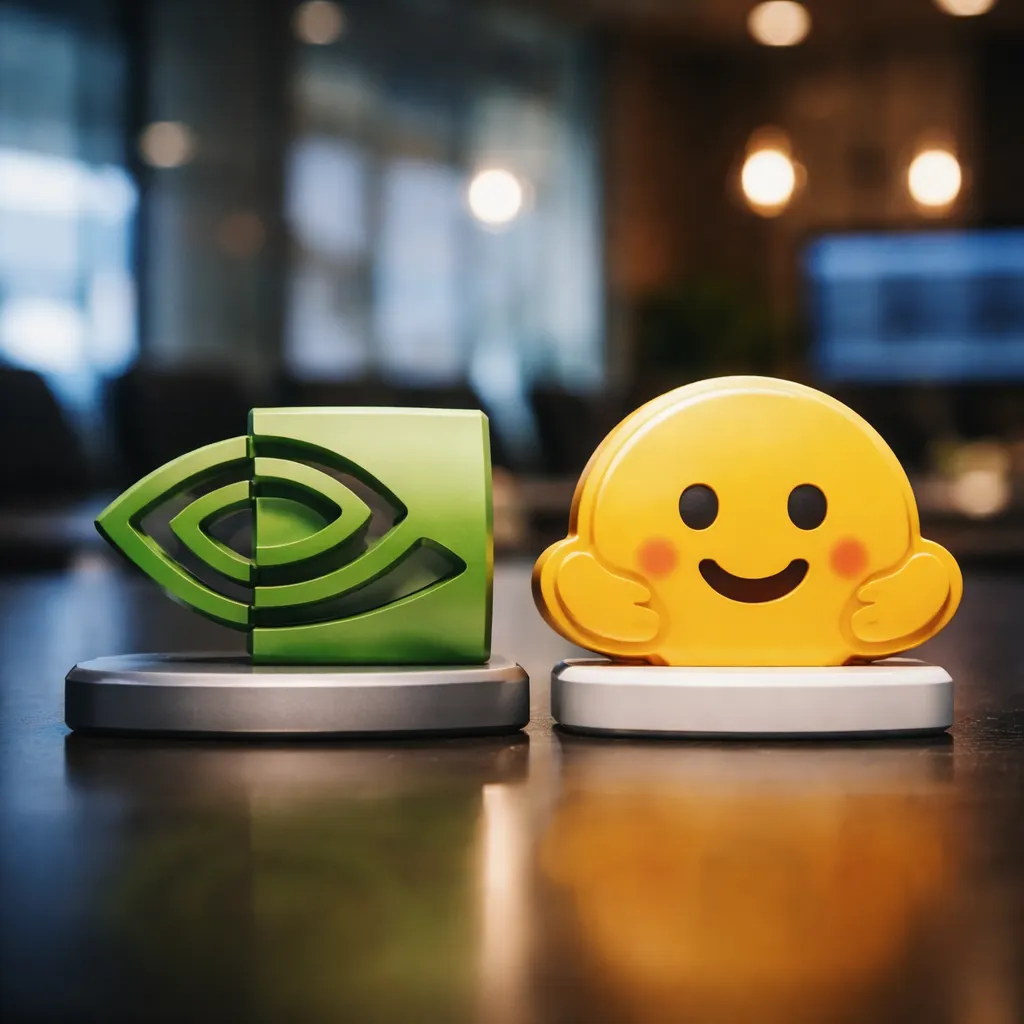
Nvidia has agreed to purchase Hugging Face in a transaction worth roughly $12.93 billion, according to an announcement the companies made Thursday, Sept. 3. The deal would place one of the industry's most significant open-model platforms under the ownership of the dominant AI chip manufacturer. Nvidia says it plans to supply infrastructure, engineering support and worldwide scale to expand Hugging Face while keeping the openness and hardware independence that turned the platform into a central resource for AI developers.
Hugging Face currently supports more than 18 million developers, researchers and creators and provides access to over 3 million models, 500,000 datasets and 1 million applications, according to Nvidia. More than 200,000 companies rely on the platform to find, assess, customize and launch AI systems. Nvidia says Hugging Face will continue supporting models from throughout the industry, along with multi-cloud and multi-accelerator implementations, and that Nvidia compute won't be mandatory for developers building or launching through Hugging Face. The Financial Times had reported earlier this year that Hugging Face turned down a $500 million investment from Nvidia that would have priced the startup at $7 billion, with the company reportedly concerned about letting a controlling investor shape its decisions.
Nvidia CEO Jensen Huang characterized the purchase as a way to broaden access to open models rather than absorbing Hugging Face into Nvidia's proprietary system. "I am honored that Clem came to me as he considered the next chapter of Hugging Face and believed NVIDIA would be a great home for the company, its community and the future of open models," Huang's statement reads in part. Nvidia VP of Enterprise AI Justin Boitano said during a Q&A after the announcement that Nvidia views both closed and open models as essential to the wider AI market, arguing that open models let businesses build domain-specific intelligence while keeping control of their data and competitive edge. Hugging Face CEO Clément Delangue challenged earlier reporting about rejected investment talks, describing much of the previous coverage as "quite far from the reality" and saying the company had declined many investment and acquisition offers over the years before deciding this summer that Nvidia had become the right long-term partner.
The strategic reasoning behind the deal centers on Nvidia's ability to profit from open-model growth without requiring developers to use its hardware exclusively. Boitano explained that "NVIDIA will benefit through the training that's done and the inference that's done on our hardware" as open models spread more widely. If a growing open-model ecosystem drives up overall AI development, training and inference workloads, Nvidia remains positioned to capture a large portion of the resulting infrastructure demand even without mandating its own chips. For Hugging Face, the central challenge will be persuading its community that Nvidia ownership won't erode the neutrality that made the platform valuable initially. Delangue said Hugging Face aims to expand from 18 million AI builders today to 100 million within the next few years, and both executives repeatedly stressed that reaching that goal requires preserving developer trust.
Both companies emphasized that maintaining neutrality is critical to the deal's success. Boitano said Hugging Face users must retain access to models and datasets on whatever infrastructure they choose, including rival cloud and hardware platforms. Delangue pointed to the open-source foundation of much of Hugging Face's technology as a built-in protection against vendor lock-in. The acquisition spotlights a wider shift in competition across the AI sector, with Nvidia dominating through compute power while companies like OpenAI, Anthropic and Google build increasingly capable proprietary model platforms. Hugging Face occupies a distinct role by providing infrastructure for a decentralized ecosystem of open and open-weight models that organizations can adapt and deploy independently. Delangue argued that the open ecosystem offers a counterbalance to the rising concentration of AI capabilities behind proprietary interfaces, though one of the most visible platforms supporting that decentralization will now belong to one of the most powerful companies in AI. The success of Nvidia's $12.93 billion investment depends not just on Hugging Face's technology or user base but on retaining the trust of an open-source community—an asset that may prove far harder to control than infrastructure or code. Cloud providers and enterprise AI vendors will be monitoring whether future product development and integrations increasingly tilt toward Nvidia's technology stack, regardless of formal commitments to neutrality.