
Elon Musk announced that SpaceX can shave up to 18 months off the timeline for bringing natural gas turbines online by manufacturing a critical component in-house, according to a report published by TechCrunch on August 30, 2026. The disclosure came after job postings and land records revealed that SpaceX has constructed a secret foundry in Bastrop, Texas, specifically to cast turbine blades and vanes—the parts that currently represent the biggest manufacturing bottleneck for gas-fired power plants. Musk's move responds directly to a power crisis gripping the AI industry, where data centers can't get electricity fast enough to keep pace with computing demand.
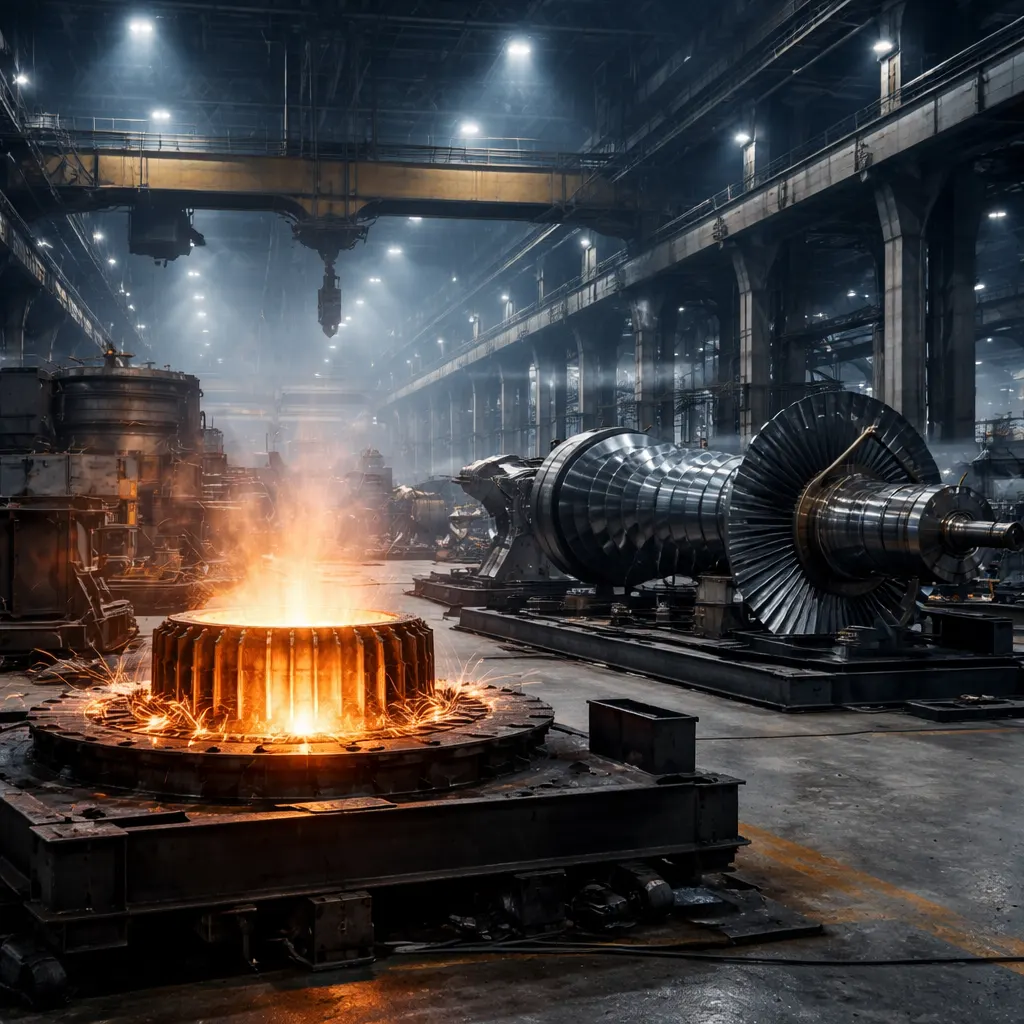
The challenge centers on a manufacturing process so difficult that only four companies worldwide can produce turbine blades at industrial scale, and all of them are completely booked through 2030, TechCrunch reports. Each blade must be cast as a single, continuous crystal inside a vacuum furnace, without the microscopic seams that would cause ordinary cast metal to fracture under stress. The blades operate at temperatures between 3,000 and 3,600 degrees Fahrenheit—roughly 800 degrees hotter than the melting point of the metal alloy they're made from—which is only possible because of internal cooling channels, thermal-barrier coatings, and the precise casting technique. Power-plant turbine blades are considerably larger than those used in jet engines, making defect-free production at scale even more challenging. GE Vernova, a major gas turbine manufacturer, says it has sold out production capacity through 2030 largely because of AI infrastructure demand, while the International Energy Agency forecasts that global data center electricity consumption will roughly double by 2030.
According to Musk's statement on X, "the limiting factor for nat gas turbine production is casting the blades & vanes," and by performing this casting in-house at SpaceX, the company can accelerate turbine deployment "by up to 18 months, which is a profound game-changer." The report notes that SpaceX purchased roughly 830 acres near its existing Starlink factory in Bastrop between March and June, a finding documented by Corey Trinetti, a due diligence specialist who publishes detailed reviews of AI infrastructure sites. Job listings explicitly referenced a "blades and vanes foundry," TechCrunch reports. Musk also wrote that SpaceX and Tesla are each building 100 gigawatts per year of solar production capacity as fast as possible, but natural gas will still be required to supplement and bootstrap solar for several years.
The speed advantage matters because building private gas-fired plants next to data centers, rather than waiting on the grid, has become a standard strategy for hyperscalers including Amazon, Google, Meta, OpenAI, and Microsoft, the report explains. After years of emphasizing wind and solar, these companies are all now wagering on natural gas to bring data centers online faster. If SpaceX succeeds—and the report cautions it's easier said than done—a Musk-controlled entity would hold a manufacturing capability that every other AI infrastructure builder currently depends on a tiny oligopoly for, giving SpaceX an edge that's difficult for any well-funded but non-manufacturing competitor to replicate quickly. GPU shortages remain an issue, with Nvidia's newest Blackwell chips still running lead times of several months, but a second constraint has emerged alongside it: the physical power grid itself.
But faster turbine deployment also means more pollution, and turbines already on the ground are drawing federal lawsuits and peer-reviewed health research over the emissions they produce, TechCrunch reports. In Memphis, where SpaceX has run gas turbines to power its Colossus data centers since 2024, the NAACP has repeatedly accused the company of operating turbines without the permits or pollution controls required by federal law. The organization's concern is that turbines like these emit smog-forming compounds and hazardous chemicals like formaldehyde, pollutants linked to asthma, respiratory disease, and certain cancers. The site sits near neighborhoods that already face heavy industrial pollution, and University of Memphis researchers said that in their own admittedly limited analysis, air pollution grew "slightly worse" because of the data center. In Virginia's "Data Center Alley," a study commissioned by the Piedmont Environmental Council used the EPA's own COBRA health-impact model to assess a single facility's eight full-time gas turbines. It found their emissions could reach more than 2.5 million people across multiple counties—with the heaviest impact landing on already marginalized communities—and cause an estimated 3.4 to 6.5 additional premature deaths a year, translating to $53 million to $99 million in annual health-related damages. The report notes that Memphis just happens to be the most visible case, and the same fight is playing out anywhere gas turbines have become the default fix for data center power shortages. The trade-off between speed and environmental impact will test whether the industry's sprint for computing capacity can coexist with public health safeguards. Companies that bet their infrastructure roadmaps on third-party turbine manufacturers may now find themselves at a structural disadvantage if vertical integration becomes the norm.