

Online and bundled newspaper subscription prices jumped 24% from January 2022 to August 2026, with the sharpest spike hitting in early 2024 when the price index leaped from 201.6 to 213.5 in just one month. That's real money leaving readers' wallets—about $12 more per year for a typical digital subscription. But here's what's more interesting than the raw increase: the growth curve is flattening. After publishers pushed prices aggressively through 2024 and early 2025, the past six months show something close to a pricing plateau, with the index creeping from 229.7 to just 230.7. Publishers have either hit a ceiling on what readers will pay, or they're getting nervous about triggering cancellations.
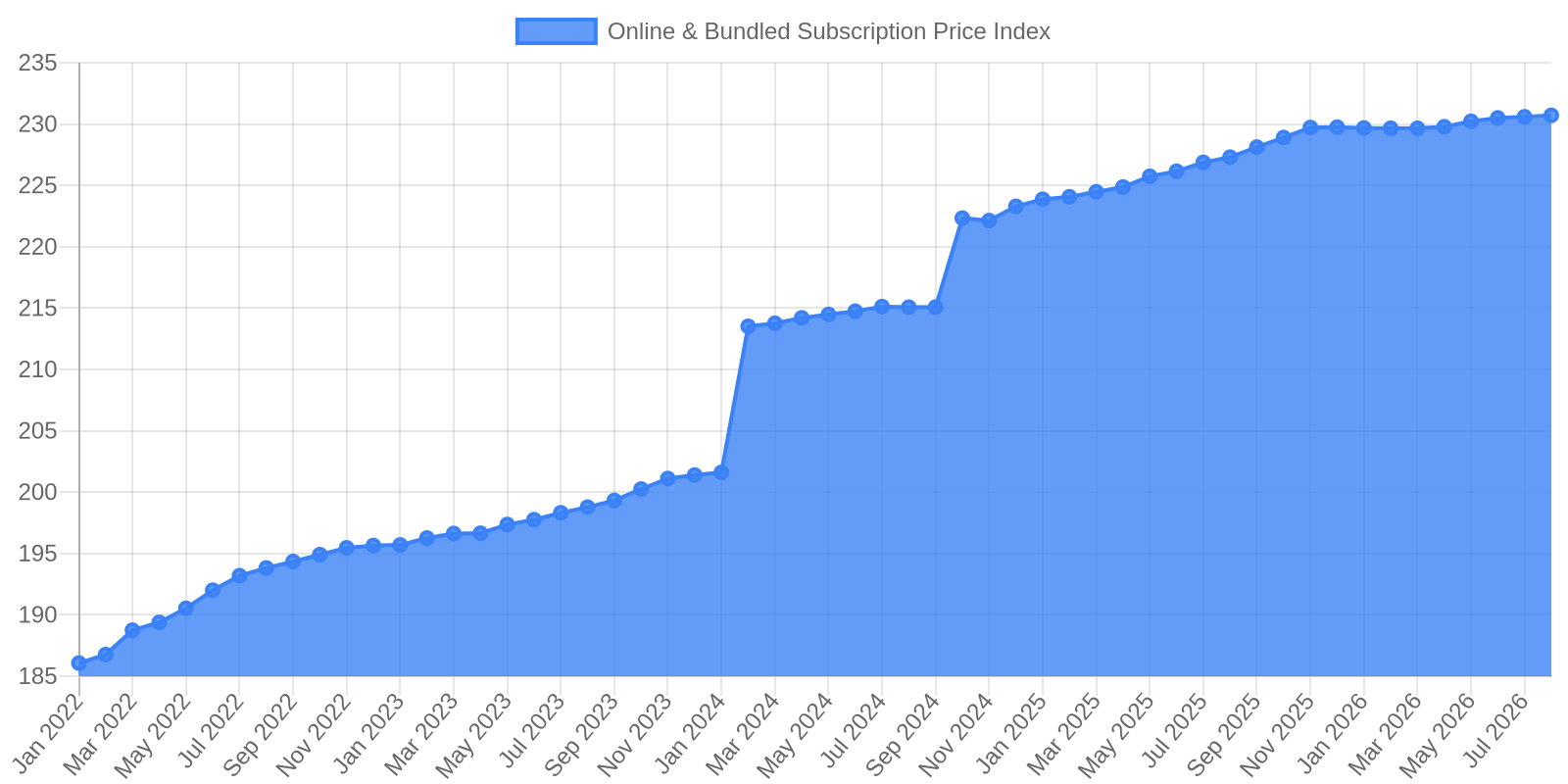
The Producer Price Index for online and bundled newspaper subscriptions shows steady growth from 2022 through 2025, with notable price surges in early and late 2024, followed by near-stagnation in 2026 as publishers ease aggressive pricing strategies.
The data reveals three distinct pricing phases over the past four and a half years. From January 2022 through December 2023, prices climbed gradually from 186.1 to 201.4—a steady 8.2% increase spread across 24 months. Then came the aggressive push: February 2024 saw that dramatic 5.9% single-month jump, followed by another 4% spike in October 2024, pushing the index to 222.3. Throughout 2025, publishers maintained their momentum with consistent monthly increases, reaching a peak of 229.7 by December. But 2026 tells a different story—the index has barely budged in eight months, hovering between 229.7 and 230.7, representing near-zero monthly growth and suggesting publishers have pulled back on price hikes.
This pricing behavior tracks closely with what's happening across the industry. Digital revenues for newspapers grew 7% year-on-year according to the World Press Trends report, while digital subscriptions remained the top revenue priority for 80% of publishers surveyed in 2024. But publishers are walking a tightrope—major outlets like Bloomberg raised prices 33% from $299 to $399 annually in 2025, while The New York Times increased bundle pricing from $25 to $30. Yet the same research shows troubling counterpressures: 88% of top news brands now offer discounted trials averaging 72% off, and digital subscription prices in the UK increased just 3% in 2026, barely ahead of inflation, suggesting consumer price resistance is forcing publishers to moderate their ambitions.
The near-stagnation in 2026 pricing reveals the fundamental tension in the online news business model. Publishers need subscription revenue because print advertising revenue dropped $12 billion from 2020 to 2023 and digital ads can't fill that hole. But readers have subscription fatigue—only 17% of people pay for online news according to recent industry tracking, and every price increase pushes more people toward free alternatives or triggers cancellations. That's why leading publishers increased spending on subscription infrastructure by 25% in 2024-2025 even as they've eased off price hikes—they're trying to reduce churn through better product experiences rather than squeezing existing subscribers harder. The good news for publishers: digital newspaper market demand is forecast to grow at 7.9% annually through 2036, reaching $121.5 billion globally, driven by smartphone adoption and subscription habit formation. The bad news: getting there requires keeping prices tolerable enough that readers stick around, which explains why the 2026 flatline isn't a pause—it's a strategic retreat from the aggressive pricing that defined 2024 and 2025.
The pricing pattern in this data tells you everything about where online news is headed: toward subscription models that look more like Netflix than newspapers. Publishers tested how much readers would tolerate with those 2024 price shocks, discovered the limits, and are now focused on volume over margin. The question isn't whether online subscriptions will keep getting more expensive—it's whether publishers can grow their subscriber base faster than they lose people to price fatigue. Right now, the data suggests they've found the price ceiling, and the only way forward is sideways.