
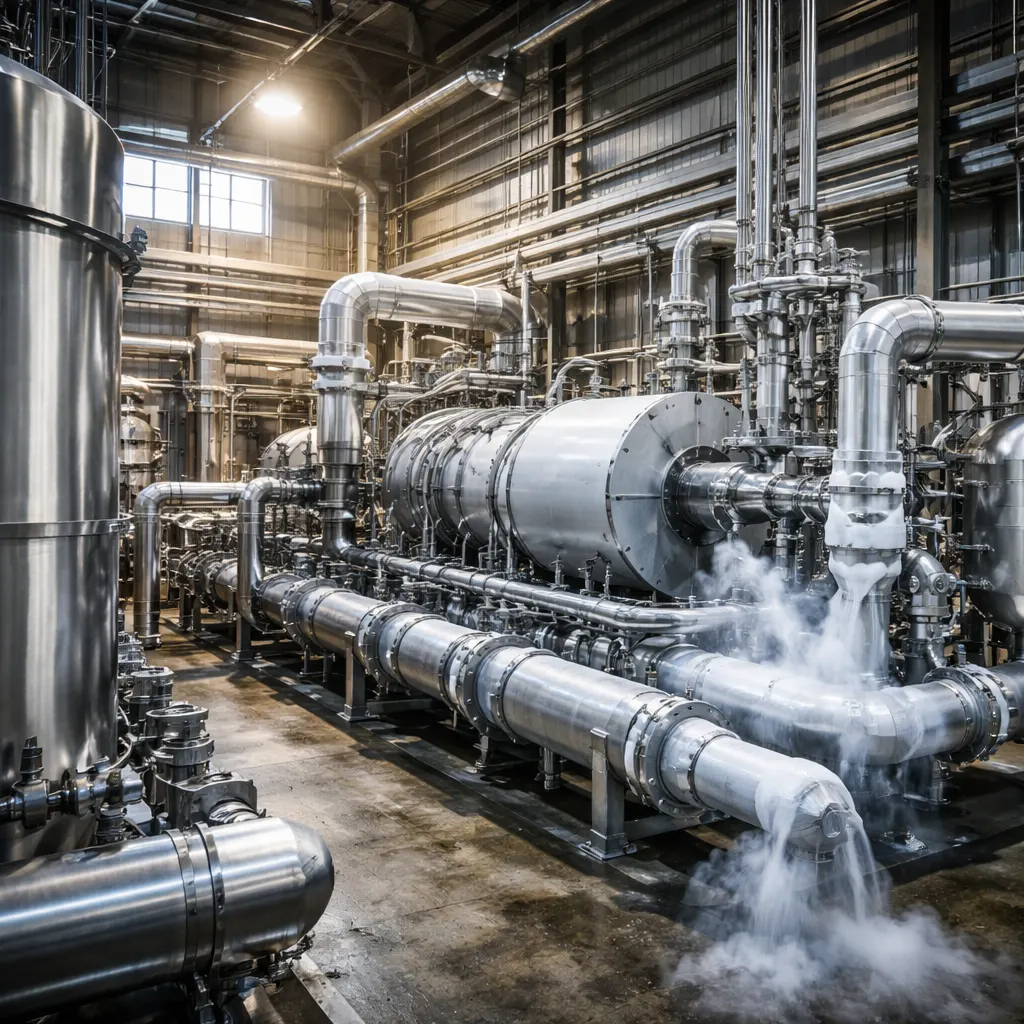
A startup emerging from stealth mode wants to make the inefficient gas turbines that power data centers work better by using liquid carbon dioxide. American Supercritical announced Wednesday that it secured $8 million in funding to retrofit gas turbines at data centers with units that can produce more electricity without increasing emissions, though the gas-fired systems will keep releasing carbon pollution. The technology could eventually work with a range of energy sources at a moment when electricity demand is surging.
Data centers across the country have chosen to run on simple-cycle turbines, which are far less efficient than the combined-cycle systems used by most large gas-fired plants in the United States. According to the report, simple-cycle turbines convert only about 35 percent of their energy into electricity, with the remainder escaping as exhaust, while combined-cycle plants reach efficiency levels closer to 60 to 65 percent. That exhaust contains greenhouse gases, making simple-cycle turbines a significantly worse environmental option. A huge data-center power plant in Texas that Amazon is constructing with simple-cycle turbines alone has permission to release more than 33 million tons of greenhouse gases annually—exceeding the yearly total of some small nations.
American Supercritical's founders say these numerous small, inefficient turbines could be an ideal fit for supercritical CO2 technology. Carbon dioxide enters a supercritical state when pressurized and maintained at a specific temperature, gaining the density of liquid while still acting like a gas, which allows it to transfer energy more efficiently through much smaller equipment. Cofounder Simon Shuham explains, "We're essentially building miniature combined-cycle plants." The company intends to sell a 10-megawatt unit initially, and by its calculations, adding supercritical CO2 units could boost turbine efficiency by up to 50 percent without any additional greenhouse gas emissions or water consumption. The CO2 operates in a closed-loop system that doesn't require refilling, similar to refrigeration systems that circulate CO2 for cooling.
The report notes that supercritical CO2 for power generation has been studied in US national labs for more than 50 years, with research shifting toward practical applications over the past two decades. Key innovations include the creation of more compact and affordable heat exchangers—devices that both heat and cool the CO2. Doug Hofer, an adviser to American Supercritical who worked at GE for two decades as a turbine engineer, says larger companies have been satisfied with traditional power plant performance and unwilling to invest in different technologies, while turbine manufacturers aren't interested in backing potential competitors. The $7 trillion expected to be invested globally in data centers by 2030 has created a new potential market, especially for an industry racing to secure as much grid power as possible to stay ahead in the AI competition. China announced earlier this year that the world's first geothermal plant using supercritical CO2 began operations, and cofounder Matthew Carlson says the units could be adapted to work with small modular reactors—a technology that's received strong backing from the Trump administration.
But retrofitting the nation's inefficient gas turbines powering data centers with supercritical CO2 units won't bring emissions down to zero, since natural gas production and use still warms the planet even with efficient turbines. Subith Vasu, a professor of engineering at the University of Central Florida who runs a lab at the school's Center for Advanced Turbomachinery and Energy Research, says companies pursuing this technology still face obstacles to reach commercial success, noting that technical challenges remain and "cost has been a huge issue." American Supercritical has already signed an initial agreement with one company for its technology, though it didn't identify the partner, and the founders say their units could convert to work with various heat sources. As Carlson puts it, "We just need to get something hot, and then we can convert that into electricity." The efficiency gains could enable data center operators to either construct additional facilities or reduce their reliance on gas turbines altogether. Whether efficiency improvements alone can reconcile the tech industry's soaring power appetite with climate commitments remains an open question, particularly as regulators and communities weigh the true cost of concentrating energy-intensive infrastructure in specific regions.