
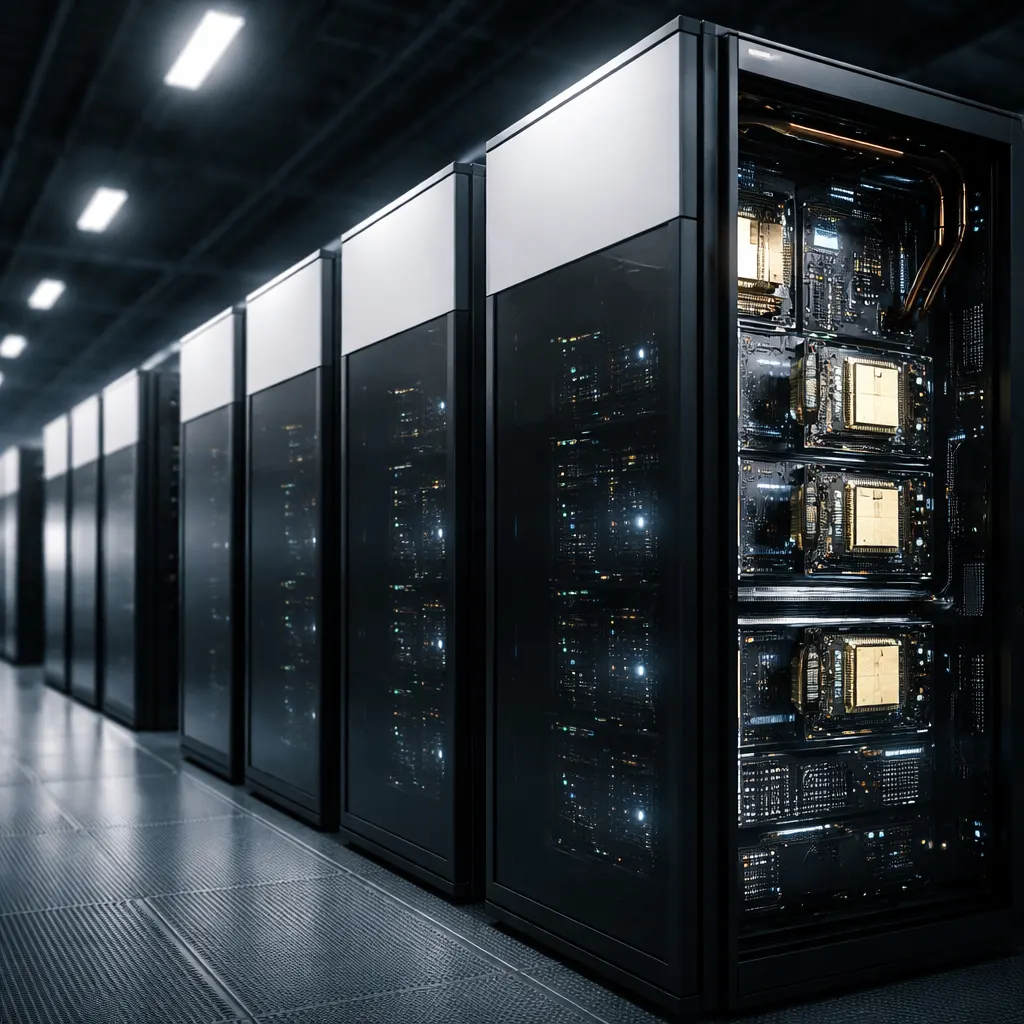
French chip designer SiPearl has begun delivering its Rhea1 processors to system builder Bull for installation in Jupiter, the European Union's first exascale supercomputer, marking the first time the continent's most powerful machine will run on European-made silicon. The delivery, which started Tuesday, represents what executives are calling a turning point for the region's push toward technological independence. Jupiter came online last year and currently ranks fifth globally on the Top500 list of publicly known supercomputers, but that performance was achieved entirely using 24,000 GH200 superchips from Nvidia to power its Booster section.
SiPearl's Rhea1 chip will power a separate CPU-only partition within the larger Jupiter system, bringing 80 cores and 61 billion transistors designed specifically for high-performance computing and scientific tasks that don't run efficiently on graphics processors. Each Rhea1 processor comes equipped with four stacks of HBM2e memory totaling 64 GB and delivering 1.8 TB/s of bandwidth, plus four DDR5 memory channels. The processor uses Arm's Neoverse V1 core designs, which are older than the V2 cores found in the Grace CPUs that power Jupiter's Nvidia-based Booster section. When finished, the CPU partition will occupy 1,300 nodes containing 2,600 processors, with projected performance reaching 5 petaFLOPS—a fraction of the Booster's output but still relevant for workloads that can't leverage GPU-based computing.
According to Thomas Lippert, director of the Jülich Supercomputing Centre, the chip's high memory bandwidth makes it especially well-suited for applications requiring efficient access to large volumes of data, and integrating this European processor technology into Jupiter marks an important milestone in making these capabilities available to researchers. Anders Dam Jensen, executive director of EuroHPC JU, characterized the delivery as a major turning point for the EU, stating the achievement shows what Europe can accomplish by uniting research, industry, and world-class infrastructure to strengthen the European high-performance computing ecosystem.
The chip's design philosophy echoes that of the Fujitsu A64FX processors that powered Japan's Fugaku supercomputer to the number one position on the Top500 in early 2020, prioritizing a higher ratio of memory bandwidth to floating-point operations that benefits many scientific computing tasks. Systems built with this architecture historically perform well on the Top500's HPCG benchmark relative to their ranking on the more widely cited HPL benchmark, reflecting their strength in memory-intensive rather than purely compute-intensive workloads. Rhea1 has been under development for several years, and despite being based on an older Arm architecture, it was purpose-built for the scientific computing tasks that constitute a significant portion of supercomputer workloads but remain poorly suited to GPU acceleration.
SiPearl's momentum extends beyond Jupiter, with the Alice Recoque supercomputer slated to use the company's next-generation Rhea2 chips in its CPU partition alongside AMD's MI430X accelerators in its GPU partition. The Rhea1 delivery fulfills a long-standing goal of European policymakers and researchers who've sought to reduce dependence on American chip technology for critical computing infrastructure. The decision to build a hybrid system—pairing Nvidia's leading-edge accelerators for maximum raw performance with homegrown processors for specialized workloads—reflects the practical reality that sovereignty ambitions must coexist with performance requirements. For organizations evaluating their own compute strategies, the split architecture offers a template for balancing geopolitical considerations against technical capabilities without sacrificing either entirely.