
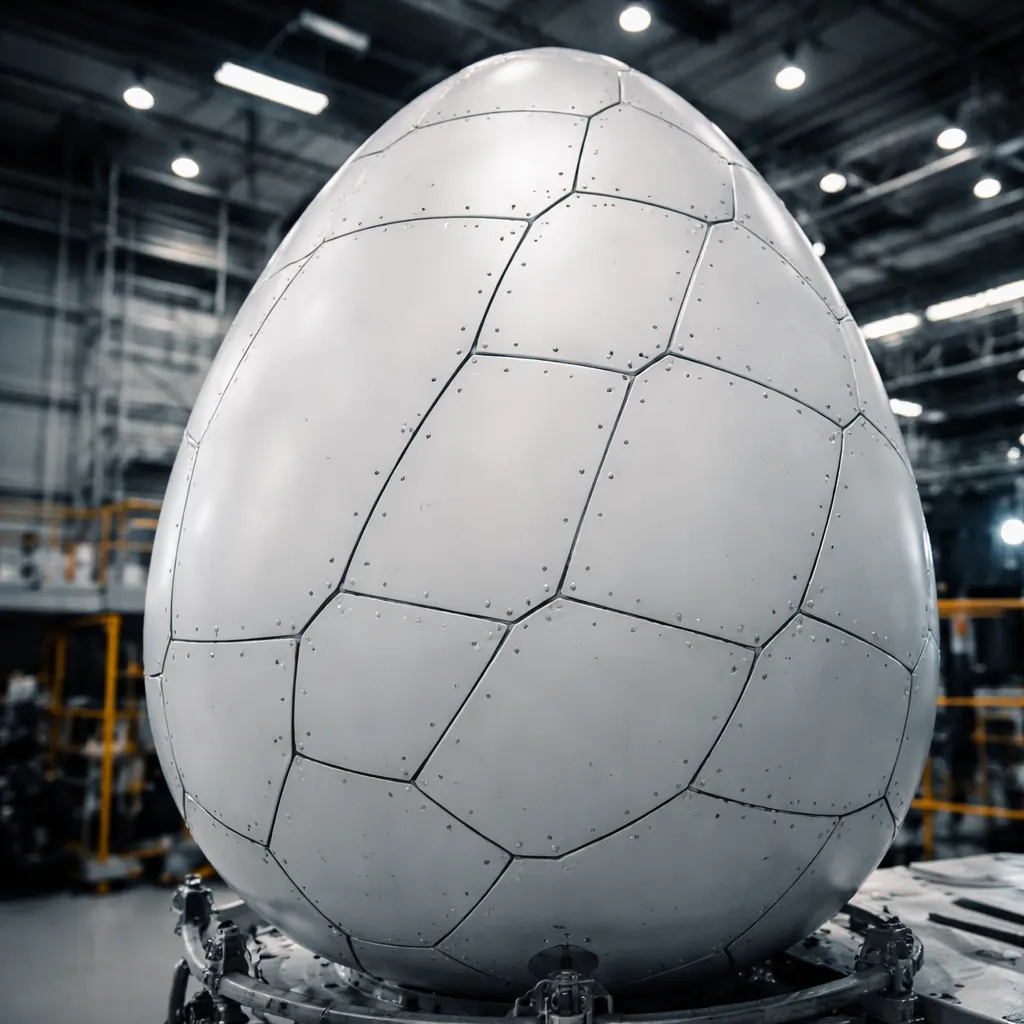
Researchers at Dalian University of Technology have created a spacecraft shield inspired by eggshells that reduced projectile velocity by 64.9 percent in simulations, according to a study published Tuesday by the American Institute of Physics. The Chinese team tested a design that sandwiches 3D-printed aluminum eggs filled with water between two aluminum plates, aiming to protect spacecraft from the growing threat of orbital debris. Low Earth orbit is increasingly crowded, and even tiny fragments can cause catastrophic damage when they strike at hypervelocity.
The research team compared several configurations, including designs with egg-shaped shells pointing toward the faceplate, an inverted version, mixed orientations, and spheres instead of eggshells. The pointy-end-forward arrangement performed best, slowing down simulated debris by nearly 65 percent compared to 51 percent for a single aluminum plate under identical conditions. The water-filled eggs measured just 12 millimeters tall—roughly half an inch—with aluminum plates only one millimeter thick on each side. Debris in low Earth orbit typically moves at 7 to 8 kilometers per second, while collisions between orbiting objects can happen at relative speeds approaching 15 kilometers per second. According to orbital debris tracker Orbital Radar, a one-centimeter aluminum sphere traveling at 10 kilometers per second carries the same kinetic energy as a hand grenade.
Lead author Yuxin Wang told the American Institute of Physics that "natural biological structures have evolved to demonstrate excellent energy absorption performance over long-term adaptation." Wang stated that the findings show "bionic, lightweight metastructures are a promising route for hypervelocity-impact protection." The team produced 3D-printed structures for testing alongside the simulations. Wang expressed hope that the research "can attract more attention to bio-inspired protective structures."
The study addresses an urgent problem as collision risks climb with more satellites entering orbit. Starlink is dropping its orbital altitude, while SpaceX has separately floated plans to launch up to one million satellites for an orbital datacenter system. International Space Station crew members have sheltered in place multiple times because of potential space junk collisions, and the rising number of satellites and debris pushes some orbital regions closer to Kessler syndrome conditions—a cascading scenario where collisions generate more debris that triggers further impacts, potentially rendering heavily affected orbits unusable. Even high-powered military rifles barely exceed 1.45 kilometers per second muzzle velocity, making orbital debris far more destructive than conventional weapons.
The research group is now working to optimize the design and run additional tests, according to the American Institute of Physics. Weight remains a potential concern, since covering a spacecraft in half an inch of water-filled eggshells would likely add considerable mass, though the team didn't respond to questions about that tradeoff. The study shows that better spacecraft protection is achievable through designs borrowed from nature, offering a practical path forward as low Earth orbit becomes more congested and dangerous. Operators launching constellations into an already crowded environment may face pressure to adopt shielding technologies that balance mass penalties against the cost of replacing satellites destroyed by debris strikes. The calculus shifts as launch costs fall but collision probabilities rise, making passive protection an insurance policy that could prove cheaper than the alternative.