
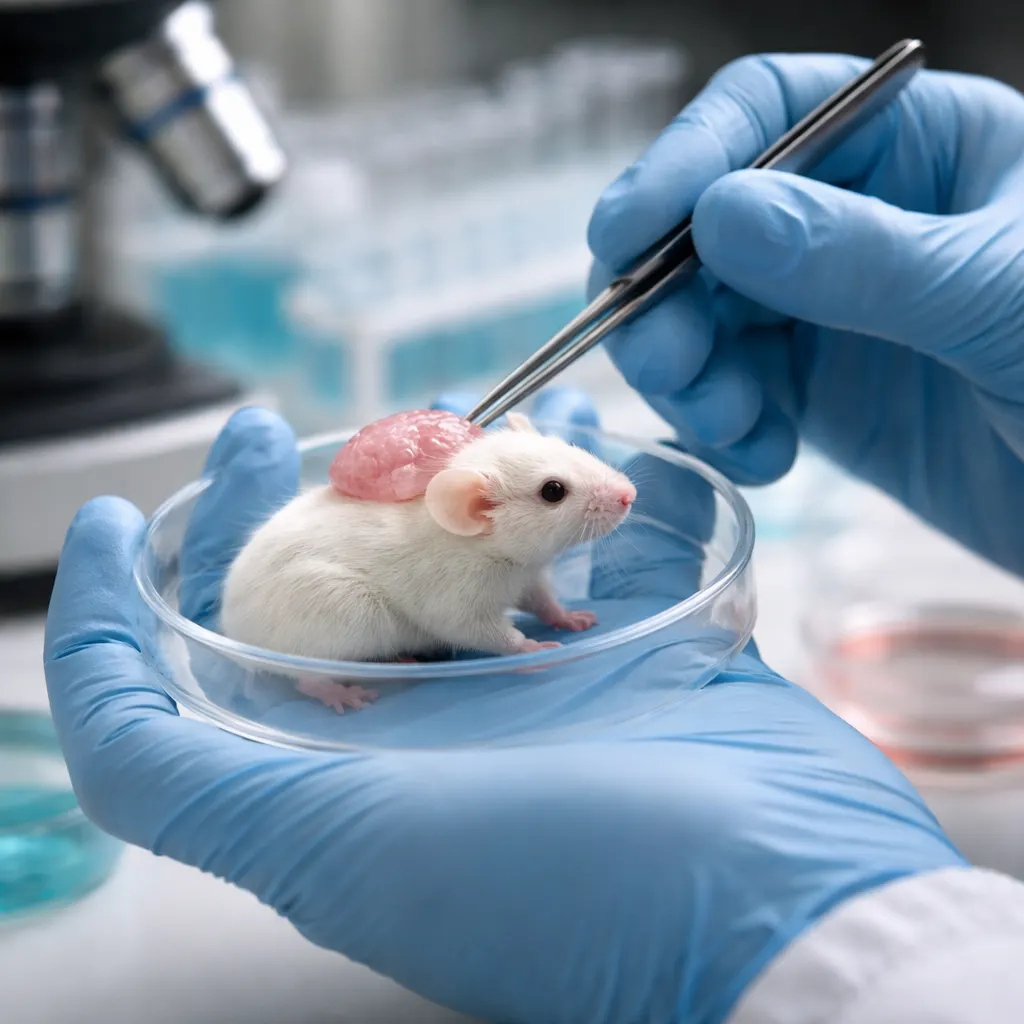
Researchers have successfully created mice whose cortex and hippocampus are largely composed of human brain cells, with the transplanted tissue restoring the animals' memory function in maze tests. The work, published today in the journal *Nature* by a Stanford University team led by neuroscientist Sergiu Pașca, represents a new frontier in mixing brain tissue across distant species. The findings demonstrate that human neural cells can not only survive in rodent brains but also play a functional role in animal cognition.
Pașca's group genetically engineered mice to lack most cells in the cortex and hippocampus, two critical brain regions. When human brain organoids—small clusters of neural tissue—were injected into these modified animals, the cells multiplied and expanded over weeks to months, eventually occupying most of the available space in those brain areas. Mice that lacked brain tissue but received no human cells walked and vocalized normally, yet displayed memory deficits in maze tests, unable to recall which sections they had already visited. By contrast, mice receiving the human cell transplants showed improved performance on the same memory tasks, indicating the human tissue was contributing to their cognitive abilities.
According to Pașca, these "xenocortical mice" could prove valuable for investigating brain injuries. Carsten Charlesworth, a Stanford scientist not involved in the study, called the work "a dramatic demonstration of the combined power of genetic engineering and stem-cell technology to reshape biology." He noted that the most striking aspect was how extensively human neural tissue introduced after birth expanded and integrated with the mouse nervous system despite the species barrier. Brain organoids are already being tested in laboratories to determine if they can interface with computers for tasks like playing video games, and other researchers have suggested using them as biological replacement parts for stroke patients.
The research raises significant ethical questions that Pașca has actively confronted. Last year, he assembled a panel of ethics experts to examine the implications of neural organoid technology, including the possibility that animals might develop human consciousness and the danger of fraudulent "organoid therapy clinics" preying on vulnerable patients. Pașca stated he isn't worried about the rodents possessing human-like cognitive capacities because their brains remain relatively small and the evolutionary gap between humans and mice is vast. However, he emphasized that this type of experiment should not be conducted on higher species, which could wind up with substantial amounts of functioning human brain tissue and potentially blur the cognitive line between humans and animals. Pașca specifically warned against transplanting human brain organoids into primates engineered to lack a cortex, calling such an experiment a "very clear red line" that isn't justified at this stage. The work positions organoid transplantation as a technology that must advance with careful boundaries, balancing scientific possibility against the risk of creating creatures whose consciousness we cannot fully understand or ethically justify.