
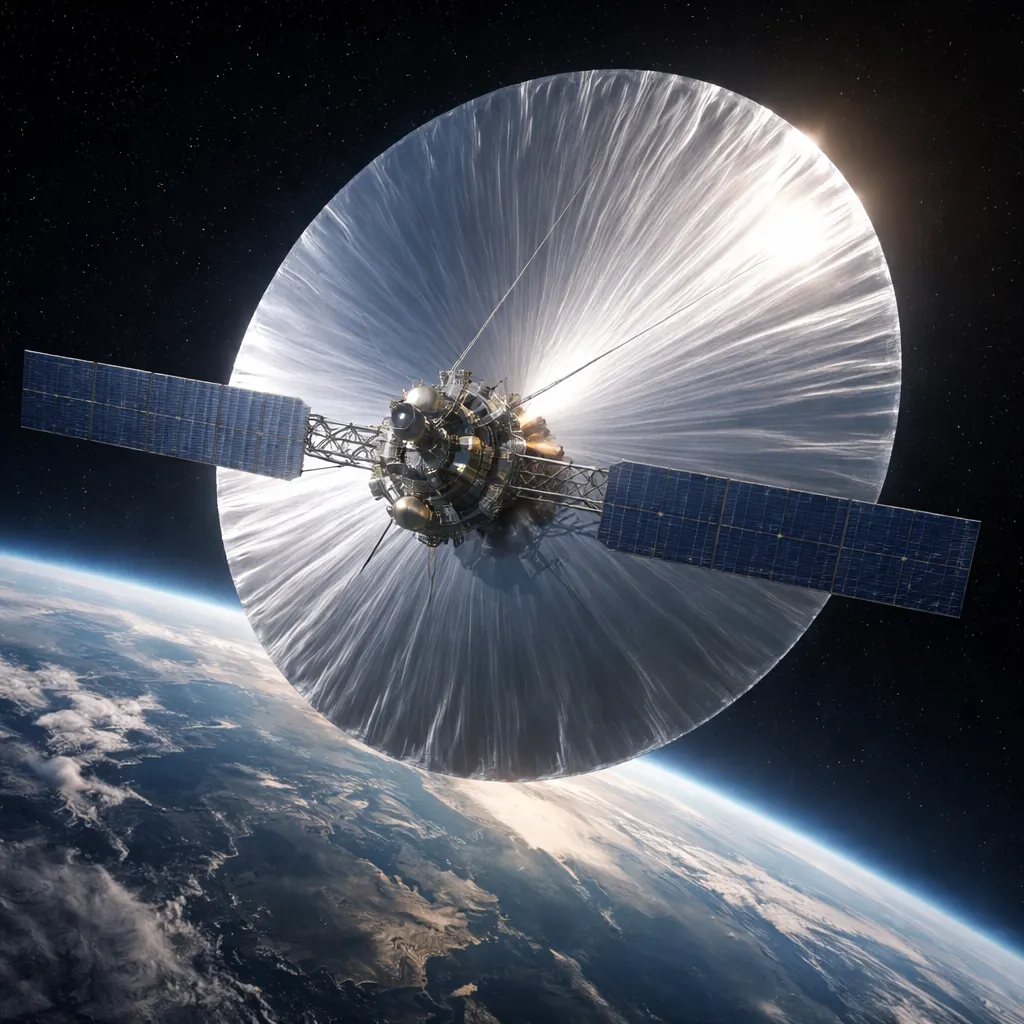
A planned satellite designed to beam sunlight from space to Earth could appear 40 times brighter than the full moon within its target zone, according to a new study published in Astrophysical Journal Letters. Researchers at the Slovak Academy of Sciences calculated the broader impact on the night sky from Reflect Orbital's upcoming test satellite, which the Federal Communications Commission approved in July. The company intends to launch Eärendil-1 later this year, followed eventually by up to 50,000 larger satellites that would reflect sunlight to Earth on demand for uses including solar panel charging, emergency response, and military operations.
The study, led by astronomer Miroslav Kocifaj and his colleagues, examined how light from the satellites would scatter beyond the intended illumination area. Within the beam's five-kilometer circular target zone, a single satellite would shine about 40 times brighter than the full moon, the researchers found. Even 14 kilometers away from the beam's center, the satellite would still match the brightness of a full moon. If Reflect Orbital deploys 400 satellites simultaneously as planned, the combined beams would produce light as intense as 10,000 full moons within the target area—equivalent to 2.4% of the sun's brightness. The researchers calculated that even people located as far as 80 kilometers away would see "a glow above the horizon" from this combined beam.
According to Kocifaj, "deploying these mirrors would be seriously damaging for astronomy and for the nighttime environment," with "the damage extends far beyond the target area." Reflect Orbital CEO Ben Nowack disputed the study's conclusions, stating that "some assumptions are simply inaccurate" and that the company's safeguards, including exclusion zones, account for light scattering. However, Kocifaj responded that the company "states that safeguards exist, that scattering is taken into account, and that the models are being updated, but it gives no numbers, no description of the model, no assumptions, and no data." Astronomer Samantha Lawler at the University of Regina said bluntly that "this is incompatible with astronomy" and that there's no way to preserve dark skies while operating such satellites.
The regulatory landscape adds complexity to Reflect Orbital's plans. Space lawyer Michelle Hanlon at the University of Mississippi explained that the FCC lacks authority to license or regulate the solar reflector itself—it can only authorize radio frequencies for communicating with the spacecraft. That means Reflect Orbital will need permission at national and local levels to reflect sunlight onto the ground, and if the beams spread as widely as the study predicts, the company could require approvals across multiple jurisdictions. Environmental groups including DarkSky International and the American Bird Conservancy have already urged the FCC to reverse its approval of the test satellite, citing potential harm to astronomy, aviation safety, and wildlife. In its own FCC filing from March, Reflect Orbital acknowledged that observing Eärendil-1 through telescopes larger than 12 inches may be unsafe for human eyes, though it added that such observations are "unlikely to result in significant injury" because the satellites aren't constantly bright.
The dispute underscores a fundamental gap between technological capability and regulatory oversight as commercial space ventures expand. Currently no global body exists to regulate satellites like these, leaving approval to national regulators who may lack comprehensive authority over their operations. The absence of binding international standards means decisions with worldwide consequences for astronomy and the environment fall to agencies with narrow mandates and limited enforcement tools.