
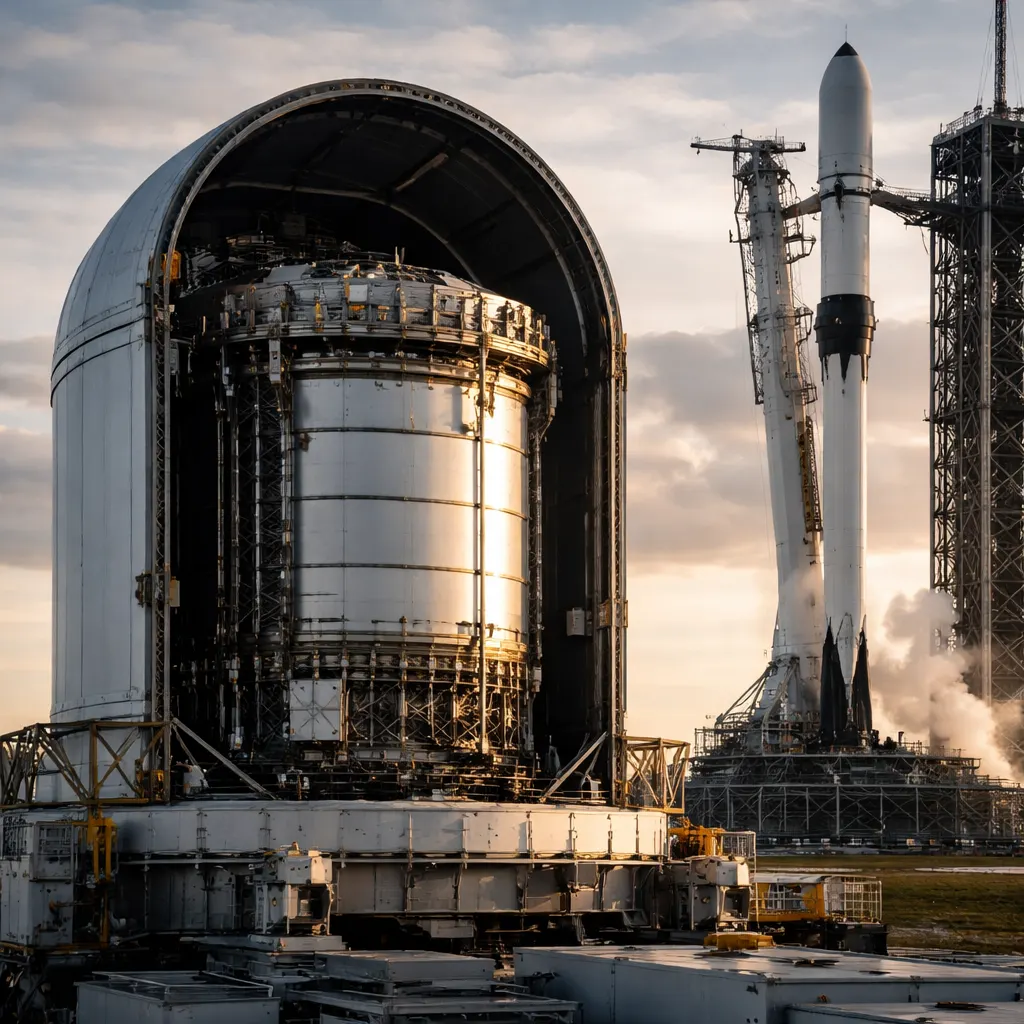
A startup founded by a former OpenAI staffer has convinced SpaceX to let it test an orbital semiconductor factory across a dozen flights aboard Falcon 9 rocket boosters, according to a report published September 9, 2026 by TechCrunch. Besxar, led by founder Ashley Pilipiszyn, aims to produce critical components for advanced semiconductors by harnessing the vacuum of space, eliminating the need for the pressurized clean rooms that make Earth-based chip factories enormously expensive infrastructure projects. The company has secured nearly $14 million in funding, including a $9 million seed round from Dauntless Ventures and Overture VC, to pursue what it calls "fabships"—small orbital canisters that manufacture semiconductor materials during flight.
The company's initial two fabships flew aboard a July Starlink mission to demonstrate that the canisters could withstand launch forces, shield wafer samples from contamination, and expose them to the space vacuum. Besxar met these goals despite one canister experiencing a flight data system malfunction now under investigation. SpaceX's Falcon 9 booster completed that round trip between Earth and orbit 163 times in 2025 and has already logged more than 100 such flights in 2026, making it the vehicle that travels to space and returns more frequently than any other. Pilipiszyn first contacted SpaceX three years ago to discuss purchasing flights on Starship, the company's next-generation rocket still under development, and ultimately agreed to the booster payload arrangement as a method to reduce technological risk in the interim.
According to Pilipiszyn, "the flown samples were the cleanest and had the least amount of particulate matter" compared to nonflown wafers produced on Earth, a result she described as "fantastic" for scaling operations. The founder told TechCrunch that "we're at a time where it's actually more cost-effective to go where the physics already works" rather than building infrastructure on Earth that fights against natural conditions. Besxar—named after the fictional metal used to forge Mandalorian armor in Star Wars Legends comics—intends to supply leading chipmakers with wafers for advanced chips that control electrical power in data centers, robots, and electric vehicles once it reaches the qualification sample stage.
The report explains that traditional chip fabrication on Earth requires massive investment because manufacturers must construct pressurized clean rooms to exclude even microscopic dust and contaminants that would destroy chips during production. Pilipiszyn argues that new rockets provide an alternative to this expensive infrastructure by accessing an environment where the necessary physics—specifically, a vacuum free of particulates—already exists naturally. The company plans to iterate over the next two years, progressively heating wafers, then depositing one material, then multiple materials, before eventually operating larger fabrication facilities aboard a vehicle like Starship. Several other companies, including United Semiconductors and Space Forge, are pursuing space-based semiconductor production, but all confront the same challenge: the restricted capacity to return commercially meaningful volumes of product to Earth.
Besxar expects to scale production from hundreds to thousands of wafers per fabrication unit, but this trajectory depends entirely on access to inexpensive rocket launches. That requirement hinges on SpaceX making Starship fully operational or on competitors such as Rocket Lab and Stoke Space successfully launching their own next-generation vehicles. Pilipiszyn told TechCrunch that the company believes "there is a solid transport layer now," allowing Besxar to concentrate on the application layer and "focus on our core manufacturing and getting our products back down to earth to market as quickly as possible." The company's roadmap centers on proving that orbital manufacturing can deliver higher-quality semiconductor precursors at lower cost than Earth-based alternatives, transforming spaceflight from a research platform into a production infrastructure. The success of this model would shift competitive advantage in chipmaking from who can build the most elaborate clean rooms to who can secure the most reliable launch capacity. If reusable rockets continue driving down the price per kilogram to orbit, manufacturing industries beyond semiconductors may find that fighting Earth's atmosphere costs more than leaving it behind.