
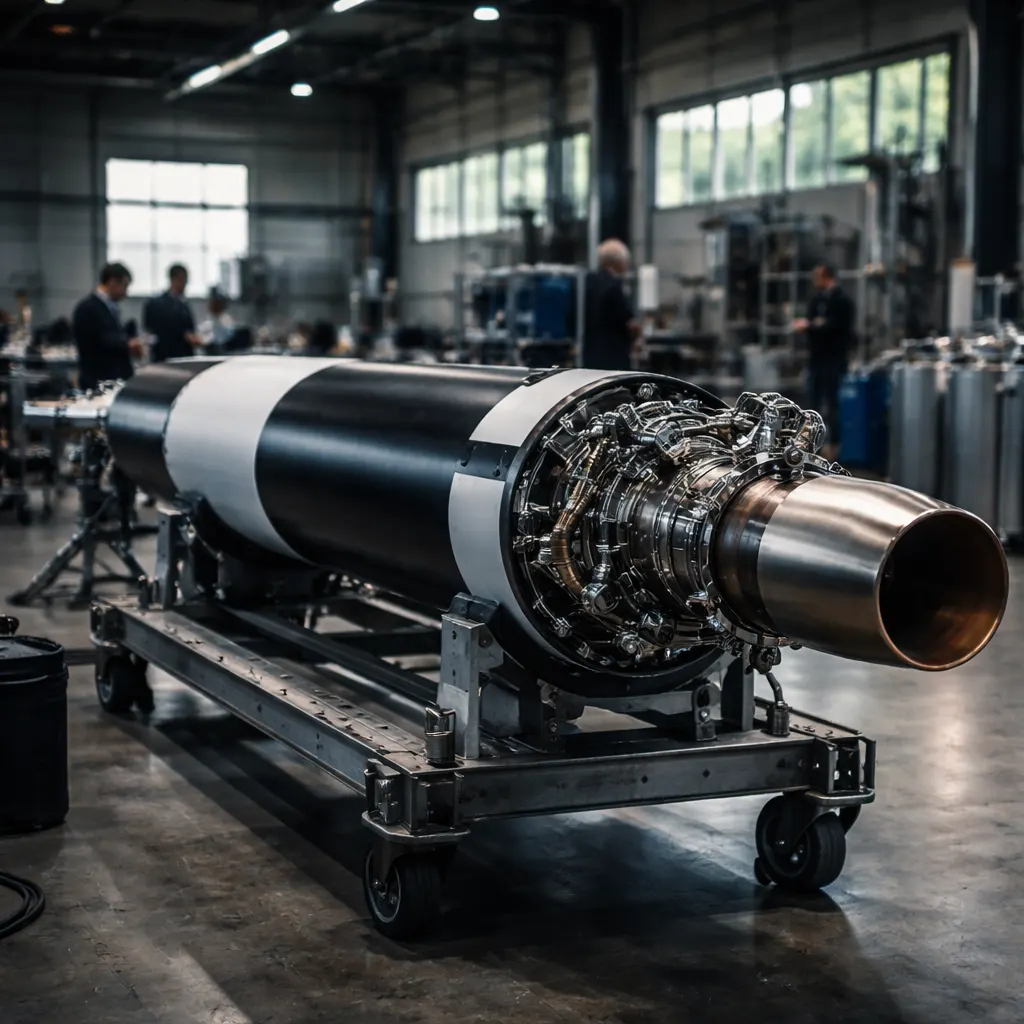
Letara, a Sapporo-based startup developing hybrid propulsion systems for spacecraft, has secured ¥2.6 billion (roughly $16 million) in new funding to expand beyond satellite thrusters into large rocket systems for space, defense, and security applications, co-CEO Shota Hirai told TechCrunch. The funding round was co-led by Headline Asia, JIC Venture Growth Investment, and Incubate Fund, with strategic participation from NES Corporation, Toyoda Gosei (a Toyota Group supplier), and Frontier Innovations, an investment fund backed by Japan's space agency JAXA. The capital arrives as Japan pours billions into its domestic space industry and relaxes defense export rules, aiming to cultivate a global aerospace sector anchored by homegrown startups.
At the core of Letara's approach is a hybrid rocket design that stores solid fuel separately from the liquid oxidizer required for ignition. The company uses cheap, readily accessible materials like plastic and rubber as solid fuel, applying a proprietary manufacturing technique that mixes, shapes, and compresses these substances to guarantee reliable ignition and steady combustion. The result is a system capable of producing greater thrust with reduced waste compared to conventional hybrid rockets, which typically rely on costly paraffin wax. The global hybrid rocket propulsion market is forecast to grow from $848 million in 2024 to $2.6 billion by 2032, representing a compound annual growth rate of 15 percent.
Hirai explained that the technology aims to address three challenges that have constrained hybrid propulsion adoption: producing adequate thrust, sustaining performance, and managing combustion. "With this round, we will go beyond demonstrating that thruster in space," Hirai said. "We plan to explore a much wider set of use cases across both the space domain and the defense and security domain, and to develop and propose hybrid rocket systems suited to each of them." The startup, which spun out of Hokkaido University in 2020, has already secured orders from rocket and satellite firms as well as the Japanese government, though contract values weren't disclosed. Its next major milestone is an in-orbit firing test with an overseas partner, viewed as a critical step toward commercialization.
Letara's expansion reflects surging demand for both launch capabilities and defense systems. Hirai noted that large spacecraft require high-thrust propulsion, especially when moving from low Earth orbit to geostationary orbit and passing quickly through the high-radiation Van Allen belt, while demand for launch vehicles continues to climb sharply. The company is targeting satellite manufacturers and operators, launch providers, and government customers, identifying commercial satellites as the largest market for in-space propulsion while government appetite for rocket systems grows, particularly in Japan. To scale, Letara will need to establish a repeatable manufacturing process supported by quality controls and a dependable supply chain for fuel and tanks. The startup indicated that recycled plastic could "very much" become a viable fuel source with its hybrid technology, though further testing and development are required. The venture faces competition from Japan's Interstellar Technologies, China's Galactic Energy, South Korea's InnoSpace, Singapore's Equatorial Space, Germany's HyImpulse, and Australia's Gilmour Space, all advancing hybrid rocket designs, alongside U.S. firms building alternative propulsion and launch systems. If Letara can deliver on its hybrid promise, it stands to carve out a foothold in a fast-growing sector where launch frequency and defense readiness are driving procurement budgets higher. Whether the company's proprietary fuel formulation and manufacturing edge prove durable enough to win contracts at scale will hinge on how quickly it can move from demonstration to serial production—and whether its safety and simplicity advantages translate into cost savings that customers can't ignore.