
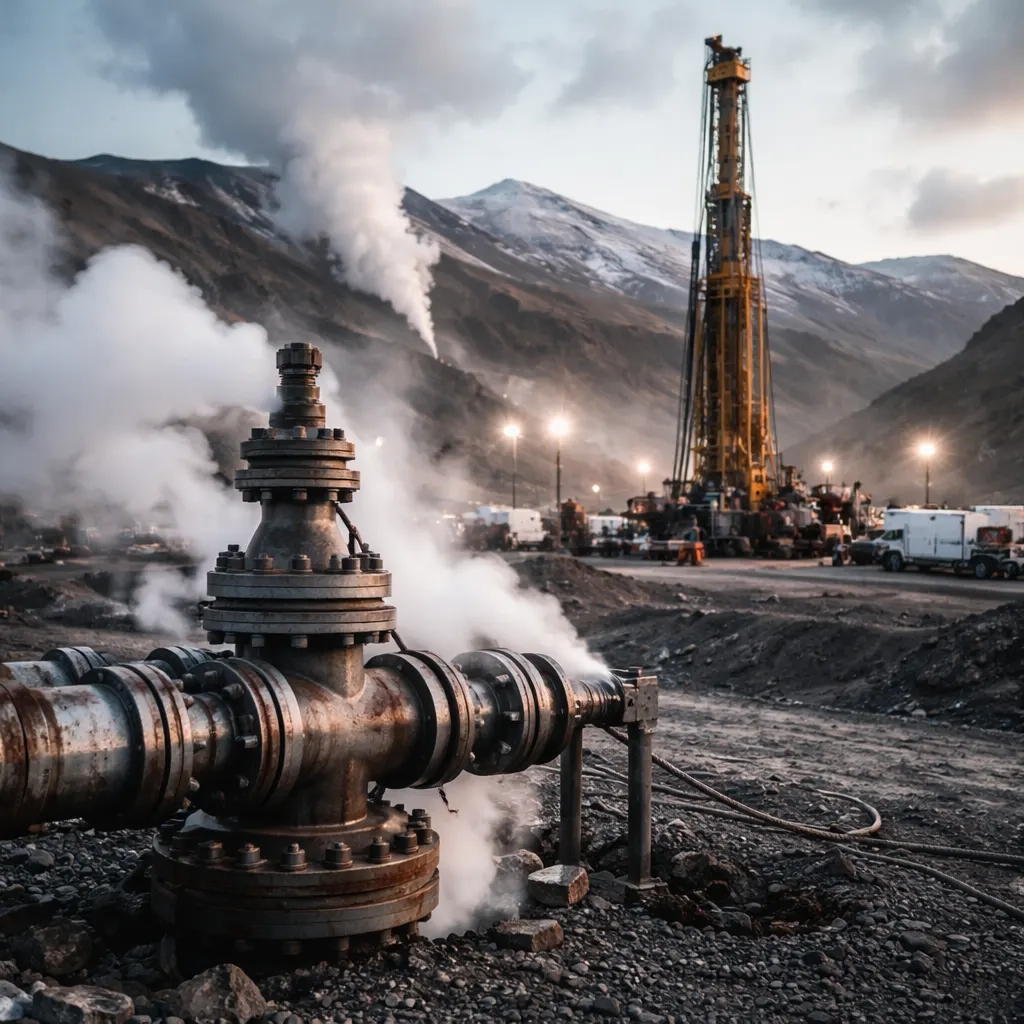
Geothermal startup Mazama Energy secured $135 million in an oversubscribed Series B funding round to advance drilling operations targeting super-hot rock formations capable of powering AI data centers and other massive electrical loads, the company announced Thursday. The fresh capital will support development of horizontal wells in extreme-heat rock layers, with each well designed to generate 15 megawatts of electricity. Mazama represents a new wave of enhanced geothermal companies racing to tap deeper, hotter underground resources than traditional geothermal projects have accessed.
Mazama's initial Oregon site can now produce 10 gigawatts of electricity, according to the company's updated projections—double the 5-gigawatt estimate investor Vinod Khosla cited last year. The startup has drilled beyond 10,000 feet in just 15 days while working toward a target depth of roughly 15,000 feet, where temperatures reach 750°F (400°C). At these extreme depths and pressures, water transforms into a "supercritical" fluid—neither completely liquid nor completely gas—that can absorb far more energy than conventional steam. The company has already obtained land for a second development site and aims to finish construction of the first location by 2030, when it expects to deliver 200 megawatts of power.
According to the report, each Mazama well will produce up to 10 times more power than traditional geothermal technologies, thanks to the supercritical fluid state achieved at extreme depths. Research from the University of Twente and the Clean Air Task Force indicates that extracting just 1% of the world's super-hot rock could yield more than 63 terawatts of electricity. The funding round was led by Centaurus Capital and Doerr Capital, with participation from ConocoPhillips and Shell Ventures, while existing backers Khosla Ventures and Gates Frontier returned alongside new investors SiteGround Capital, H. Barton Asset Management, and the Jeffrey and Marieke Rothschild Foundation.
Enhanced geothermal startups are emerging as unexpected contenders in the race to supply electricity for AI data centers, even as technology firms and data center operators have been backing natural gas, the report notes. Unlike earlier geothermal efforts, these next-generation companies are drilling to far greater depths to access hotter rock formations, which unlock dramatically higher energy output per well. Mazama was incubated at Khosla Ventures and is now positioning itself to capture a share of the massive power demand driven by artificial intelligence infrastructure. The company's Oregon work remains in early phases, but the dramatic upward revision in capacity estimates—from 5 gigawatts to 10 gigawatts in a single year—signals rapid technical progress. With its first electricity generation slated for next year and full development of the inaugural site by decade's end, Mazama is betting that super-hot rock geothermal can deliver reliable, massive-scale power when the grid needs it most. The choice between incumbent fossil fuels and emerging clean baseload technologies may hinge less on policy mandates than on which option can scale fastest to meet voracious data center appetite.